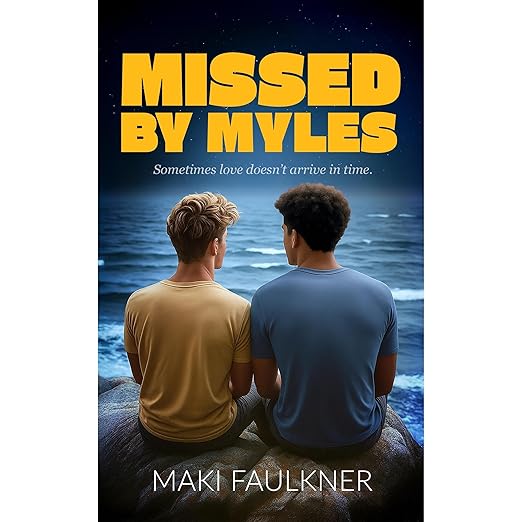
Quick Take
- Narration: Virtual Voice AI narration is a significant limitation here; the emotional registers this story requires are precisely the ones synthetic narration handles least convincingly.
- Themes: Self-concealment and the cost of silence, slow-burn first love, competitive swimming as identity
- Mood: Tender and introspective, with a pace that trusts the reader to stay with it
- Verdict: Missed By Myles is a genuinely affecting debut buried under the wrong narration format; readers willing to work past the Virtual Voice delivery will find real emotional substance.
I want to start with an honest admission: Missed By Myles is narrated by Virtual Voice, which is Audible’s AI text-to-speech system, and that fact matters for this particular story. Maki Faulkner is writing a slow-burn romance that depends heavily on internal emotional texture: Jake’s loneliness, his carefully maintained separateness, the almost unbearable tension of wanting to reach toward Myles while every instinct says to protect himself instead. These are precisely the emotional qualities that synthetic narration struggles most to render.
I say this not to dismiss the book, which has attracted genuinely enthusiastic response from readers who connected deeply with it, but to be clear about what you are selecting when you choose this audiobook format. The story itself is exactly the kind of slow-building, achingly honest gay coming-of-age narrative that readers have been hungry for. Jake’s life organized around competitive swimming, around the discipline of forward motion as a way of not having to be still with himself, is a setup with real resonance.
Our Take on Missed By Myles
What Faulkner gets right that many debut authors miss is the architecture of a slow burn. Jake’s secrets are not revealed to the reader all at once. The loss he is haunted by, the specific shape of what he is hiding and from whom, is parceled out in a way that maintains genuine uncertainty rather than simply withholding information for effect. Myles arrives in his life not as a savior but as a complication, which is exactly the right narrative function for a love interest in this kind of story. The reviewer who felt made to feel 18 again, thinking of their own conflicting feelings about their sexuality, is describing exactly what this book is trying to accomplish: a recognition that operates below plot.
Why Listen to Missed By Myles
The one formal critique worth naming directly is that a substantial portion of the dialogue exists in Jake’s head rather than as actual exchange between characters. A reviewer flagged this as the book’s most significant weakness: so many lost opportunities for actual conversation. This is a genuine structural choice on Faulkner’s part, not an oversight. Jake is someone who processes everything internally before, if ever, letting it out. But in audio format, where the difference between internal monologue and dialogue is carried entirely by the narration, that internalized quality can become monotonous without a skilled human voice to modulate it. The Virtual Voice narration is particularly limited here.
What to Watch For in Missed By Myles
The California swim-team dream that haunts the edges of Jake’s plan to escape his current life adds a dimension of ambition and future-orientation that keeps the story from becoming purely about the present romantic tension. Faulkner is interested in where Jake is going, not just who he is now. That forward pressure is well-managed and prevents the introspective quality from tipping into stagnation. The independent publication context is worth noting: this book arrived without the editorial scaffolding of a major house, and while it shows in places, it also shows a writer with a genuinely individual voice.
Who Should Listen to Missed By Myles
This audiobook is for readers who prioritize the emotional experience of a slow-burn gay romance and are willing to listen past the Virtual Voice narration limitations to get there. Readers who have found AI narration workable for other genres should be aware that this is harder to sustain here than in, say, a self-help or business book, because the emotional range required is larger. If you are very sensitive to synthetic narration, the print version may be the better call for this particular story. Listeners who connect with the swimming-as-discipline setup and who want to follow a character’s painstaking emergence from isolation will find what they are looking for in the story itself. Faulkner is a writer with something to say and enough craft to say it, even if the audiobook format is not the ideal vessel for this particular work.
Frequently Asked Questions
How noticeable is the Virtual Voice narration in Missed By Myles compared to human narration?
It is noticeable, particularly in emotional scenes that require fine gradations of feeling. Virtual Voice has improved over time but still struggles with the kind of quiet, sustained intimacy this story requires. Listeners who have found AI narration workable for other types of books may find it more limiting here.
Is this book appropriate for younger teen listeners, or is it aimed at older YA and adult readers?
The book’s themes of sexual identity confusion, loss, and slow emotional unfolding make it better suited to older teen and adult readers. There is nothing explicit, but the emotional complexity is aimed at readers who have some distance on the feelings being described.
Does the swimming backdrop play a significant role, or is it purely incidental to the romance?
Swimming is genuinely integrated into Jake’s characterization. His discipline, his relationship with his body, and his future plans are all tied to competitive swimming in ways that shape how he approaches everything else including Myles. It is not window dressing.
Is Missed By Myles a standalone story with a resolved ending?
Yes, it is a complete standalone with a resolution to both the romantic arc and Jake’s central emotional journey. Reviewers who hoped for a sequel are responding to affection for the characters rather than any structural incompleteness.