Quick Take
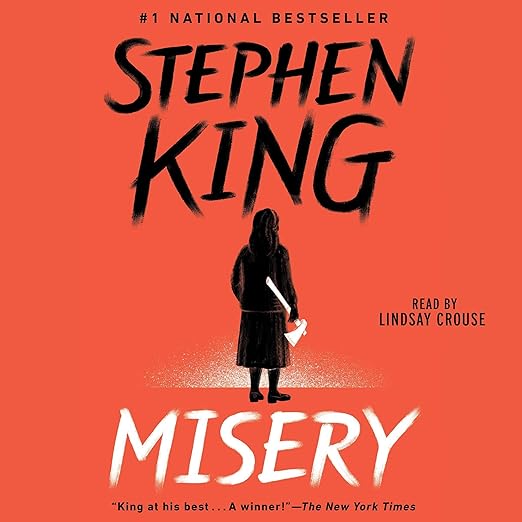
- Narration: Lindsay Crouse is an unexpected and excellent choice, her voice gives Annie Wilkes an off-kilter precision that is more unsettling than any attempt at obvious menace would be.
- Themes: Creative captivity and the pathology of fandom, the will to survive, the relationship between writer and reader taken to its extreme
- Mood: Slow-burn dread that ratchets into sustained panic, the first half is a pressure chamber, the second half is an explosion
- Verdict: One of King’s most controlled novels, and the audio format suits its claustrophobic domestic terror remarkably well.
I started Misery on a Friday night, telling myself I would stop after an hour. It was well past midnight before I put it down, and even then I was not entirely certain I was making a free choice. That’s the King effect, you know intellectually that Paul Sheldon is trapped in Annie Wilkes’s guest room, and somehow you get trapped there too.
Published in 1987 and adapted into the Rob Reiner film in 1990, Misery is one of those books that most people think they already know. They know the broad outline, the hobbling scene, the axe. What the audiobook reminds you is that the novel’s real achievement is in the accumulation of dread before those moments, and in King’s extraordinary precision about what captivity does to a person’s psychology over time.
Our Take on Misery
Paul Sheldon is a bestselling novelist who has just killed off Misery Chastain, the historical romance heroine who made his career, in favor of more literary ambitions. His car accident in a Colorado blizzard and subsequent rescue by Annie Wilkes, his self-described number one fan, sets the novel’s machinery in motion. Annie’s discovery of Misery’s death triggers a transformation that King calibrates with remarkable care. She does not simply turn violent. She imposes a structure of control and conditional kindness that Paul must learn to navigate the way you learn to navigate a live explosive.
Multiple reviewers note the novel’s structure, slow first half, then ramping to eleven, and that observation is accurate but slightly misleading. The first half is not slow in the sense of uneventful. It is slow in the sense of deliberate: King is building the emotional physics of the situation, establishing the precise texture of Annie’s instability, so that when the second half arrives, the acceleration feels earned rather than arbitrary. One reviewer said it left their heart racing in a way no other book had. That physiological response requires the setup.
Why Listen to This Rather Than Read It
Lindsay Crouse’s narration is the audio version’s most significant asset and its most interesting creative decision. A female narrator for Misery is not the obvious choice, Paul Sheldon is the protagonist, and King’s prose is written from deep inside his male perspective. But Crouse brings Annie Wilkes into peculiarly sharp focus. There is something in her precision and her slightly formal quality that captures Annie’s particular brand of terrifying: not the roaring menace of a film monster, but the off-kilter certainty of someone who is absolutely sure they are right.
The novel’s interior monologue, Paul’s constant mental calculation of risk, opportunity, and performance, is handled with intelligence. Crouse does not overdramatize it. The restraint keeps Paul’s desperation from tipping into bathos, which is exactly right for a novel that is fundamentally about a person maintaining enough control over their own mind to survive.
What to Watch For in the Novel’s Structure
King uses a manuscript-within-the-novel device, Paul’s forced resurrection of the Misery character, to add a second narrative layer. The Misery Chastain sections that Paul writes are included in the novel in a way that functions as both plot and thematic commentary: Paul is being forced to do the thing he most resisted, and the quality of what he produces under duress becomes its own question. This meta-textual dimension is easy to miss on a surface reading but rewards attention in the audio version.
The novel is also notably autobiographical in its anxiety. King has spoken about writing Misery as a metaphor for his relationship with addiction, the thing that holds you captive, demands constant production, punishes deviation. You do not need that context to appreciate the novel, but it adds resonance to Paul’s particular brand of creative imprisonment.
Who Should Listen to This Recording
Listeners who enjoy psychological suspense with a genuine slow-build are in the right territory here. Those expecting action-thriller pacing will need to adjust: King is after something more cumulative and interior than that. Existing King fans who somehow missed this one are the most obvious audience, but readers who generally avoid horror often find Misery accessible precisely because its terror is domestic and psychological rather than supernatural. Lindsay Crouse’s narration is particularly worth seeking out for listeners who appreciate a quieter, more precise approach to character voice.
Frequently Asked Questions
Does knowing the plot from the 1990 film significantly diminish the suspense of the audiobook?
Less than you might expect. The film adaptation is faithful but compresses the novel’s extended psychological interior, Paul’s mental calculations, the gradual mapping of Annie’s instability, the specific texture of his captivity. The novel’s most effective material is in that interior space, which the film can only gesture at. Listeners who know the film will still find the audio version distinctly rewarding.
Is Lindsay Crouse’s female narration distracting given that Paul Sheldon is a male protagonist?
Reviewers do not flag this as a problem, and on listening it is not. Crouse maintains Paul’s perspective cleanly while bringing particular precision to Annie’s voice. The choice turns out to work better than a straightforward casting might, because Annie’s register is so specific and so central to the novel’s effect.
How explicit is the violence in Misery, and does audio narration amplify its impact?
The novel contains several scenes of extreme physical violence, the hobbling scene is the most famous. King writes violence with clinical precision rather than gratuitous detail, and Crouse reads it in the same register: matter-of-fact, which is more disturbing than theatrical delivery would be. Audio does not significantly amplify the violence relative to print, though listeners sensitive to described physical harm should be aware it is present.
Is this a good entry point for Stephen King if I have not read him before?
Misery is frequently recommended as a King entry point for readers who are uncertain about horror. It contains no supernatural elements and operates entirely within a domestic psychological register. The craft is evident throughout, King’s particular skill at building character-specific dread is on full display here. If any King novel would convert a skeptic, this is a strong candidate.