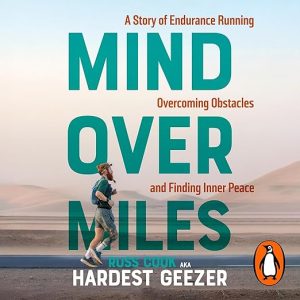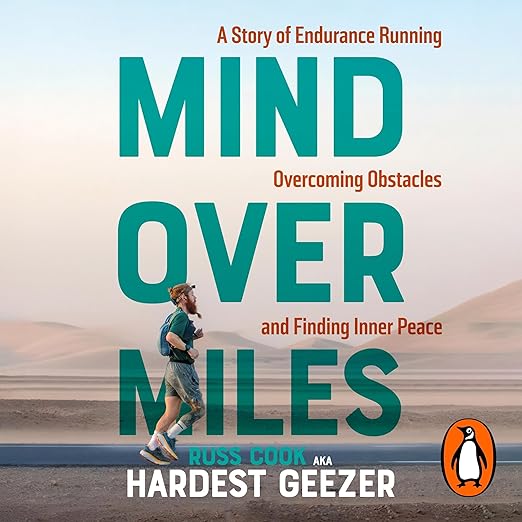
I went into Mind over Miles having watched none of Russ Cook's social media content. My knowledge of the Hardest Geezer project extended to one photograph I had seen in passing and a vague recollection that someone had run the length of Africa. I mention this because I want to be clear that the book works without prior context. It does not assume you were watching. It builds the story from the beginning, which is exactly right for a memoir of this kind, and it gives people who come to it cold the same access as those who followed every mile in real time.
What it assumes, correctly, is that you are interested in what happens to a person who commits to something that should not be possible. Not the logistics of running 10,000 miles across 16 countries in 352 days, though those are covered in more than enough detail. What Cook is really writing about is what it cost him to become the person who could do this, and what the run then cost him in turn. The physical achievement is the frame. The psychological reckoning is the content.
The decision to have Cook narrate his own book is not a commercial shortcut. It is the correct artistic decision. Within the first few minutes, you understand that the voice is inseparable from the story. Cook's working-class English delivery, his slight roughness in certain passages, the moments where you can hear him genuinely reliving something rather than reading a rehearsed performance, these qualities create an intimacy that no professionally trained narrator could manufacture. The imperfection is the point. A polished reading of this material would betray it.
One reviewer noted the satisfaction of hearing him recount the adventure in full after following it on social media. Another described the book as one of their favorites in a while, recommending it specifically to people feeling stuck in the day-to-day grind. What neither fully captures is how the audiobook format allows Cook's natural speech rhythms to carry emotional weight that the page alone would distribute differently. When he describes being held at gunpoint during an armed robbery in one of the countries he crossed, the flatness in his voice while narrating it is more affecting than any dramatized reading would be.
What Stands Out
The moment in the book that I found most interesting from a narrative standpoint is not one of the physical extremes. It is the period when Cook was denied the right to cross Algeria, threatening to end the entire attempt. The synopsis mentions it as one of the challenges, and the book gives it the weight it deserves. The episode forces Cook to reckon with the limits of individual determination against bureaucratic and political reality, and how he resolves it reveals something specific about his psychology that the highlights of the physical run cannot. Grit is useful against terrain and weather and injury. It is insufficient against a government that will not issue a permit. The gap between those two kinds of obstacle is where Cook has to develop something new.
The book is structured to show Cook's life before Africa, including earlier extreme challenges like pulling a car through a marathon distance and spending a week buried alive with only water and a camera. These are framed not as stunts but as steps in a developing philosophy about what a person can voluntarily choose to put themselves through and why. The Africa run was not his first extreme commitment. It was his most consequential one, and understanding the earlier episodes makes the larger undertaking legible rather than simply astonishing.
Before You Commit to Mind over Miles
One element that reviewers consistently underplay is how well Cook renders the landscape and the people he encountered along the route. The sandstorms in the Sahara, the mountain ranges, the long empty roads described in the synopsis are not scenic backdrop. They are obstacles that the narrative has to solve. Cook writes about each environment with enough specificity that the listener builds a physical sense of the route rather than an abstract sense of distance. Africa at its scale, crossed on foot, requires a different kind of attention than a trail run, and Cook communicates what that difference feels like from the inside.
Best Suited For
This is not exclusively a running book. Listeners who have no interest in ultramarathon content but are drawn to psychological portraits of people who pursue extreme self-imposed challenges will find it rewarding. People in the middle of some version of their own hard thing will get more from this than dedicated runners looking for training philosophy. If you followed the Africa run on YouTube and want the interior version of what you watched, this is precisely what you are looking for, and the self-narration makes it something no documentary could replicate.
There is a line from Cook in the synopsis that functions as the book's thesis: you get one chance at life, go and have a stab at it. That sentiment is easy to dismiss as motivational poster material in someone else's voice. In Cook's own narration, across five and a half hours of genuine accounting for what it cost him to act on that belief, it lands differently. The book is not trying to inspire you to run across a continent. It is trying to show you what happens when someone takes the sentiment seriously enough to build a life around it, and what the building process actually requires, which is considerably more than grit and less than genius. That specificity is what separates it from the motivational genre it could have settled for.
Does Russ Cook's self-narration feel amateurish, or does it enhance the listening experience?
The narration is unpolished by professional audiobook standards, but that quality is an asset rather than a defect. His voice and delivery are so specific to who he is that a trained narrator would have produced something technically superior but experientially false.
How much of the book covers the attempt to cross Algeria that nearly ended the run?
The Algeria episode receives significant attention proportional to its impact on the project. Cook treats it as more than a logistical obstacle, examining the psychological weight of having the entire effort potentially cancelled by factors entirely outside his control.
Is this primarily about running, or does it function more broadly as a memoir about Cook's life and motivations?
The Africa run is the book's spine, but Cook spends considerable time on his life before the attempt, including what drew him to extreme challenges in the first place. Listeners without a running background will find the memoir dimension fully accessible.