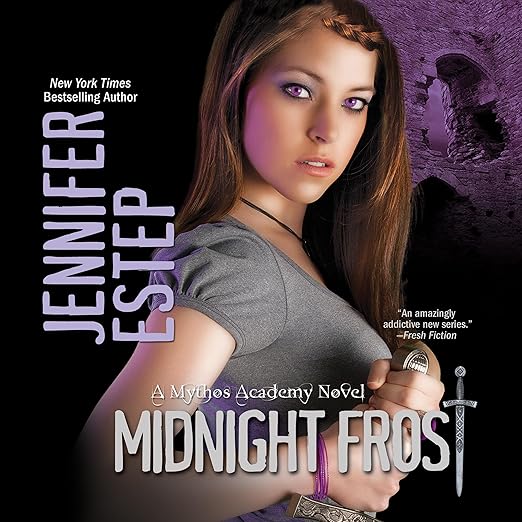
Quick Take
- Narration: Tara Sands is one of the most consistent performers in YA urban fantasy audio, and her work on the Mythos Academy series is tight and propulsive throughout.
- Themes: Nike’s Champion mythology, antidote quests, the cost of carrying other people’s survival
- Mood: Action-driven and emotionally bruised, with Gwen carrying visible weight from prior events
- Verdict: The fifth Mythos Academy entry works because Gwen Frost has genuinely grown, and Sands knows how to keep the momentum from collapsing under that weight.
By the fifth book in any YA series, a certain fatigue can set in on both sides of the narrator-listener relationship. The world has been established, the main cast is familiar, and the risk is that each new volume feels like a slightly remixed version of what came before. Jennifer Estep avoids that trap in Midnight Frost by doing two things: taking Gwen Frost out of Mythos Academy’s walls entirely, and letting the emotional fallout from Logan Quinn’s storyline breathe rather than resolving it cleanly and conveniently. I picked this one up knowing I was entering mid-series, and while the mythology around Nike’s Champion required some orientation, the arc of Gwen’s character was legible and compelling on its own terms even without full prior-series context.
Our Take on Midnight Frost
Estep starts this book with Gwen already wounded. The events involving Logan Quinn from earlier books have left marks that the plot does not simply paper over in the first chapter, and that is the right call. Gwen is hurting and determined simultaneously, which is a more interesting combination than the relentlessly optimistic heroine who bounces back from everything. What the book requires of her is substantial: as Nike’s Champion, everyone around her expects leadership even as she is privately dealing with grief. Estep captures that gap between public expectation and private reality without letting it tip into self-pity. Gwen remains functional and active even while carrying something heavy, and that balance is harder to write than it looks.
Why Listen to Midnight Frost
The road trip structure is a genuine advantage here. Leaving Mythos Academy opens the world up in ways the static academy setting cannot. The journey to creepy ruins where a rare flower blooms only at specific times is the kind of adventure quest that suits audio well because Tara Sands handles the momentum of travel sequences with real skill. The introduction of a new mythological creature, which reviewers mention without spoiling, gives longtime fans something genuinely new to encounter rather than a reshuffling of familiar elements. Estep also seeds more backstory about Gwen’s past throughout the book, a thread that reviewers note increases in significance as the series continues. At nearly ten hours of audio, this is a substantial listen, and the runtime feels earned rather than padded.
What to Watch For in Midnight Frost
The poison-and-antidote structure requires some suspension of disbelief about timing and access, which is a standard requirement for quest-based YA fantasy and rarely a problem for genre-comfortable listeners. Readers who want internal logic rigorously maintained may find the convenience of certain plot solutions a mild irritation. The emotional thread involving Logan is present throughout but not resolved, which is accurate to series reality rather than satisfying in isolation. If you have been listening to this series primarily for the romance, this is a frustrating installment. If you are here for Gwen’s development as a warrior and a leader, it is one of the stronger entries in the run.
Who Should Listen to Midnight Frost
Listeners who are following the Mythos Academy series will find this a worthwhile continuation, particularly if they have been waiting for Gwen to step into her role as Nike’s Champion with genuine conviction rather than reluctance. New listeners should absolutely start with book one. Estep builds her mythology carefully across the earlier volumes, and jumping in at five means missing the scaffolding that makes the stakes legible. Adults who read YA urban fantasy will find the blend of Greek mythology and academy setting familiar but well-executed by someone who has found her narrative rhythm across four prior books. Tara Sands is one of the better narrators working in this specific subgenre, and her performance alone is reason enough to choose the audio format over the page. The academy-road-trip combination in book five is Estep’s smartest structural choice in the series. That balance between personal grief and professional responsibility gives Gwen a dimension that the earlier books were still building toward, and it makes book five feel like a turning point rather than a placeholder.
Frequently Asked Questions
Can Midnight Frost be listened to without the first four Mythos Academy books?
Not comfortably. Estep assumes familiarity with the existing cast, the Nike’s Champion mythology, and especially the Logan Quinn storyline, which is an active emotional thread in this book. Listeners who start here will follow the surface plot but will miss the weight behind Gwen’s choices and reactions.
How does Tara Sands handle the emotional scenes versus the action sequences?
Sands is practiced in both registers. She gives Gwen’s grief over Logan a different quality than the urgent combat sequences, and that differentiation keeps the book from sounding monotone across nearly ten hours. Multiple series fans cite her narration as a consistent asset across all the Mythos Academy audiobooks.
Is the Logan Quinn romantic thread resolved in this book?
No. Reviewers note that Estep leaves the emotional situation in motion, which frustrates some listeners who want closure and satisfies others who appreciate that the book does not rush a repair for the sake of reader comfort. This is a series installment, and the romantic arc extends across multiple remaining volumes.
What mythology does Estep draw on for the Mythos Academy series?
The series is built primarily around Greek mythology with Gwen positioned as a champion of Nike, goddess of victory. Other mythological traditions appear across the series, and Midnight Frost introduces additional creatures from the wider mythological record. The ruined setting and rare-bloom flower have roots in classical imagery that Estep adapts for the YA adventure framework.