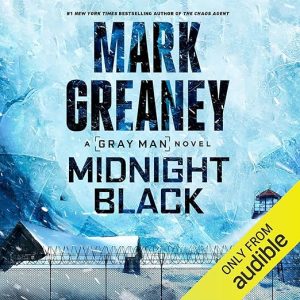
- Read by: Jay Snyder is the named reader, up against Russian proper nouns, a penal colony known by a code and a cast fourteen books deep.
- At its heart: Rescue thriller, Russian penal system, espionage tradecraft, loyalty pushed past sense
- Vibe: Frozen, relentless, single-minded
- Short version: A strong series entry and a poor entry point, best taken after the earlier Gray Man books have done their work.
Book fourteen of a series is a peculiar thing to assess, because the only question most buyers actually have is whether it still works after thirteen. Midnight Black runs fifteen hours and fifty-one minutes, which makes it a substantial audiobook by any measure, and the premise is about as stripped down as thriller premises get: Zoya Zakharova is being held in a Russian penal colony, and the Gray Man is coming for her. Everything else in this book is a variation on that sentence, which is both its greatest strength and the reason it behaves differently from the entries around it.
The publisher's opening move tells you what kind of book you are getting. Sunrise over the Russian plains arrives as a threat rather than a relief, the thermometer barely clears freezing, and at Penal Colony IK22 the guards are introduced through their appetite for making inmates carry the misery for them. Weather is doing antagonist duty before a single character has acted. That is a very old trick and it still works, particularly in audio, where a cold, static opening buys a lot of atmospheric credit before the plot machinery starts turning.
What lifts the setup above a straightforward rescue is that Zoya is not cargo. The copy establishes her as a former master spy for Russian foreign intelligence, and it makes clear she holds information the Kremlin wants badly enough to keep working for it. She therefore has leverage, a professional history and her own reasons to survive, none of which a hostage in a lesser thriller would be granted. My reservation is structural rather than a complaint about execution. A rescue plot collapses everything into a single objective, which is excellent for momentum and less generous to the kind of layered mission plotting that a long-running espionage series usually trades on. You get propulsion here in place of complication.
The Strengths
The reviewers on this page are specific about what Mark Greaney reliably delivers. One credits him with 'thrilling action sequences, engaging character development, captivating plot twists, and compelling espionage-paramilitary stories', which is a fair inventory of the brand. Another, a self-described devotee, writes that 'each new book in the Gray man series continues to give the reader non stop action and unexpected twists and turns', and singles out something more interesting than the action: the way 'the storyline uses some of the real world events' as scaffolding. That grounding is a genuine appeal of this series and a real reason to pick up the current volume rather than an older one.
The most useful review on the listing is the one that is not about the audio at all. A reader of more than seven decades, whose range takes in everything 'from the hardcore scientific to the esoteric and from the classics to spy/assassin and westerns', describes buying 'this 894-page paperback'. That single figure gives you a scale the runtime alone does not. Set against a recording of just under sixteen hours, it works out near fifty-six pages an hour, and since page counts swing wildly with trim size and typesetting I would not treat that as evidence of anything by itself. It is a good prompt to confirm the edition you are buying is the unabridged one if that matters to you.
Jay Snyder is credited as the reader, and the demands here are concrete: Russian personal and place names arriving steadily, a facility designated by code rather than by a name you can picture, and a recurring cast that has accumulated over thirteen previous books. Sixteen hours of sustained pursuit also asks for stamina in a way a standalone thriller does not. If you have listened to earlier entries, the narrator question is worth settling against your own library before you buy, since continuity of voice across a long series matters more to most listeners than any individual performance choice.
Before You Commit to Midnight Black
Series position is the first and biggest consideration. This is the fourteenth Gray Man novel, and while the rescue itself explains itself in about ten minutes, the emotional weight depends entirely on a relationship the earlier books built. The copy assumes you already know who Zoya is, what she was to the protagonist, and why he would burn a continent down for her. A newcomer will follow the plot perfectly well and feel almost none of the stakes, which is the worst of both outcomes. Start at book one if you want what this book is actually offering.
Ignore the score. Fourteen ratings is far too small a sample to carry meaning, and on a series with this commercial profile that number reads as a recently released audio listing rather than as a signal about the book. Treat the 4.8 as noise and go by the written commentary instead.
Notice, too, where the description came from. The product copy on this audio listing ends with a cover design credit for the print jacket, which tells you the blurb was written for the physical edition and carried across unchanged. Pair that with a top review describing an 894-page paperback and a clear pattern emerges: much of the visible commentary here attaches to the book as an object rather than to the recording. Useful to know when you are weighing what those stars are actually measuring.
The real-world grounding, lastly, cuts both ways. A thriller that borrows from current geopolitics feels urgent on release and dates faster than one built on invention, and the Russian setting here is not a neutral backdrop. Some listeners will find that immediacy exactly the appeal; others will notice how quickly the news moves underneath a novel.
Who Should Listen to Midnight Black
Existing Gray Man readers need no encouragement from me and should treat this as required series reading, since a book about rescuing Zoya is not something you skip and pick up later. Beyond that, it suits listeners who want a long, single-objective action thriller with a cold, hostile setting, and anyone who enjoys infiltration plotting where the environment is as dangerous as the guards. Sixteen hours is a serious commitment, and the momentum is the reason it does not feel like one.
Newcomers should genuinely start elsewhere in the series rather than here. Anyone who prefers espionage with moral ambiguity and slow institutional maneuvering over pursuit and extraction should also look at a different shelf, because this book is not interested in ambiguity and never pretends to be. Come for the chase, stay for the cold, and know what you signed up for.
Before You Listen
Can I start the Gray Man series with Midnight Black?
You can follow it, but you should not. The plot explains itself quickly while the emotional stakes rest entirely on a relationship built across thirteen previous novels. Beginning here means understanding every event and feeling almost none of them, which is the least satisfying way to meet this series.
How does the audiobook runtime compare with the print edition?
A reviewer on this listing describes an 894-page paperback, while the recording runs a shade under sixteen hours. That pairing gives a useful sense of scale, though page counts vary enough between editions that the arithmetic proves nothing on its own about what has been included.
Is this audiobook narrated by the same reader as earlier Gray Man books?
This listing credits Jay Snyder and says nothing about the rest of the series, so I cannot confirm continuity from the page alone. If a consistent voice across fourteen books matters to you, compare the credit against the entries already in your library before buying this one.