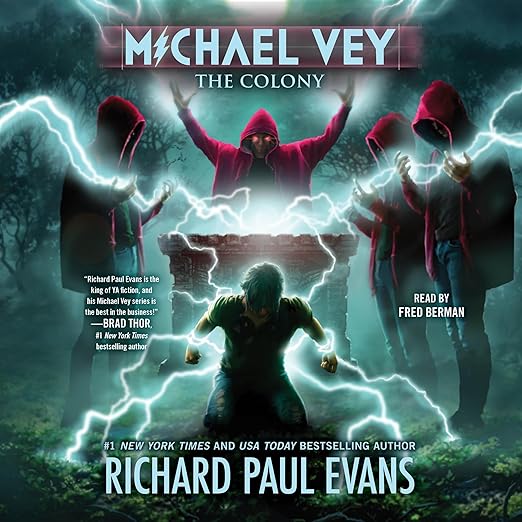
Quick Take
- Narration: Fred Berman brings his decade-long familiarity with the Electroclan to the finale with full command, Michael’s anxious energy and the ensemble’s distinct voices land with the confidence of a narrator who knows these characters bone-deep.
- Themes: Loyalty under pressure, the cost of war on young shoulders, chosen-family sacrifice
- Mood: Fast-moving and emotionally charged, with a bittersweet undercurrent
- Verdict: A satisfying close to a beloved series, best experienced by listeners who’ve been with Michael from the start, though a slightly rushed finale keeps it just short of perfect.
I finished the Michael Vey series the way I imagine most long-haul listeners do: with a kind of bittersweet reluctance. The tenth installment landed in my queue on a quiet December afternoon, and I rationed it over three sessions because I genuinely didn’t want to reach the end of something I’d been emotionally invested in across so many books. That’s not a minor thing. Series conclusions carry enormous pressure, and Richard Paul Evans clearly felt the weight of delivering a worthy goodbye to the Electroclan.
What he gives us in this final volume is essentially the series in concentrated form: a high-stakes rescue mission, an ensemble that functions like a fractured but devoted family, and the central tension of young people carrying responsibilities that would break most adults. After the harrowing battle in the Peruvian jungle against the Chasqui, an Elgen offshoot, and the devastating losses the team absorbed, the Electroclan regroups stateside. The downtime is appropriately brief. Abi has been abducted from outside her college dorm, and the clock is already ticking.
Our Take on Michael Vey 10
This is a confident, propulsive series finale that trusts its readers. Evans doesn’t reset the emotional stakes or give the characters a convenient breather, he drops them straight back into the field, this time facing something genuinely new: electrics with powers potentially exceeding their own. The Colony, led by a figure holding Abi captive somewhere in Peru, forces the Electroclan to confront the question the series has been quietly building toward: what happens when your advantage disappears? When the thing that made you special is now working against you?
There’s something Evans does well throughout this book that he’s always done well in the series: he writes Michael as someone who experiences doubt. The decision to nerf Michael’s abilities at key plot moments frustrated at least one reviewer, and I understand that reaction, but I read it differently. It’s a structural choice that stops the protagonist from being a solution generator and forces the team to function as a unit. The Electroclan has always been more interesting as a collective than as Michael-plus-sidekicks, and the finale leans into that honestly.
Why Listen to Michael Vey 10
Fred Berman has narrated this series from the beginning, and that continuity is genuinely valuable at a series conclusion. He doesn’t have to find these characters, he’s lived with them for years. The ensemble voicing is clean and consistent, Michael’s narration carries the right mix of exhausted determination and residual teenage awkwardness, and the action sequences, which Evans writes with kinetic clarity, translate well to audio. At just over ten hours, the pacing stays tight. This is not a book that meanders before its climax.
The emotional payoff is also real. The reviews collected from listeners are almost uniformly affectionate, and one longtime fan noted receiving signed copies across Evans’s entire career, which tells you something about the community this series has built. That kind of loyalty doesn’t happen around books that are merely competent. The Electroclan resonated because Evans wrote characters who feel genuinely responsible for each other, not just narratively convenient allies. That warmth carries through to the end.
What to Watch For in Michael Vey 10
The most honest caveat here is the one surfaced by a careful reader in the reviews: the ending feels somewhat rushed. This is a pattern Evans has shown before, book 7 was cited as a similar case, and in a ten-book series, the final sprint can feel compressed after the sustained buildup. Whether that bothers you depends partly on what you want from a finale. If you’re after tight emotional closure over every dangling thread, you may feel the landing was slightly truncated. If you’re satisfied by the core question being answered, does the Electroclan make it out?, then the pace will feel appropriately urgent rather than hurried.
The Colony as a villain faction is also relatively new, introduced in the extensions to the original seven-book arc. Listeners who joined the series at book 8 or 9 will have more context for Grace’s consciousness-breaking-free-of-her-body storyline than anyone coming in fresh would, so this is very much a book for the faithful, not a standalone entry point.
Who Should Listen to Michael Vey 10
Listeners who have stayed with the series through all nine preceding volumes will find this a worthy, if slightly breathless, conclusion. The combination of Fred Berman’s narration, the genuine emotional stakes Evans has built across the franchise, and the satisfying resolution of the Abi rescue arc makes it worth the listen. Readers new to the series should start with book one, the callbacks and character dynamics here assume deep familiarity. Fans of action-driven YA with ensemble casts, clean content, and real heart will find exactly that delivered with care.
Frequently Asked Questions
Do I need to have read all nine previous Michael Vey books to follow this finale?
Yes, unambiguously. Book 10 assumes complete familiarity with the Electroclan, the Elgen, Grace’s consciousness subplot, and the events of the Peruvian jungle battle. This is a series conclusion, not an entry point.
Does Fred Berman’s narration hold up after ten books in the series?
Berman has narrated the full Michael Vey series, and the continuity shows in the best way. His voice differentiation across the ensemble cast is consistent, and his command of Michael’s first-person narration feels earned rather than mechanical at this point.
Is Michael Vey 10 appropriate for the series’ core middle-grade and YA audience?
Yes. The series has always maintained clean content, no significant profanity, no explicit material, and book 10 is consistent with that. Reviewers specifically cite it as appropriate family listening, with one noting they read it alongside their ten-year-old.
Does the book resolve the Colony storyline satisfactorily, or does it feel unfinished?
The core rescue mission resolves, and the Electroclan’s central arc reaches a definitive close. However, multiple reviewers note the ending feels somewhat rushed, echoing a similar critique of book 7. If you need every thread tied with precision, temper your expectations slightly, the final pages move quickly.