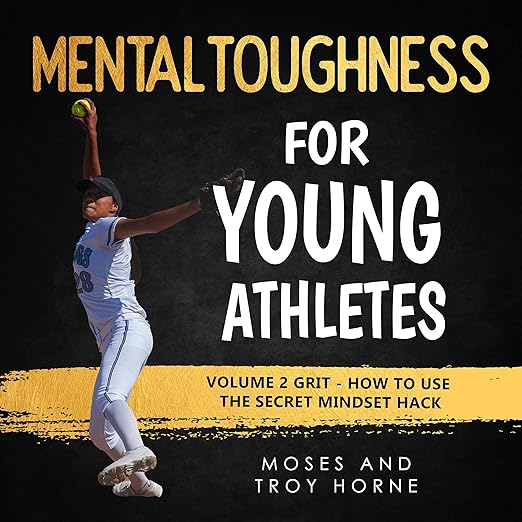
Sports psychology written for adults and handed to a fourteen-year-old is one of the quieter failures in youth athletics. The vocabulary is wrong, the examples come from professional careers, and the kid stops listening on page three. This audiobook was built specifically against that problem, and the description says so directly: most books in the field "were either written for adults or not written for youth athletes in competitive sports". Three hours and nineteen minutes, aimed at the athlete rather than at the parent buying it.
Volume two picks up where the first left off, and the framing is continuous rather than standalone. The Hornes describe getting "through the next level of challenges" and leveling up, which tells you the shape: this is not a fresh introduction but the second stage of a program. Coming in cold works, since grit is explained from the ground, though you will hear references to a first volume that assume you were there.
Grit gets defined here as the trait that makes everything else durable, "that one trait that makes your mental toughness work long term", and the distinction matters more than it might sound. Plenty of young athletes can summon focus for a game. Far fewer can sustain effort through a season where their teammates have stopped caring, which the description names outright as the situation this book was written for.
Keziah Coombs, who writes "As a coach", gives the most professionally useful account of what the book does in practice, choosing it "to get a new outlook on GRIT to reframe the concept to my players". That is a coach using it as a vocabulary source rather than as a handout, and it points at the real value: the book gives adults and kids the same words for something they usually discuss in slogans.
The Strengths
Three hours and nineteen minutes is short enough to finish on two car rides to a tournament, and that is not a trivial observation for this audience. A young athlete who will not open a book will often sit through a recording, particularly one addressed to them rather than about them. The pacing assumes a listener who has somewhere else to be, and the chapters are sized accordingly, short enough to finish one between warmups.
Moses Horne reads the edition while Troy Horne holds the byline, and the surnames are the interesting part of the credit. Keziah Coombs closes a review by saying "I love that it was a father/son duo!", and the book presents itself throughout as coming from a young athlete rather than about one. Whether a peer-aged voice or an adult one is delivering that first-person address changes the entire proposition, and it is the single production decision a parent should sample before buying.
Podcast material sits underneath a lot of this, which gives the advice a provenance most books in the category lack. The description credits the Hoopchalk Basketball Podcast with interviews behind the method and names Chauncey Billups, Tywanna Smith, Keiko Yoshimine, Earl Boykins, Jason Richardson and Kobe Bryant among the people they spoke to. Take the list as the authors present it. What it signals is that the framework came out of conversations rather than out of a literature review.
What to Watch For in Mental Toughness for Young Athletes
Trash talking gets a chapter, and the only reviewer to withhold a star is the one who flags it. Keziah Coombs would have "reframed the chapter about trash talking" and instead "focused more on athletes being more affirmative of themselves", while noting the book covers that ground later anyway. Parents handing this to a younger child should know that section exists, since the framing is competitive rather than sportsmanlike, at least at that point.
Authorship is genuinely murky on this listing. The description speaks in the first person plural throughout, claims to be "written by a young athlete from an actual young athlete's perspective", and the byline credits Troy Horne alone. A reviewer describes a father and son project. None of that is hidden, exactly, but a buyer who wants to know whose voice they are hearing has to assemble it from three separate fields.
Marketing language runs hot in the description, with exclamation points, promises about standing out, and a closing run of questions aimed straight at anxious parents. The book itself, on the evidence of the five written comments, is calmer than its own copy. The series numbering is also inconsistent, with Volume 2 in the title and no number recorded in the series field, so check you are buying the one you meant to before you press play.
Recommended For
Parents of committed young athletes are clearly the buyers, and the pool reflects that exactly. Of the five people who wrote something, one is a coach, one describes a son who first read it at eight and returned to it years later, one bought it for a nephew and his three sons, and one passed it around a youth baseball team in the offseason. The fifth assesses the method itself. Nobody in that group is a professional athlete or a sports psychologist, which is exactly the readership the book claims.
Coaches working with age-group teams get more out of it than the title suggests, on Keziah Coombs's account, who recommends it "to my athletes, fellow coaches, and parents" after using it to reframe a concept for a squad. Eric Marshall reports something concrete from the same use: "I noticed a difference in resiliency" after circulating it through a team. Neither of those uses requires the athletes themselves to listen, which makes the short runtime useful to the adult in the room as well.
Leave it alone if you want peer-reviewed sports psychology with citations, or if your young athlete is not actually competitive. This is a program built by a family that went through it, pitched at kids who already care enough to be frustrated. The aggregate of 4.8 across 317 ratings suggests it lands with the people it was written for, and the same enthusiasm will read as noise to anyone outside that group.