Quick Take
- Narration: Thomas Edward delivers a clean, professional read that keeps the short runtime moving, functional rather than memorable, which suits the reference-style format.
- Themes: mental tactics for match play, opponent profiling, pre-match preparation rituals
- Mood: Practical and brisk
- Verdict: A solid mental-game primer for players new to the psychological side of tennis, though experienced competitors will find it covers familiar ground quickly.
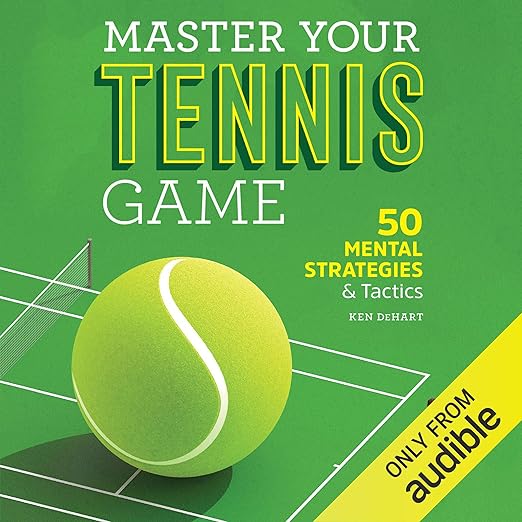
Two hours is a short window for a book promising mental dominance on the tennis court. I listened to Master Your Tennis Game during a single evening walk, and that runtime felt right for what Ken DeHart is doing here: a structured, digestible overview of fifty mental tactics for players who want to start thinking more intentionally about match play without committing to a dense academic treatment of sports psychology.
DeHart has a background in tennis coaching, and that practitioner perspective comes through in the organizational logic. The fifty methods are grouped into recognizable categories, pre-match preparation, in-match concentration, opponent analysis, and each chapter is short enough to revisit as a reference rather than requiring a cover-to-cover listen to extract value. Thomas Edward’s narration is clean and unhurried at a pace that suits the reference-style content.
Our Take on Master Your Tennis Game
The book’s greatest strength is also its clearest limitation. DeHart keeps things accessible and actionable, which means that any given chapter gives you a concept and a few application notes rather than a deep exploration of the underlying psychology. The sections on analyzing specific play styles, the aggressive baseliner, the left-hander, the net rusher, are among the more useful stretches because they translate mental strategy into concrete tactical adjustments. The profiles of pros like Serena Williams and Roger Federer serve the motivation function rather than the instruction function; they are illustrations of competitive mindset rather than detailed breakdowns of how those players actually construct points.
One reviewer noted finding some content generic or “apple pie,” and that is fair. Chapters on pre-tournament logistics, mapping the venue, managing travel, exist in a self-help register rather than a strictly tennis-specific one. Whether that reads as practical common sense or padding depends on how much of this territory you have already covered in other performance reading. For players who have never thought systematically about match preparation, those chapters land. For players who have, they cover ground that already feels familiar.
Why Listen to Master Your Tennis Game
The honest answer is that this works best for players in the 2.0 to 3.5 USTA range who are encountering mental game content for the first time, and for junior players whose coaches are looking for accessible supplemental material. The journaling recommendation that one reviewer highlighted as newly motivating is genuinely useful for players starting to build consistent pre-match routines. At just over two hours, the time investment is low enough that even if only ten of the fifty strategies prove directly relevant to your specific game, the return is still positive.
The audio format suits the content particularly well, you can treat this as a commute listen and return to specific sections in the days before a match rather than consuming it as a linear reading experience that demands continuous attention. Short chapters mean easy re-entry after a gap.
What to Watch For in Master Your Tennis Game
Players with established mental game frameworks, anyone who has already worked through Brad Gilbert’s Winning Ugly or read extensively in the sports psychology space, will find the depth here insufficient. The book does not engage with the neuroscience behind mental performance or situate its advice within any theoretical framework beyond practical coaching observation. It is coaching advice, not psychology, and the distinction matters if you are looking for the mechanism behind the method rather than the method itself.
The opponent profiling sections, while useful, are necessarily simplified. Real match play is more fluid than the type categories suggest, and experienced players will encounter plenty of opponents who do not fit neatly into aggressive baseliner or left-hander categories. The framework is a starting point rather than a complete system.
Who Should Listen to Master Your Tennis Game
Best for beginners and intermediate players who want a mental game starting point they can work through quickly and revisit in sections before matches. Junior players and their coaches will find it accessible without being condescending. Competitive club players with existing mental game reading under their belts will likely find it covers ground they already know, though a listen at 1.5x speed as a refresher still has value. Non-tennis players have no reason to pick this one up, it is sport-specific throughout and makes no attempt to generalize beyond the court.
Frequently Asked Questions
Is this audiobook useful for doubles as well as singles tennis?
Yes. DeHart addresses both formats, including sections on finding and working with partners and adapting mental strategies to the doubles dynamic, though the emphasis throughout is somewhat heavier on singles match play.
How does Master Your Tennis Game compare to other mental tennis books like Winning Ugly by Brad Gilbert?
DeHart is more introductory and concise. Gilbert’s book digs deeper into tactical match strategy with specific competitive experience behind every point. Master Your Tennis Game covers a broader range of mental topics at a shallower depth, better suited to newer players, while Winning Ugly rewards more experienced competitors.
At just over two hours, is there enough content to justify the listen?
For beginner to intermediate players, yes. The fifty strategies give you a practical checklist to work through, and the short runtime means you can revisit specific sections before matches. Advanced players may find the density too low to justify the time.
Does Thomas Edward’s narration add anything to the listening experience, or is this the kind of book better read in print?
The narration is competent and clear without being particularly distinctive. The short chapters make either format workable, but the audio version is convenient for commutes and pre-match warm-up listening.