Quick Take
- Narration: Travis Baldree is a natural fit for Harmon Cooper’s slightly off-kilter fantasy voice, bringing warmth and dry wit to a cast that could easily feel thin.
- Themes: Cultivation and chi mastery, survival after catastrophic loss, the reluctant hero rebuilt from nothing
- Mood: Adventurous and occasionally quirky, with slower middle sections before a propulsive final act
- Verdict: A solid series opener for fans of Eastern-influenced progression fantasy, with enough character texture to reward patience through the slower build.
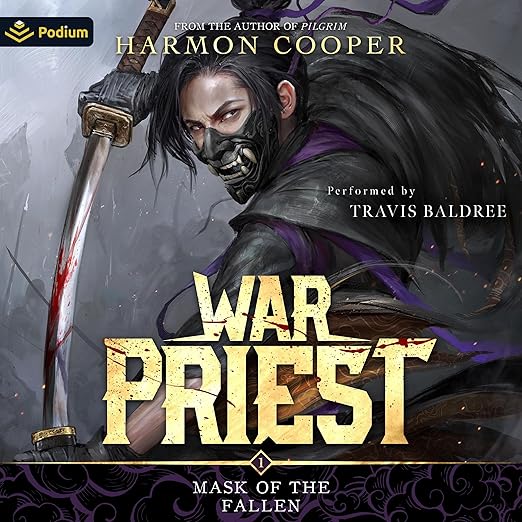
I came to Mask of the Fallen knowing Harmon Cooper’s reputation from the Pilgrim series, which means I arrived with calibrated expectations. Cooper writes a particular kind of fantasy: worlds that feel slightly sideways from the familiar, protagonists who are more interesting for their interior life than their power level, and a tendency to take cultivation tropes and push them somewhere unexpected. The War Priest series opener lands in familiar territory for the genre while adding just enough strangeness to distinguish itself.
The setup is stark. Arik is the last of his kind after his academy is destroyed. He survives a fall from a cliffside window and a vicious attack by winged wolves, gets captured by slave traders, escapes, and teams up with an irritable water spirit. Cooper moves Arik through the opening disaster efficiently and without much sentimentality, which is the right call. The world of Taomoni and the threat of the Crimson Realm unfolds across the narrative rather than front-loading exposition, a structural choice I appreciate in a genre that often buries its first hours under worldbuilding dumps.
What the Chi System Actually Does
The progression fantasy mechanics here draw from Japanese mythology and Eastern cultivation traditions rather than the Western RPG template that dominates the genre. Arik’s relationship with chi is not about leveling up in a quantifiable sense but about deepening awareness, which gives the system a more philosophical texture. The master illusionist who becomes Arik’s unlikely teacher operates on principles that feel rooted in actual contemplative traditions: chi as attention, as presence, as the gap between stimulus and response.
Travis Baldree handles these sections with appropriate gravity without tipping into pomposity. He is one of the more technically skilled narrators working in fantasy audiobooks, with a particular gift for comedic timing that serves Cooper’s occasionally quirky dialogue well. The irritable water spirit Meosa, who attracted her own fan following in the reviews, benefits enormously from Baldree’s vocal characterization. She is funny without being a comic relief character, which is a harder needle to thread than it sounds.
The Pacing Problem in the Middle Passages
Multiple reviewers flag the same issue: the middle section of the book is a slog. One listener notes she had to push through until the final quarter convinced her to continue into book two. Another describes scenes with no more than three interacting characters as feeling sparse. Both observations are fair. Cooper builds his worlds through accumulation rather than spectacle, and there is a stretch of roughly three to four hours in the audio that will test listeners who need constant forward momentum.
I think this is partly a structural feature of cultivation fantasy as a genre: the training montage is the point, and if the training feels repetitive it is because growth is repetitive. But Cooper does not always find the variety within that repetition that would make those sections crackle. The comparison one reviewer makes to the 1980s film Remo Williams is both surprising and accurate. There is something retro about the master-disciple dynamic here, a deliberate classicism that feels intentional but can also feel slow.
Series Potential and Where Book One Leads
The final act of Mask of the Fallen is substantially stronger than its middle, and multiple listeners note the ending pushed them directly to book two. The worldbuilding that feels tentative in the opening volumes does cohere. The continent of Taomoni, the il’Drach people, and the connections between the Ursans and the ancient wormhole network suggest a mythology that Cooper has worked out in detail and is parceling out carefully. At twelve hours and forty-nine minutes, this is a substantial investment for a first book.
This is best suited for listeners who came to progression fantasy through cultivation systems rather than through Western LitRPG mechanics, and who want their heroes to feel genuinely damaged and uncertain. If you need your protagonist to be competent from the start, or if you want a faster payoff on the power fantasy elements, Cooper’s approach will frustrate. But if you are willing to invest the runtime, this free audiobook rewards the patience it asks for, particularly once Baldree finds his rhythm with Meosa and the final quarter delivers on the promise of the first.
Reading Arik’s Interiority Alongside the Action
What Cooper prioritizes over set pieces is Arik’s internal architecture, how he thinks under pressure, what he is willing to sacrifice and what he is not, how his understanding of chi shifts as his circumstances become more desperate. Those interior moments are where Baldree’s narration does its best work. He is not a narrator who reaches for vocal theatrics; he builds character through restraint and through the quality of attention he brings to quieter scenes. Readers who want spectacular audiobook performance will find him understated. Readers who value character presence over spectacle will find him exactly right for what Cooper is doing here.
Frequently Asked Questions
Do I need to read the Pilgrim series before starting War Priest?
No. Mask of the Fallen is set in a completely different world and introduces its own mythology from the ground up. Pilgrim readers may recognize Cooper’s stylistic signatures, but there is no narrative connection between the series.
Is this cultivation fantasy or LitRPG? Are there stats and level-up systems?
It is cultivation fantasy, not LitRPG. There are no numeric stats or explicit level displays. The power progression is framed through philosophical awareness of chi rather than game mechanics, which gives it a different texture from most Western progression fantasy.
How does Travis Baldree’s narration handle the humor in the water spirit character Meosa?
Well. Baldree has a natural feel for comedic timing and gives Meosa enough personality to justify the fan response she attracted in the reviews. She is irritable and funny without feeling like a tonal mismatch against the more serious elements of the story.
Does the slow middle section resolve by the end, or does the pacing problem persist into book two?
Reviewers who continued into book two generally report that Cooper’s pacing tightens as the series develops. The first book is building foundations that pay off later, so your experience of the middle section depends on how patient you are willing to be with that kind of structural investment.