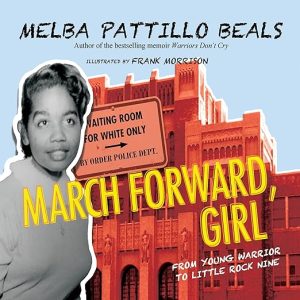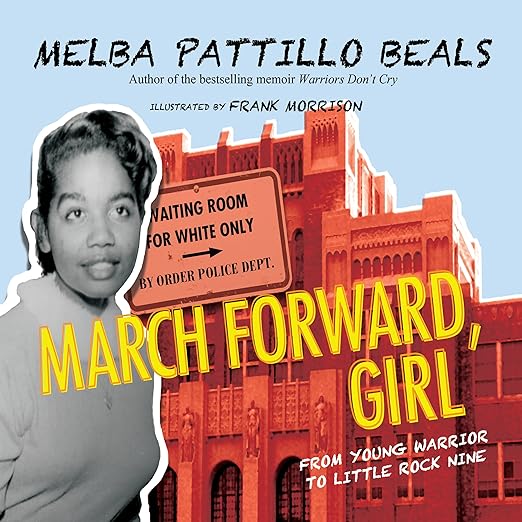
Melba Pattillo Beals earned her place in history as one of the Little Rock Nine, but March Forward, Girl is the audiobook that tells you who she was before that. This is the story of a child who was already furious, already asking questions that the adults around her refused to answer. Janina Edwards narrates with a quiet, steady authority that matches the tone of the memoir perfectly: the kind of voice that lets difficult material land without becoming a performance of suffering.
Verdict first: this memoir belongs in audio. The intimacy of a first-person account, read by a narrator who clearly respects every sentence, produces an experience that is different in kind from reading the page. The questions Beals asks as a child, why she cannot drink from a certain fountain, why church walls cannot keep her safe, feel immediate in audio. They are asked aloud, left unanswered in the silence before Edwards continues, and that silence is part of the meaning. Hearing these questions voiced rather than seen on a page shifts their character entirely.
What Melba Pattillo Beals Delivers
Beals frames her early life not as a period of waiting for history to arrive, but as a series of encounters that shaped a fighter. She was not radicalized by the Little Rock Nine crisis; she arrived at that moment already formed. The memoir traces how that formation happened: through her grandmother's steady faith, through the humiliations small and large that segregation inflicted daily, through the moment a young Melba decided that patience was not a value she could afford to carry if she wanted to be free.
What makes this audiobook worth the time is how specifically Beals renders that childhood world. It is not a survey of the Civil Rights Movement but a close-grained portrait of one girl's experience inside it. One reviewer described it as a visceral, intimate rendering of growing up under segregation, and that phrase earns its accuracy. The language has been calibrated for young readers, but it does not soften what happened. The result is that it communicates across age ranges. An 8th grader quoted in another review called it insight to an era we should all know about so that it never repeats again. That is a 14-year-old's verdict, and it holds up under scrutiny.
What Melba Pattillo Beals Gets Right
Janina Edwards brings a crucial quality to this narration: she resists the temptation to editorialize. She does not signal to the listener which moments are supposed to be moving. She trusts Beals' words, and that trust is exactly right for a memoir this particular. At just over four and a half hours, the audiobook is an ideal length, long enough to build the emotional arc of Beals' childhood years, short enough to listen in two or three sessions without losing the thread of who she is becoming across the chapters.
The memoir sits in an interesting relationship to Beals' better-known Warriors Don't Cry, which covers the actual integration crisis at Central High School. One reviewer noted that nothing dethrones that book as their favorite Beals title, but March Forward, Girl comes close. Listening to these two in sequence turns into something larger: a portrait of a life whose public heroism was rooted in private stubbornness built long before the cameras arrived. Reading them together is the fuller experience.
Where Melba Pattillo Beals Loses Some Ground
The memoir works best when Beals stays closest to specific scenes rather than general reflection. The moments that carry the most weight are the ones that put you inside a child's experience of confusion and injustice: the water fountain, the church, the daily geography of a segregated town. Where the narrative moves into more summary mode, it loses some of that compression. This is worth knowing so you recognize the gear shift when it happens rather than assuming the pace has changed permanently.
This is a book written with young people in mind, and the prose style shows it. That is not a criticism. The clarity serves the material and keeps the stakes legible for every listener, whatever their age or prior knowledge of the period. But those who come expecting the density of adult literary memoir should calibrate their expectations accordingly. What is here is something more useful in some ways: a first-person primary source from inside a historical moment, written with enough honesty that it does not flatten into lesson. One reviewer who used it for a church civil rights pilgrimage described it as exactly that kind of primary source material, and the framing is accurate.
Beals went on to become an acclaimed journalist, a bestselling author, and a recipient of the Congressional Gold Medal. This memoir does not feel like a retroactive self-portrait shaped by those achievements. It feels like she is actually recovering who she was before any of that, and that authenticity is what makes the audiobook worth returning to even after you know the outcome of the story it tells.
Who Should Pick Up March Forward, Girl
This audiobook works for middle grade and YA listeners who want American history through a personal lens rather than a textbook. It also works for adults who missed Warriors Don't Cry or want a more accessible entry into Beals' story. Teachers and parents looking for civil rights content that is both age-appropriate and substantively honest will find it a reliable choice. Skip it if you are expecting the full Little Rock Nine crisis story. That is Warriors Don't Cry, and March Forward, Girl is a prequel to that experience, not a retelling of it.
- Read by: Janina Edwards reads with warmth and controlled intensity, honoring Beals' childhood voice without sentimentalizing it, and the audiobook format suits the intimacy of this personal account.
- At its heart: Civil rights resilience, childhood defiance under segregation, the cost of speaking truth early
- Vibe: Urgent and intimate, with a slow-burning courage running underneath every scene
- Short version: A clear-eyed account of a fighter's origins that works for young listeners and adults alike, best experienced in audio where Edwards' measured delivery gives the outrage its full weight.
Good to Know
Is this audiobook appropriate for middle school students?
Yes. The language is calibrated for young readers, and the content, while honest about the realities of segregation, is appropriate for middle grade and high school listeners. Multiple reviewers confirmed using it as required or supplemental reading for 8th graders.
At four and a half hours, does this audiobook feel complete or abridged?
It feels complete for the period it covers. The memoir is not intended to be a comprehensive life story but a specific portrait of Beals' early years, and the length fits that scope. Listeners who want more should follow it with Warriors Don't Cry.