Quick Take
- Narration: Lesley Manville is the rare case of a narrator whose own cultural stature, she is a Bafta-winning actress, seems genuinely matched to the material’s literary self-awareness.
- Themes: Metafictional mystery, real and fictional worlds colliding, the dangerous knowledge inside books
- Mood: Elegant, layered, and pleasurably labyrinthine
- Verdict: The third Susan Ryeland novel is the best of the three, and Manville’s narration turns an already brilliant structural conceit into a full listening experience.
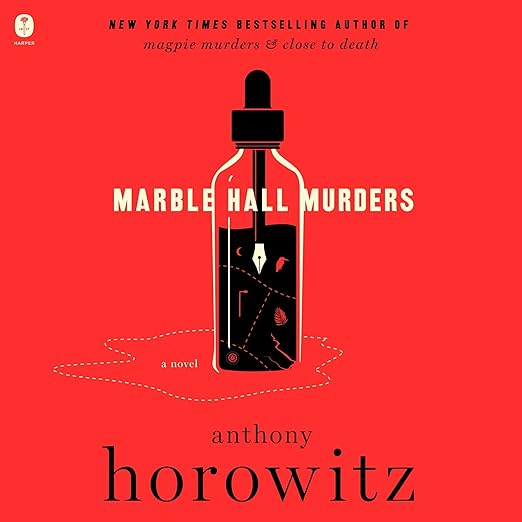
I came to Anthony Horowitz’s Susan Ryeland series in the wrong order, which turned out to be accidentally instructive. I listened to Moonflower Murders first, found it extraordinary, went back to Magpie Murders, and then spent several months waiting for Marble Hall Murders to arrive. When it did, I cleared a weekend for it. Seventeen and a half hours later, which is a substantial investment even by my standards, I understood why one reviewer called it the most fantastic and complex of any mystery series she had read. She was not overstating it.
The structural conceit of the series is a book within a book within a book: editor Susan Ryeland is given a manuscript to edit, the manuscript conceals clues about a real crime, and the process of reading the fictional story becomes the mechanism for solving the actual one. Horowitz has now done this three times without the device becoming mechanical, which is a genuine achievement. In Marble Hall Murders, Susan is editing a continuation novel featuring Atticus Pund, the series’ fictional Golden Age detective, written by Eliot Crace, the troubled grandson of a legendary children’s author who may have been murdered twenty years ago by poisoning.
Our Take on Marble Hall Murders
Publishers Weekly gave it a starred review and called Horowitz at the top of his game, which feels accurate. The virtuosity here is in the seaming between the fictional Pund manuscript, set in the South of France, centered on a death that was also apparently by poison, and Susan’s contemporary London investigation. The clues move in both directions. What Eliot has hidden inside the Pund novel illuminates what happened to his grandmother; what Susan discovers in the real world reshapes how she reads the fiction. By the time the two investigations converge, the structure has been doing work that only becomes fully visible in retrospect.
Horowitz also handles Susan’s personal situation with more texture than the series synopsis might suggest. She has left her Greek island, her hotel business, and her boyfriend Andreas, a relationship that has been the emotional through-line of all three novels, and returned to London. That loss runs quietly alongside the mystery, giving the book’s final act a melancholy weight that pure puzzle-box plotting would not have produced. This is a mystery about grief as much as it is about poison.
Why Listen to This Rather Than Read It
Lesley Manville’s narration is the version you want. She brings to Susan Ryeland the specific quality of a woman who is both sharp and bruised, intelligent enough to read the danger in a situation, human enough to be affected by it. The Atticus Pund sections, narrated by Susan within the fiction, have a slightly different register in Manville’s performance that helps listeners track which layer of the nested story they are in. At seventeen and a half hours, it is a long listen, but the pace is calibrated for the format, Horowitz does not write thin chapters, and Manville does not rush.
What to Watch For in the Series Order
This is the third book in a sequence, and while Horowitz provides enough context that newcomers can follow the mystery, the emotional weight of Susan’s situation requires the prior books to register fully. The Atticus Pund sections work as standalone pastiche for any reader who enjoys classic detection. The Susan frame is richer with the series history behind you. One reviewer noted that Horowitz has said this may be the last of the three, which makes the finale feel appropriately weighted, a conclusion arrived at rather than abandoned.
Who Should Listen to Marble Hall Murders
Anyone who has already listened to Magpie Murders and Moonflower Murders should not delay. Readers new to the series can enter here for the mystery, but should plan to go back for the full emotional arc. Fans of Agatha Christie, John Dickson Carr, and the Golden Age tradition will find Horowitz’s Pund sections affectionate and accomplished homage. Skip the series entirely if nested narratives and self-referential structure frustrate you, this is precisely that kind of book, and it is unrepentant about it.
Frequently Asked Questions
Is Marble Hall Murders accessible without having read the first two Susan Ryeland novels?
The mystery works as a standalone. The emotional stakes, particularly Susan’s decision to leave Andreas and Greece, will carry less weight without the prior books, but the puzzle-box structure is self-contained enough for new readers to follow and enjoy.
How does Lesley Manville handle the shift between the Susan Ryeland frame and the fictional Atticus Pund manuscript sections?
With notable skill. She maintains a slightly different tone for the Pund sections that signals to the listener they are inside the manuscript rather than in Susan’s present-tense investigation. The transitions are clean and the distinction is maintained consistently across the full seventeen hours.
Is this really the last Susan Ryeland novel, as some reviews suggest?
Horowitz has indicated this may be the final entry in the series, though authors change their minds. The ending of Marble Hall Murders functions as a satisfying series conclusion if it is, and as a strong chapter close if he returns to Susan later.
Do you need to be familiar with Agatha Christie and the Golden Age mystery tradition to appreciate the Atticus Pund sections?
Familiarity helps but is not required. Horowitz writes the Pund sections as genuine pastiche, formally accomplished enough to work for readers unfamiliar with the tradition, and rewarding enough in their allusions for those who are. One reviewer described it as a modern twist on a Golden Age plot, which captures the balance well.