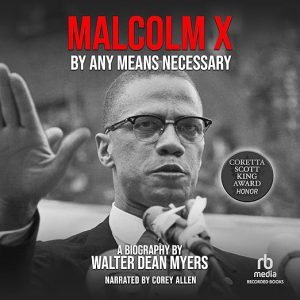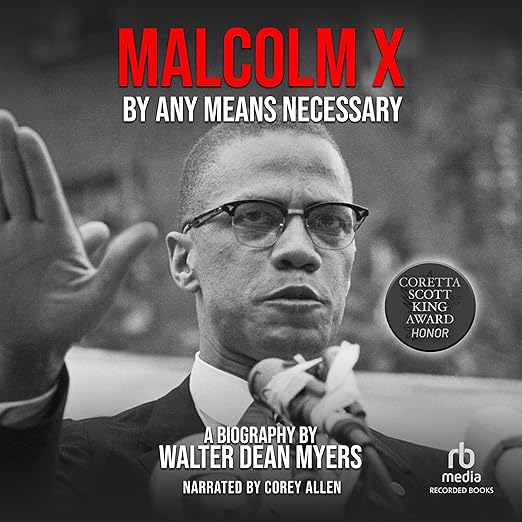
Walter Dean Myers's Malcolm X audiobook opens with a biographical fact that is also a trajectory: at 14, Malcolm Little was class president and a top student. By 16, he was hustling at a Boston nightclub. By 20, he was in prison. Myers lists these data points without editorializing, and that restraint is characteristic of his approach throughout this 4-hour-and-13-minute biography narrated by Corey Allen. Part of the Scholastic Focus series, it's designed for students while remaining substantive enough for any adult reader encountering the material with serious intent.
The biography's particular achievement is in handling the transformation that begins in prison without reducing it to a simple conversion narrative. Malcolm Little's time in incarceration is when he becomes Malcolm X, when the Black nationalist teachings of the Nation of Islam give shape to a coherent politics from what had been a life of accumulating damage. Myers traces this development with a biographer's interest in causation rather than a hagiographer's interest in elevation. The beliefs that shook America, and still shake America, are presented as having emerged from a specific, traceable set of experiences. That framing makes them more, not less, significant as a subject for young listeners to grapple with.
How Malcolm X Holds Up
Myers was one of the most decorated young adult writers in American publishing history, and his craft shows in how he handles the compressed timeline of this biography. The life between 14 and 39, from Malcolm Little to Malcolm X to the post-Mecca figure who broke from the Nation of Islam and was assassinated months later, is dense with transformation. Myers doesn't try to narrate every phase equally. He focuses on the moments of fundamental change, the decisions that made the next chapter of the man's life possible, and lets the connective tissue run at speed. The result is a biography that covers the full arc without becoming either shallow or overwhelming for its intended audience.
One reviewer noted this audiobook served as an introduction to Malcolm X for a mature 12-year-old, used alongside a class assignment on civil rights activists. That use case is exactly what the Scholastic Focus series is designed for, and it's worth being specific about what the biography does and doesn't include. It covers the key arc: street life, prison, Nation of Islam, national prominence, the break with Elijah Muhammad, the pilgrimage to Mecca, and the assassination. It does not attempt to be as complete as Alex Haley's co-written autobiography, nor should it for its intended audience. What it offers is a carefully shaped portrait that treats young listeners as capable of handling genuine complexity.
Why Malcolm X Works as an Audiobook
The audiobook format serves Myers's biography well because so much of Malcolm X's legacy is rooted in the spoken word. He was an extraordinary orator, and while this biography is about the man rather than a reproduction of his speeches, the choice to listen rather than read connects naturally to how Malcolm X himself communicated and why his influence persisted across decades. Corey Allen's narration respects the gravity of the subject without becoming reverential in a way that would soften the edges of a figure who was deliberate about his confrontational quality.
For educators and parents looking for a biography that can support discussion, reviewers specifically note that the book works well for use with students and that it provides a full picture of his life. The discussion potential is significant: the text raises questions about systemic racism, about how environments shape people, about the relationship between anger and political vision, that are not resolved by the biography but are made concrete and discussable through the particular story of one person's life from street hustler to national figure.
Weak Spots in Malcolm X
The biography covers the arc up to Malcolm X's assassination in 1965. The influence of his ideas on subsequent generations, the development of Black Power politics, the cultural resonance of his image in hip-hop and contemporary racial justice movements, falls outside this book's scope. Listeners who encounter this biography as a first introduction and want to understand Malcolm X's ongoing influence will need to continue elsewhere after finishing. Myers's task was the life itself, and he accomplishes that task with disciplined, focused attention rather than sprawling completeness.
The Scholastic Focus framing also means this biography is not a replacement for more comprehensive adult-level biographical treatments. Readers who want extensive archival detail, nuanced treatment of his philosophical development, or deep engagement with the historiography around him should move to longer works after encountering the life story in compressed form here. The Myers biography is a rigorous introduction, not an exhaustive study, and knowing that distinction before you begin will shape your expectations appropriately. Listeners who use this audiobook as an entry point before moving on to longer biographical treatments will find Myers has given them a reliable, carefully calibrated foundation for understanding the more contested aspects of Malcolm X's legacy that emerge in more comprehensive studies.
The Right Listener for Malcolm X
Listen if: you are a student, parent, or educator looking for an accessible but substantive audiobook biography of Malcolm X for young adult audiences, or if you want a tightly focused overview of his life and transformation before engaging with longer biographical works. Allen's narration serves classroom contexts and independent listening equally well and handles the material with genuine respect.
Skip if: you want a comprehensive, adult-level biography that covers the full scope of Malcolm X's philosophical development and posthumous influence. Myers's biography is intentionally calibrated for younger audiences and shorter attention spans; adult readers with existing familiarity will find the compression more limiting than useful for their purposes.
- Narrator: Corey Allen brings focused energy and appropriate gravity to Walter Dean Myers's compact biography, serving the material's intended classroom and young adult audience well.
- Subjects: Racial identity in America, transformation through belief, the complexity of Black political thought
- Tone: Direct and sobering, with genuine urgency
- Bottom line: A compact but substantive YA biography that does not simplify Malcolm X for young audiences, making it one of the stronger entry points to his life and legacy.