Quick Take
- Narration: Gary Dikeos brings a warmth and steadiness to Frosty Hesson’s voice that matches the memoir’s tone, unhurried, sincere, and never showy.
- Themes: Mentorship and found fatherhood, living with purpose and risk, grief and legacy
- Mood: Heartfelt and bittersweet, with stretches of genuine awe
- Verdict: A surfing memoir that is really a book about how we pass something of ourselves to the people we love, made more poignant by what happened to Jay Moriarty.
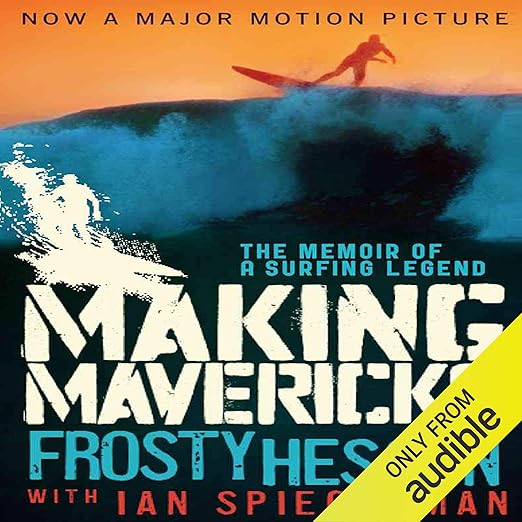
I came to Making Mavericks without knowing much about Jay Moriarty beyond a vague memory of a photograph, the one of him falling at Mavericks, arms outstretched, the wave enormous and indifferent above him. It is one of those sports images that stays in the mind without attaching to a name. By the time Gary Dikeos finished reading me the final pages of Frosty Hesson’s memoir on a Saturday afternoon, I understood the name, and I understood the loss, in a way the photograph had never allowed.
This is a book that works better than its premise suggests. A surfing mentor writes about his famous student, that could easily become hagiography, the posthumous lionizing of someone who died young and is therefore safe to mythologize. Hesson resists that. He is honest about his own turbulent youth, his difficult relationship with risk, and the philosophical framework he developed not as a finished wisdom but as a working practice, revised as life demanded. The phrase Live Like Jay did not emerge from a greeting card; it emerged from a specific grief, and Hesson earns it by showing you the actual Jay, restless, determined, occasionally frustrating, deeply alive.
Our Take on Making Mavericks
The memoir is structured in two movements. The first is largely autobiographical, covering Hesson’s own upbringing and how he came to the water, the philosophy he built around big wave surfing, and the principles he would eventually teach. Readers who pick this up expecting wall-to-wall Jay Moriarty content will need patience here. One reviewer noted the subtitle, The Memoir of a Surfing Legend, is genuinely ambiguous because both men could claim the title. That ambiguity is actually the book’s point: mentorship is a two-way formation, and Hesson cannot explain what Jay became without explaining what made Hesson the teacher he was.
The second movement covers Jay directly, the training, the partnership, the competitive surfing, and finally the death while free diving in the Maldives at twenty-two. Hesson does not linger on the tragedy in a manipulative way. He is more interested in what Jay demonstrated while alive than in the pathos of the ending. That restraint gives the book its emotional power: you feel the loss precisely because Hesson refuses to weaponize it.
Why Listen to Making Mavericks
Gary Dikeos is an excellent choice for this material. His voice has the quality of someone telling you something true rather than performing something dramatic, which is exactly what the memoir requires. Hesson’s prose is personal and digressive in the way real memory is, and Dikeos honors that rhythm without trying to punch it up. The result is a listening experience that feels like conversation, which suits a book built around the relationship between two people talking about what matters.
The audiobook format serves Making Mavericks particularly well because the memoir is built from anecdote and reflection rather than argument. You do not need to stop and take notes; you need to be present with it. At seven hours and forty-five minutes it sits in a comfortable range, long enough to develop its characters, short enough to finish in a weekend.
What to Watch For in Making Mavericks
If you approach this expecting technical surfing content, a detailed account of how big wave riding works, the physics, the equipment, the competition circuit, you will find that material present but not foregrounded. Hesson is more interested in the interior life of the surfer than the mechanics of the sport. The waves at Mavericks are described vividly, but what Hesson really wants to talk about is what it means to take that kind of risk deliberately and what it teaches you about how to live.
Some readers find the philosophical passages slightly generic when taken out of context, the life principles Hesson articulates are familiar enough. But they land differently when you understand they were tested against enormous water and real grief, and Dikeos delivers them with the gravity they deserve rather than the self-help cadence they could easily tip into.
Who Should Listen to Making Mavericks
This one belongs to listeners drawn to mentor-student stories with genuine emotional stakes, readers who have loved books like The Boys in the Boat or Unbroken for what they reveal about human resilience. You do not need to know anything about surfing; the ocean here is a setting for questions about purpose and character that are entirely legible without technical knowledge. Those looking for a fast-paced action narrative should know the book is reflective in pace and mostly interior in focus. And if you saw the 2012 film Chasing Mavericks, the memoir rewards you with the version of events that the film could only approximate.
Frequently Asked Questions
Do I need to know anything about big wave surfing to follow Making Mavericks?
No prior knowledge is needed. Hesson explains the context as he goes, and the book is really about mentorship and purpose rather than competitive surfing. The waves are vividly described but the focus stays on the human relationship.
How much of the book is about Jay Moriarty versus Frosty Hesson himself?
The first half of the memoir is primarily autobiographical, Hesson’s own upbringing, philosophy, and approach to surfing. Jay enters significantly in the second half. One reviewer described this balance accurately: the subtitle could apply to either man.
Is the ending handled sensitively given that Jay died young?
Yes. Hesson is notably restrained about the tragedy and more interested in Jay’s life than his death. The book closes on the Live Like Jay philosophy without becoming maudlin, which most listeners find affecting rather than manipulative.
How does Making Mavericks compare to the 2012 film Chasing Mavericks?
The memoir is more interior and philosophical than the film, which dramatized events for a wider audience. Hesson’s own voice gives the book details and emotional texture that the adaptation had to compress. Most readers find them complementary rather than redundant.