Quick Take
- Narration: Bob Rotella reading his own work gives this audiobook an intimacy that a hired narrator could not replicate; the decades of coaching authority comes through directly in the voice.
- Themes: Present-moment focus in performance, building confidence and routine under pressure, releasing outcomes without emotional spiraling
- Mood: Calm, focused, and quietly motivational without manufactured energy
- Verdict: Rotella’s consistent message lands with a different emphasis in every book, and this one is worth the listen for golfers working seriously on the mental dimension of their game.
I am not a golfer, but I have now listened to enough of Bob Rotella’s catalog to understand why golfers keep returning to him. I started this one on a long drive, which seemed appropriately ironic, and by the halfway point I found myself applying his framework to something entirely unrelated to golf. That transfer is the mark of a sports psychology book that has actually thought through its principles rather than simply wrapping them in sport-specific anecdote and moving on.
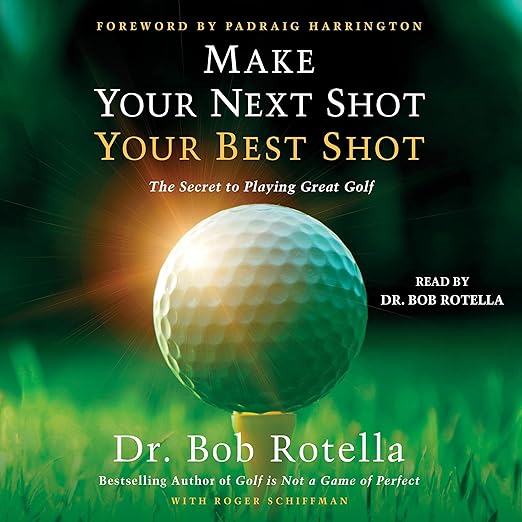
Make Your Next Shot Your Best Shot is Rotella’s distillation of what he considers the essential mental act in golf: releasing the previous shot entirely, committing fully to the next one, and playing within a process rather than tracking outcomes moment to moment. At just over six hours, it is a complete and unhurried listen. Rotella narrates his own book, which is unambiguously the right decision. His coaching voice, patient and direct, carries an authority that comes from decades of work with professional athletes rather than from any performance training.
Our Take on Make Your Next Shot Your Best Shot
One reviewer who captures this book’s value most precisely is a pianist and piano instructor who found Rotella’s performance psychology framework directly applicable to music practice and recital performance. That transference is real and worth noting. The principles Rotella outlines, focusing on process over outcome, building a reliable pre-shot routine, accepting results without emotional spiraling, sustaining confidence without arrogance, describe a mental discipline that functions in any context where execution under pressure matters. Golfers will find the sport-specific examples immediately applicable; non-golfers will find the underlying framework extractable and broadly generative.
One reviewer described the journey toward a single-digit handicap and the goal of shooting their age before eighty as the dream this book gave them permission to take seriously. That willingness to give ambitious goals full psychological permission is a consistent Rotella strength: he does not manage expectations downward. He argues that the mind chasing something extraordinary performs better than the mind that hedges against disappointment.
Why Listen to Make Your Next Shot Your Best Shot
Rotella is aware that listeners who have read his other titles will encounter familiar themes. Reviewers note this openly and without complaint: many of the same points appear in all of his books, but each entry conveys a different emphasis. What distinguishes this audiobook specifically is its focus on the singular moment of commitment immediately before each shot, and the argument that the mental act of committing to your next shot regardless of what came before is both the hardest and most essential skill in the game. That framing gives this entry a distinct emphasis even within Rotella’s consistent body of work.
Rotella is aware that listeners who have read his other titles will encounter familiar themes. Reviewers note this openly and without complaint: many of the same points appear in all of his books, but each entry conveys a different emphasis. What distinguishes this audiobook specifically is its focus on the singular moment of commitment immediately before each shot, and the argument that the mental act of committing to your next shot regardless of what came before is both the hardest and most essential skill in the game. That framing gives this entry a distinct emphasis even within Rotella’s consistent body of work, and the author’s narration gives it the weight of coaching delivered directly.
What to Watch For in Make Your Next Shot Your Best Shot
This book will not fix a mechanical swing problem, help with course management strategy, or address technical dimensions of the game in any meaningful way. Rotella is explicit that his focus is exclusively the mental dimension, and listeners hoping for technical instruction will be looking in the wrong place. The book also assumes willingness to commit to the psychological reframing it proposes, which requires honest self-assessment about your own mental patterns on the course. Listeners who resist the premise that belief and confidence are trainable skills will find the framework difficult to apply regardless of clarity.
Who Should Listen to Make Your Next Shot Your Best Shot
This audiobook is for golfers who have the mechanical fundamentals in place and are struggling specifically with the mental side: consistency under pressure, recovering mentally from bad shots, sustaining confidence across a full round. It also works for anyone in a performance discipline, music, public speaking, competition, who wants to examine the psychology of commitment and present-moment focus. Skip it if you are looking for swing instruction, strategic course management, or a technical approach to improvement.
Frequently Asked Questions
How does this book compare to Rotella’s other titles like Golf Is Not a Game of Perfect?
Reviewers note that Rotella’s core message is consistent across his books, but each entry emphasizes a different aspect of the mental game. This one centers specifically on the pre-shot commitment and the ability to reset mentally after each shot. Listeners who enjoy one Rotella title typically find the same value in all of them.
Is this audiobook useful for non-golfers?
Yes. The performance psychology framework transfers to other disciplines. A pianist reviewed the book and found the principles directly applicable to music performance. The sport-specific examples are golf-centric, but the underlying mental framework is broadly applicable to any performance context.
Does Rotella narrating his own book make a meaningful difference to the listening experience?
Yes. The coaching voice Rotella has developed over decades of working with professional athletes comes through directly, and the intimacy of the author-read format suits the mentoring tone of the material. Several reviewers specifically mention the narration as a meaningful strength.
Is this appropriate for beginner golfers or only for experienced players?
Rotella’s work is most useful for golfers who already have the mechanical basics in place and are looking to improve the mental dimension. Complete beginners may find it premature; the book assumes a foundation of technical skill and addresses what happens when that foundation exists but mental consistency is missing.