Quick Take
- Narration: Krystal Hammond handles the holiday warmth and the genuine emotional undercurrents of Caroline’s perspective with sensitivity, a strong vocal match for a story that needs its quieter moments to land.
- Themes: Second chances between old friends, the cost of ambition on the people you leave behind, sapphic identity and small-town homecoming
- Mood: Festive and bittersweet, with genuine ache beneath the Christmas lights
- Verdict: A sapphic holiday rom-com that takes its emotional injuries more seriously than the format usually demands.
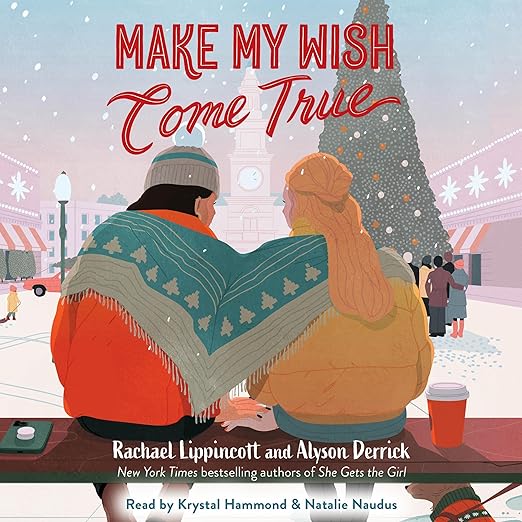
I listened to Make My Wish Come True in the week between Christmas and New Year, which is either exactly the right time or slightly past it depending on how you feel about holiday fiction once the actual holiday has passed. For me, the snow-covered small town and the twelve fake dates and the Cosmopolitan byline deal still landed with warmth. Rachael Lippincott and Alyson Derrick, the co-authors behind She Gets the Girl, have built something that understands fake-dating as an emotional pressure mechanism rather than just a plot convenience, and that understanding is what separates Make My Wish Come True from the more mechanical entries in the genre.
The setup is efficient: Arden James is a Hollywood teen actor whose reputation for recklessness just cost her an audition. To rehabilitate her image, she returns home for the holidays, recruits her former best friend and first love Caroline Beckett to play her secret girlfriend across twelve holiday dates, and offers a Cosmopolitan byline in exchange for a write-up on their staged romance. Caroline, who has spent four years building a journalism portfolio and trying not to think about what Arden walking away felt like, says yes for her own reasons. The Booklist starred review that called this forgiveness, friendship, and vulnerability shining as brightly as holiday lights was not wrong, though it slightly underplays the thornier material underneath.
Our Take on Make My Wish Come True
What Lippincott and Derrick handle with more care than the genre average is the asymmetry of the original wound. Arden left at fourteen and did not look back. Caroline stayed and built a life and told herself she had moved on. Neither of those positions is fully honest, and the twelve-date structure is useful precisely because it creates repeated proximity that exposes the dishonesty in both. The rom-com formula assumes a happy ending, which means the emotional weight has to be front-loaded, and this book front-loads it effectively. One reviewer described the experience of feeling genuinely included in the story, sensing what it was like to have your dream come true at fourteen while everyone around you took advantage, and then to come home to the person you abandoned. That emotional accuracy is the book’s real accomplishment.
Why Listen to Make My Wish Come True
Krystal Hammond’s narration is a natural fit for the dual-timeline emotional content. She handles the lighter holiday sequences, the genuinely funny fake-date set pieces in a Christmas-obsessed small town, without sacrificing the weight of the quieter scenes. The Kirkus Reviews description of the book as swoon-worthy holds up in audio; the scenes where old feelings surface under the pressure of performed romance are well paced in Hammond’s reading. The book also combines Christmas and Hanukkah traditions in a way that feels integrated rather than decorative, and Hammond navigates that specificity without flattening either tradition. For fans of Lippincott and Derrick’s earlier collaboration, this is a step forward in emotional complexity even if the scale is smaller.
What to Watch For in Make My Wish Come True
The YA audience positioning matters here. One reviewer who listened to it in November noted that they might have needed another month to be emotionally ready for the holiday framing, the seasonal context is central rather than ambient. A more substantive observation from multiple readers is that the book does not deliver much in terms of physical or emotional heat between the two leads for most of its runtime; the tension is primarily about the history rather than the present attraction. Readers who come to sapphic romance specifically for explicit connection will find this book restrained by design. The authors are writing about trust being rebuilt more than about desire being acknowledged, and the final pages reflect that priority. There is also an implied critique about what the entertainment industry does to young people, Arden’s situation at fourteen, managed by adults who prioritized her marketability over her wellbeing, that the book gestures at but does not fully develop.
Who Should Listen to Make My Wish Come True
Best consumed in December, and best consumed by readers who connect with second-chance romance built around genuine injury rather than misunderstanding. The sapphic content is warmly handled and central rather than marginal, which matters for LGBTQ readers who have watched mainstream holiday rom-coms treat queerness as a subplot. Lippincott and Derrick wrote She Gets the Girl for an older YA audience, and this book lands in a similar register, accessible to adult readers but firmly grounded in a teenage emotional vocabulary. Skip it if you need your holiday fiction to be breezy all the way through. The book has real sadness in it, and Hammond’s narration does not soften that.
Frequently Asked Questions
Is Make My Wish Come True connected to She Gets the Girl, or can it be read completely independently?
Completely independent. The co-authors and the sapphic rom-com format connect them tonally, but there are no shared characters or story threads. New readers to Lippincott and Derrick can start here without any prior context.
How does the book handle the fact that Arden is a celebrity while Caroline is a small-town journalism student, does the power imbalance get addressed?
Yes, and more seriously than you might expect in the genre. The original wound, Arden leaving at fourteen and cutting contact, is acknowledged as a real abandonment rather than a misunderstanding. The Cosmopolitan byline deal also functions partly as a rebalancing mechanism, giving Caroline something concrete in exchange for her vulnerability.
The synopsis mentions both Christmas and Hanukkah, how integrated are the two traditions in the story?
Both are woven through the twelve-date structure in ways that feel intentional. This is a holiday romance that reflects Caroline’s family traditions authentically rather than using Hanukkah as a token gesture alongside the Christmas-obsessed small-town setting. Reviewers who noted this found it one of the more thoughtful versions of the dual-holiday approach in recent YA.
At nine hours and twenty-five minutes, does the pacing stay consistent or does the middle section lag?
The middle is the one area where reviewers flagged some unevenness, the fake-date structure means some dates are more emotionally loaded than others, and the lighter ones can feel like marking time. The emotional engine revs back up in the final third, and the resolution pays off what the setup promised. Overall pacing is closer to comfortable than laborious.