Quick Take
- Narration: Samantha Bond is exactly the right choice, her voice carries the period confidence of the Atticus Pund chapters and the more contemporary register of Susan Ryeland’s sections with clear distinction, making the book-within-a-book structure feel organic rather than gimmicky.
- Themes: The pleasures and burdens of genre conventions, jealousy and ambition in publishing, the reader as detective
- Mood: Clever and layered, with genuine suspense underneath the meta-fictional architecture
- Verdict: A structurally ambitious mystery that delivers on its concept, the puzzle-box construction rewards attentive listening, and Samantha Bond’s narration makes both fictional layers feel fully inhabited.
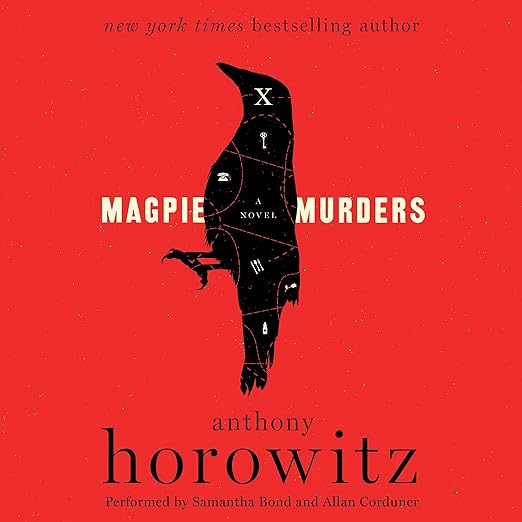
There is a particular pleasure in a book that is genuinely doing something different with a genre it clearly loves. I listened to Magpie Murders over the course of four evenings in early spring, pausing twice to explain the book’s structure to my partner, who kept walking into the room and asking why I was listening to what appeared to be an Agatha Christie novel. The explanation, that this is a contemporary mystery about an editor who begins to suspect that a golden-age crime novel she is proofreading contains hidden evidence of a real murder, produced exactly the skeptical look it deserves. And yet it works, almost completely.
Anthony Horowitz has made a career of writing official continuations of classic detective fiction, James Bond, Sherlock Holmes, so the decision to write a book partly in the style of Agatha Christie’s most canonical territory was a natural extension of that sensibility. What elevates Magpie Murders beyond pastiche is the second layer: editor Susan Ryeland’s investigation into the real-world motives and deaths surrounding her author Alan Conway, the creator of Atticus Pund. Horowitz is using the form of the classic detective novel to examine the form itself, the reader’s appetite for pattern and resolution, the complicated relationship between a series writer and the character who has consumed their career, the jealousies and ambitions that circulate around commercial literary success.
Our Take on Magpie Murders
The structural gambit is the book’s central achievement. You are reading Conway’s Pund novel as Susan reads it, which means you are simultaneously trying to solve the fictional murder in the manuscript and gathering clues about the real-world crime that Conway may have embedded in the text. One reviewer accurately described this as getting two novels for the price of one, and both hold up independently. The Pund sections are genuinely satisfying as golden-age pastiche, the sleepy English village, the manor house, the roster of suspicious characters, the elegant explanation. The Ryeland sections have a different texture: more procedural, more contemporary, and, some readers argue, slightly less propulsive. But together they create a feedback loop that keeps the question of what is real and what is fiction productively unstable right up to the ending.
Horowitz also has something to say about what it means to be trapped by a character’s success. Conway’s complicated feelings about Atticus Pund, the public demand for the series he has come to resent, the question of how far an author’s creative desperation can go, these themes connect Horowitz’s book to the Conan Doyle and Christie precedents directly, and add a dimension that readers willing to engage with the meta-fictional layer will find genuinely interesting. It is never labored; it is woven into the plot mechanics.
Why Listen to Magpie Murders
Samantha Bond is a primary reason to choose the audio version over the page. Her voice has the right quality of English authority that the Pund sections require, a mode that could easily slide into self-parody but in her hands stays grounded in genuine period feeling. She also differentiates the contemporary Ryeland material without making it feel like a jarring tonal break. The two fictional registers coexist in her narration with a naturalness that suggests she understood what Horowitz was doing with the structure and made choices accordingly.
At nearly 16 hours, the audio experience requires genuine commitment, but the length serves the double-narrative architecture. You need space to inhabit Conway’s fictional village fully enough that the real-world resonances can register, and the audio format’s immersive quality suits that requirement better than the fragmented reading experience of a busy week with a physical book.
What to Watch For in Magpie Murders
One reviewer who appreciated the first layer considerably more than the second makes a fair point: the Ryeland investigation, while competent and well-plotted, operates with slightly looser grip than the interior Pund mystery. Susan is an editor rather than a trained investigator, and Horowitz renders that distinction accurately, her detective work is more intuitive and less procedurally elegant than Pund’s. If you find the contemporary framing story less gripping than the pastiche chapters, that gap in register is intentional. Whether it works for you depends on how much you enjoy watching an amateur work through a real-life crime using the same pattern-recognition skills she applies to fiction.
The ending also requires careful listening. There are clues planted earlier in both narrative layers that will reward re-listening, and at least one reviewer reported needing to pause and trace back through the text once the final revelation landed. In audio form, that means you will want to stay genuinely attentive in the closing hours rather than drifting into passive listening mode.
Who Should Listen to Magpie Murders
Mystery readers who love Agatha Christie and the golden-age canon will find the Pund sections deeply satisfying as homage. Readers who also enjoy fiction that engages with the mechanics and culture of publishing, or with questions about how genre shapes reader expectation, will get the full layered experience Horowitz is building. The book is not well suited to listeners who prefer their mystery plots direct and uninterrupted, the switching between fictional frames requires tolerance for structural complexity. But for readers who enjoy the puzzle-box experience of being asked to solve two crimes simultaneously, Magpie Murders delivers that experience with genuine craft.
Frequently Asked Questions
Do you need to be familiar with Agatha Christie’s work to appreciate the Atticus Pund sections of Magpie Murders?
Familiarity helps but is not strictly required. The golden-age pastiche is self-contained enough to work on its own terms, but listeners who know Christie’s Hercule Poirot stories well will recognize the specific conventions Horowitz is drawing on and find the homage more nuanced.
Is the book-within-a-book structure confusing to follow in audio format, or does the narration make the two layers clear?
Samantha Bond’s narration handles the transitions clearly. The shift between the contemporary Ryeland framing story and the 1950s Pund manuscript is marked enough that listeners should not lose track of which layer they are in, though attentive listening is genuinely required in the book’s final hours.
Some reviewers find the Susan Ryeland sections less compelling than the Pund mystery, is the contemporary framing story strong enough on its own?
It is a legitimate observation. The Ryeland investigation operates with a more realistic, amateur-detective logic that lacks the formal elegance of the Pund chapters. Most readers find the contrast intentional and thematically productive; those who prefer procedural precision throughout may find the framing sections slightly looser than they’d like.
Is this book part of a series, and does it end on a cliffhanger or resolve fully?
Magpie Murders is the first in the Susan Ryeland series, and it resolves both the Pund mystery and the contemporary crime fully. There is no cliffhanger, though the ending does establish enough about Ryeland as a character to set up the subsequent books in the series.