Quick Take
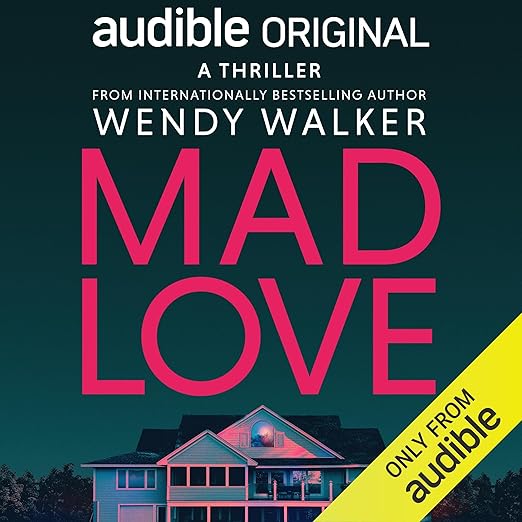
- Narration: Julia Whelan leads a full cast in this Audible Original, and the production’s spatial audio design adds genuine atmosphere to the domestic thriller format.
- Themes: Secrets within a seemingly perfect marriage, the danger of what neighbors choose not to see, family loyalty tested by criminal complicity
- Mood: Compact and propulsive, with a soap-opera intensity that suits the short runtime
- Verdict: A well-produced Audible Original that works better as a listening experience than it might on the page, with a twist-driven plot that earns its final revelations.
Mad Love arrived in my queue on a morning when I had exactly four hours to fill between a canceled appointment and my next commitment. I started it expecting to get halfway through and return to it later. I did not return to it later because I did not stop. At four hours and eleven minutes, this Audible Original is designed for exactly that kind of session, and Wendy Walker and her production team have calibrated it precisely for the format.
The setup is efficient and deliberately familiar. Gin Talcott and Adam Archer are the perfect couple in South River, the kind of town where perfection is both aspiration and performance. When both are found shot in their bed, Adam dead and Gin clinging to life, the investigation peels back a marriage that looked nothing like its surface. Detectives Greta Jessup and Finn Pate drive the procedural strand, with Greta carrying the additional complication of a personal history with Gin’s first husband Eddie and a determination to protect his 18-year-old twins. Piper discovered the bodies. Daniel is missing, along with Adam’s gun. The production’s Dolby Atmos mix, available to Audible subscribers, places dialogue in genuine spatial relationship to each other in ways that standard stereo audiobooks do not attempt.
Our Take on Mad Love
What Walker does shrewdly is layer the perspectives. The most structurally interesting element is the letter Gin left with estate attorney Sarah Branford two days before the shooting, a device that allows Gin’s voice to narrate her own situation with a retrospective clarity that the present-tense investigation deliberately withholds. It is a familiar thriller mechanism, but it works here because Walker uses it to build genuine sympathy for Gin before the more complicated revelations arrive. The character of Adam is constructed to be loathed, and one reviewer noted that he had them thinking about how many real people like him exist in the world. That unsettled quality is what elevates Mad Love above pure puzzle plotting.
Why Listen to Mad Love
The full cast production is the primary argument for the audio format here. Julia Whelan leads, and her narration carries the investigative thread with the composed authority she brings to most of her thriller work. The supporting voice cast differentiates characters who might blur together in a single-narrator version, particularly the siblings Piper and Daniel, whose very different ways of withholding information are made distinct by casting. The Dolby Atmos production places the listener inside spaces, the crime scene, the attorney’s office, the tense family dinner, in ways that the thriller genre rarely bothers with. A reviewer noted feeling like they were listening to a movie. That is an accurate description of the production’s ambition, and it largely succeeds.
What to Watch For in Mad Love
The twist mechanics in this novel operate on a compressed timeline, which means the reveals arrive faster than in Walker’s longer work. Pay attention to the aunt Ruth Talcott early. She is introduced as a peripheral figure and her function in the plot depends on an accumulation of small details that could easily register as atmospheric texture before they snap into focus. Also worth noting: at four hours, the characterization is necessarily economical. The detectives are types rather than fully realized people, and listeners who prefer procedural depth over pace may find the secondary characters thin. The central focus is Gin and Adam’s marriage, and everything else serves that strand efficiently rather than expansively.
Who Should Listen to Mad Love
Listeners who enjoyed Liane Moriarty’s Big Little Lies for its domestic-violence-behind-perfect-surfaces structure will recognize the template here and find Walker’s execution satisfying within its shorter scope. This is an excellent choice for a single listening session, a long drive, an afternoon walk, or a travel day where something self-contained is preferable to a commitment. Those who prioritize psychological depth and complex characters over plotting and atmosphere will find the short runtime constraining. Readers of Wendy Walker’s longer novels like Emma in the Night should adjust their expectations: Mad Love operates in a more concentrated register, but it is very good at what it does.
Frequently Asked Questions
Is Mad Love available in formats other than audio, or is it exclusively an Audible Original?
Mad Love is an Audible Original, meaning it was produced specifically for audio and is not available as a print or ebook. The full cast production and Dolby Atmos sound design are integral to the work rather than adaptations of an existing text.
How does Julia Whelan’s performance compare to her work on other thriller audiobooks?
Whelan is one of the most reliable narrators working in the thriller space, and Mad Love gives her more to do than a standard single-narrator recording. Her role here is more conductor than sole voice, and she brings the same composed authority to the investigative thread that characterizes her best work.
Does Mad Love require any familiarity with Wendy Walker’s other novels?
No. Mad Love is a complete standalone that does not share characters or continuity with Walker’s other books. It is a good introduction to her style in a condensed format.
Is the killer’s identity genuinely surprising, or is it guessable early?
Reviewer responses vary. Some found the resolution unexpected; others noted that careful attention to the characters’ early behavior made the reveal feel foreseeable in retrospect. The story is constructed to sustain plausible suspicion across multiple characters, which is the correct approach regardless of whether the final answer surprises you.