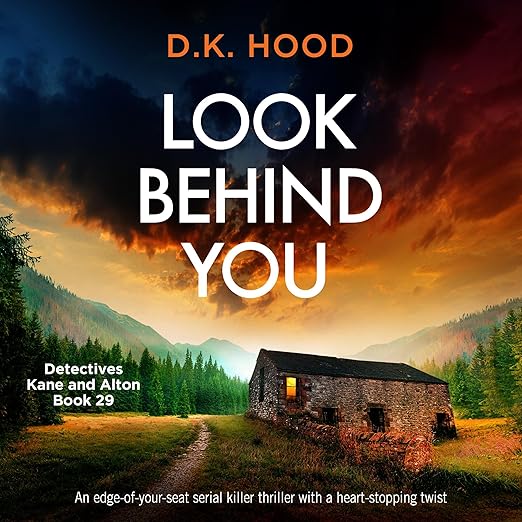
By the twenty-ninth entry in the Detectives Kane and Alton series, D.K. Hood has built a fictional world so familiar that Black Rock Falls feels like a place you could navigate without a map. Look Behind You is an audiobook that uses that familiarity as a structural weapon. The town feels safe because we know it. Hood then systematically dismantles that safety by placing the killer inside the community rather than arriving from outside it. Patricia Rodriguez's narration locks in early and does not let go for seven hours and eleven minutes.
Self-Defense Students Targeted From Inside Jenna's Circle
The setup in Look Behind You is deliberately unsettling in its logic. A group of women are taking self-defense classes together - precisely the kind of community resource meant to make women safer - and they are being killed one by one. The first victim, Jan Pierce, is found at the bottom of a ravine with bruising in the shape of a boot on her back; someone pushed her deliberately, and the staging mimics an accident. The second, Sierra Lang, is found submerged in her bathtub with signs of struggle but no forced entry, meaning she let the killer in. The pattern Hood constructs is methodical: this is not impulsive violence but predatory patience.
Sheriff Jenna Alton's investigation proceeds with the procedural competence that defines this series, but Look Behind You raises the stakes in a specific way. The trail eventually leads to someone Jenna knows, someone inside her own professional circle. Hood has always been willing to implicate the people around Jenna - Kane, her deputies, her community - but book twenty-nine makes that vulnerability feel genuinely personal rather than formulaic. One reviewer describes being shocked alongside Jenna, which is the intended effect and Hood delivers it.
Rodriguez Voices the Fear of Misplaced Trust
The Kane and Alton series works in audio in part because Hood writes with enough scene-setting detail to build atmosphere without the visual support of print, and Patricia Rodriguez is skilled at making that atmosphere audible. The forest sequences, the isolation of Black Rock Falls, the specific quality of fear that comes from realizing someone you trust may not be trustworthy - Rodriguez calibrates her delivery to each of these registers without overplaying any of them. The flooding rain that closes sections of the investigation, mentioned by at least one reviewer as a genuine plot complication rather than mere backdrop, also comes through vividly in audio.
Hood is a USA Today and Wall Street Journal bestselling author with a large and loyal readership, and reviewers of book twenty-nine note specifically that the series shows no signs of the fatigue that afflicts long-running procedural franchises. One reviewer writes that they do not know how Hood writes so fast but are extremely grateful she does - a sentiment that reflects genuine affection rather than uncritical enthusiasm. At seven hours and eleven minutes, Look Behind You is on the shorter end for the series, which some listeners will appreciate as pace, though it does mean some investigative threads resolve more quickly than in longer entries.
Victims Given Weight in a Standalone-Friendly Series
Hood distributes attention carefully between the victims and the investigation rather than focusing purely on Jenna's process. The victims' lives - their friendships, their fears, the signs they may have noticed and not acted on - get enough space to make them people rather than plot functions. This is one of Hood's consistent strengths and it is fully on display here. The question of whether someone known to the whole self-defense group could be responsible creates a specific kind of suspense different from stranger-threat thrillers: it is the suspicion of everyone, the way safety dissolves not through dramatic intrusion but through the slow corrosion of trust.
Listeners new to the series can join here - Hood explicitly notes that each Kane and Alton book can be enjoyed as a standalone - though long-term fans will get additional resonance from the accumulated weight of Jenna and Kane's relationship and the professional dynamics within her team. The twist that reviewers reference without naming is genuinely surprising and does not feel manufactured; it grows from character logic that Hood has been building across the series.
For new listeners wondering about the format commitment: each Kane and Alton book averages around seven to nine hours. The series is long and the reading investment is significant if you want to catch up, but Hood writes each volume to be accessible without that history, and Look Behind You is structured to be as self-explanatory as any entry in a long-running procedural can be. The Black Rock Falls setting, Jenna's role as sheriff, and Kane's role as her deputy are all established within the first two chapters for listeners arriving without prior context.
Familiar Ground for Long-Time Procedural Fans
Readers who enjoy Lisa Regan's Josie Quinn series, Melinda Leigh, or Mary Stone's procedurals will feel immediately at home here. Long-running series fans who worry about quality decline at book twenty-nine will be reassured by the consistency Look Behind You maintains. Listeners who are new to the series and want a procedural thriller with a strong female detective, a small-town setting with genuine menace, and a mystery that holds its solution past the obvious suspects will find this a reliable entry point. Those who require graphic violence rather than psychological suspense should know Hood's emphasis falls primarily on the latter.
The high rating - 4.9 from thirteen reviews - is a strong signal for a book with limited review volume. That rating reflects readers who are specifically invested in the series rather than casual browsers, which means the signal is reliable. Hood's readers do not give five stars by default; they give them when a book earns it by delivering what the series has trained them to expect and then finding a new angle within those expectations. Look Behind You earns its rating by doing exactly that: serving the series' conventions while finding a premise - the self-defense group as target - that gives the procedural fresh energy at entry twenty-nine.
How does Patricia Rodriguez's narration handle the large cast of characters across this audiobook?
Rodriguez differentiates characters through voice and pacing rather than exaggerated characterization, which suits the procedural tone well. She handles Jenna's professional authority and emotional responses distinctly from Kane and the supporting deputies, making it easy to follow conversations without visual dialogue tags.
At 29 books in, does this audiobook feel repetitive compared to earlier entries in the series?
Reviewer responses suggest no. The self-defense class setup gives Look Behind You a specific premise that distinguishes it, and the direction of the investigation toward someone inside Jenna's circle adds a dimension that long-term fans describe as both surprising and satisfying. Hood consistently finds new angles within the series' established parameters.