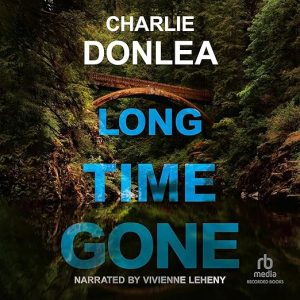
A DNA test taken for a class assignment turns out to be the worst thing that ever happened to Dr. Sloan Hastings, and Charlie Donlea gets that engine running inside the opening stretch of this audiobook. Sloan uploads her genetic profile to an online genealogy site to understand what such sites actually hold. She is adopted, mentions the reservation, proceeds anyway, and learns her profile matches Charlotte Margolis, the infant who vanished with her parents in July 1995 and held the nation's attention while nobody was ever found.
Nine hours and nineteen minutes later, the thing I kept thinking about was not the twist but the job. Sloan is a forensic pathology fellow training under Dr. Livia Cutty, and the book keeps her professional competence in play rather than reducing her to a woman with a past. Thrillers usually hand a heroine an occupation and then forget about it the moment the plot starts moving. Reviewer 2LZ names that as a genuine pleasure, listing "a glimpse into a medical examiner fellowship" alongside the DNA genealogy as what made the novel work.
A Closer Look at Long Time Gone
Cedar Creek, Nevada is where the book gets its grip. Sloan goes looking for relatives and finds a family whose influence saturates Harrison County, initially welcoming and, as the description puts it, mysterious and tight-lipped. Sheriff Eric Stamos has his own stake, since his father died suspiciously soon after starting to investigate the disappearance. Two people with separate wounds investigating the same silence is an efficient structure, and Donlea does not waste it. Nevada in a stifling summer supplies the weather as well, and heat is a useful device in crime fiction because it makes everybody plausibly short-tempered.
Twists land, on the evidence of everyone here. Denise Lydon reports "surprising twists...my mouth dropped open several times", Gem's Girl praises the "great ending", and an anonymous five-star reviewer calls it "the perfect thriller". Even the pool's declared skeptic came around partway. Phil, Julia and Veronica open by saying they have "never found murder mysteries to be anything more than" a reasonably good read at best, then concede the premise was interesting and the pacing good. That is the shape of a book doing its job on someone who arrived braced against it, and it did much the same to me. Nobody in this group complains about the ending either, which in a twist-dependent thriller is the single most important thing to establish before buying.
What Makes Long Time Gone Worth Hearing
Chapter architecture is the strongest structural argument for the audio, and two readers noticed it independently without being asked about format. 2LZ found "the length of the chapters was just right, making for a quick and enjoyable read", and Gem's Girl lists "chapter format" among the things enjoyed, right beside style and ending. Short chapters are worth more in audio than on the page. They give a commuting listener natural exit points and keep a nine-hour thriller feeling like progress rather than endurance.
One reviewer here did listen, and the method is instructive. 2LZ describes immersion reading the novel, following the text and the recording at the same time, and recommends the experience outright. Immersion reading is also a signal about density, since readers generally reach for it when they suspect a book carries detail they would otherwise let slide past. Vivienne Leheny performs the audio edition, and what the material asks of a reader is visible from the premise alone: a clinical forensic register that has to hold steady through postmortem detail and crack open when the case turns out to be Sloan's own family.
Donlea's storytelling gets separate credit from his plotting, which is worth noting in a genre where the two usually get conflated. Gem's Girl calls him "a brilliant story teller in his writing", and Denise Lydon opens with "Well-written and immediately engaging". Nobody here is praising the twist while apologizing for the prose, which happens more often than thriller readers like to admit.
Things to Know Before Starting Long Time Gone
Manage your expectations about weight. Phil, Julia and Veronica place it as "a fun beach or travel read", using Tana French as their benchmark for the literary end of the genre, and that positioning feels right. This is a propulsive commercial thriller rather than a slow character study, and listeners who want prose to linger over should adjust. The same review begins a caution about a key piece of evidence before the text breaks off, so I cannot tell you where that objection was heading.
Ratings here rest on a thinner base than they look. Just thirteen scores support that 4.5, which for a novelist the publisher bills as a number one international bestseller is a small sample rather than a consensus. Written responses cluster oddly too: three of the five arrived inside a single month in January 2026, well over a year and a half after the May 2024 release. That pattern reads like a later discovery wave rather than a launch, which is encouraging about word of mouth and tells you nothing about quality.
Squeamish listeners need one content note. Sloan's training is in forensic pathology and the book puts it to work, so anatomical and postmortem detail comes with the territory. Listeners sensitive to that material should also know a missing infant sits at the center of the case, which the description makes plain but which lands differently when spoken aloud.
Who Charlie Donlea Is Writing For
Listeners drawn to genetic genealogy cases have an obvious match, and the premise is executed with more procedural credibility than the subject usually gets. Commuters are the other natural audience, given the chapter lengths two readers singled out and a runtime that spreads neatly across an ordinary week of driving without ever going slack. Anyone who enjoys a competent professional heroine solving a case that happens to be her own will find Sloan good company, and the forensic material gives her something to do besides being pursued.
Steer away if you want literary crime with slow atmosphere, because the most demanding reader here filed it under travel reading and meant it kindly. Avoid it if autopsy detail unsettles you, or if missing-child plots are a hard limit. And treat that 4.5 average as provisional rather than settled, since thirteen scores cannot carry the weight a four-figure count would. Listeners who find adoption-reveal plots wearing should note the premise turns on precisely that, disclosed up front in the description rather than saved as a surprise.
A Few Questions About Long Time Gone
Does the audiobook work well for commuting?
Unusually well, and two readers point at the reason without being asked. Both single out the chapter format, one saying the lengths felt exactly right. Frequent breaks give a driver natural places to stop, and a nine hour listen spreads across an ordinary working week without the thread going slack between sessions.
Is a 4.5 average from thirteen ratings reliable here?
Treat it as provisional rather than settled. Thirteen scores is a thin foundation for any novel, let alone one from a bestselling name, and a handful of extra listeners could move that figure noticeably in either direction. The written feedback is more useful than the number, though it arrived in an odd late cluster nearly two years past release.
Did anyone in this pool actually listen to the audiobook?
One reader did, and in a specific way. 2LZ describes immersion reading this audiobook, running the text and Vivienne Leheny's recording together, and recommends the method outright. Endorsing the format that specifically is worth more than a general recommendation, and it hints at a novel dense enough in forensic and genealogical detail to reward following both at once.