Quick Take
- Narration: Maxwell Glick commits fully to the absurdist comedy without winking at the audience, giving Haruka a dry, bewildered register that sustains the book’s central joke.
- Themes: Isekai genre parody, social alienation played for comedy, competence made invisible by unconventional presentation
- Mood: Dry and relentlessly self-aware, the humor of someone who finds everyone around them baffling
- Verdict: A genuinely funny isekai parody that works best for genre-literate listeners, with a protagonist whose social strangeness is played as authentic characterization rather than romantic fantasy.
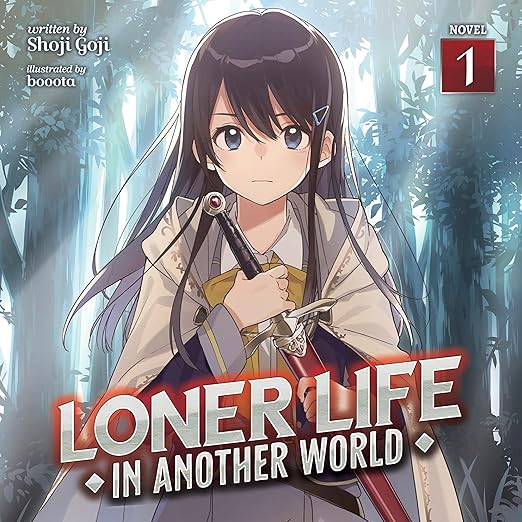
I came to Loner Life in Another World Vol. 1 with fairly specific expectations calibrated by years of isekai light novels, a genre I follow with the resigned affection you develop for something that reliably delivers what it promises while rarely transcending its own conventions. What I did not expect was the degree to which the author uses the genre’s well-worn premise to mount a sustained parody of it. This is not an isekai that takes its own tropes seriously. It is an isekai that finds those tropes absurd and is delighted to say so at every available opportunity.
The premise is established with admirable economy: when Haruka’s class is transported to another world, the magic skill distribution sequence leaves him at the back of the line. By the time it is his turn, all the powerful abilities are gone, and he is forced to assemble something useful from an odd collection of leftovers. In most isekai, this would be a setup for a hidden overpowered ability that emerges later. Here, the setup is primarily a joke, and the joke is on anyone who expected the standard resolution. Maxwell Glick narrates with an energy that honors the absurdist tone without tipping into self-parody.
Haruka as an Anti-Protagonist
Haruka’s defining quality is not his skill set but his relationship to social connection. He is a genuine loner, not in the romanticized sense that isekai often assigns to misunderstood protagonists who secretly crave belonging, but in the more functionally accurate sense that he finds other people’s behavior genuinely difficult to predict and often baffling. His inability or refusal to remember anyone’s name is a running feature of the book that one reviewer identified as actually reflecting her own real-world tendency, which suggests the characterization has landed as authentically odd rather than merely conveniently plot-useful.
The ADHD-adjacent internal logic that reviewer CRM identified in Haruka is what makes him interesting rather than irritating. He makes deductions that are genuinely impressive from oblique angles, arrives at correct conclusions through chains of reasoning that are technically sound even when they look ridiculous from outside, and then watches other characters fail to register what he has demonstrated. That pattern of competence made invisible by unconventional presentation is both a comedy engine and a surprisingly accurate portrait of a particular kind of social alienation that the isekai genre typically romanticizes rather than examines honestly.
The Isekai Genre as Target
The book’s funniest material comes from its relationship with isekai conventions. The classmate distribution of magical powers, with its clear favorites and obvious left-behinds, is presented as the rigged system it clearly would be in practice if anyone thought about it for more than a moment. The infighting and chaos that break out among Haruka’s classmates shortly after their arrival is less a dramatic escalation than a realistic observation about what would actually happen if a group of teenagers with suddenly unequal power found themselves in a new world without established social structures to constrain them or incentivize cooperation.
Reviewer clay hunter noted that everyone is completely oblivious to Haruka’s actual capabilities even after watching him demonstrate them, which is both funny and slightly repetitive. That is a fair criticism of the book’s principal comic mechanism: it works well as an engine but can feel like it is cycling through the same gear across the full runtime. The series apparently improves with each installment, as reviewer james buchanan noted that each book gets better, which suggests the author finds ways to develop the premise meaningfully beyond its initial setup once the foundational humor has been fully established.
Maxwell Glick and the Voice of Absurdism
Narrating absurdist comedy requires a specific quality: the narrator must commit completely to the material without winking at the audience. Maxwell Glick manages this well throughout. His Haruka is dry without being affectless, bewildered by other people without being condescending toward them, and capable of the kind of delivery that makes an impeccably logical non-sequitur land as comedy rather than confusion. At exactly 12 hours, the audiobook is well paced for a first volume that needs to establish a world, a protagonist, and a comic sensibility simultaneously. Glick sustains consistent energy across the full runtime without the material feeling stretched or the jokes losing their timing as the book progresses.
Translation, Series Potential, and Who Should Listen
The translation quality across the audiobook is generally good, though some idiom choices reveal the seams between the source language and the English rendering. Reviewer CRM’s note about the poster girl translation is a minor example of the kind of thing that isekai readers following Japanese-language versions will notice and general listeners will not. These moments do not disrupt the narrative and are perhaps inevitable given how culturally embedded some of the source material’s humor is. What comes through clearly enough to work regardless of translation is Haruka’s fundamental strangeness and the series’ affectionate mockery of the genre it inhabits.
Readers who are already familiar with isekai conventions will get the most from this book, because the jokes are funnier the more clearly you recognize what they are subverting. That said, the book works well enough as a standalone comedy even without genre familiarity. At 4.5 stars across 944 ratings, it has found its audience among readers who appreciate what it is doing. The first volume is primarily an establishment exercise, and those who find the comedy mechanism clicking will want to continue with the series to see how the author develops it across subsequent installments.
Frequently Asked Questions
Do I need to be familiar with isekai light novels to find this funny?
Genre familiarity makes the parody significantly funnier because you recognize what is being subverted. That said, the book works as a dry comedy of social alienation even without isekai context, and the core humor of Haruka being competent in ways nobody notices transfers without genre knowledge.
Is this a standalone or do I need to commit to the full series to get a satisfying story?
Volume 1 functions as a complete establishment of premise and protagonist rather than delivering a contained plot arc. The series reportedly improves with each installment. Readers looking for full narrative resolution within a single volume may feel the first book is more of an extended introduction.
How significant is the translation quality issue that reviewer CRM noted?
Minor idiom choices occasionally reveal the seams between the Japanese source and English rendering, but these do not disrupt the narrative. The core humor and characterization come through clearly. Listeners unfamiliar with Japanese light novel idiom will likely not notice the moments that stand out to genre veterans.
Is Haruka’s refusal to remember names genuinely funny throughout, or does it become repetitive?
Reviewer clay hunter noted that the obliviousness to Haruka’s capabilities does get repetitive, and the same applies to the name-forgetting gag. The comedy mechanism is consistent but relies on the same gear across the full runtime. Those who find it click within the first few chapters will find it sustainable; those who do not will find it wearing.