Quick Take
- Narration: Joel Leslie is exceptionally well-cast here. His ability to sustain two distinct first-person voices across nearly ten hours without collapsing the alternating structure is the technical achievement that holds the whole novel together.
- Themes: Trauma hidden behind performance, the particular loneliness of adolescence, mental health and the courage of being known
- Mood: Emotionally intense and occasionally heavy, with genuine warmth underneath
- Verdict: A YA LGBTQ novel that takes its characters’ damage seriously and earns its emotional climaxes through consistent psychological specificity rather than melodrama.
I listened to the final ninety minutes of Lock and West on a Sunday morning when I had nowhere to be, which was probably the right circumstance for it. The book had been building for hours toward something I could feel coming but could not precisely locate, and when it arrived I was genuinely moved in the way that good YA fiction can move adult readers, not despite the adolescent stakes but because of them. Alexander C. Eberhart is writing about things that happen to sixteen-year-olds, but he is not writing about them as if they are small things. They are not.
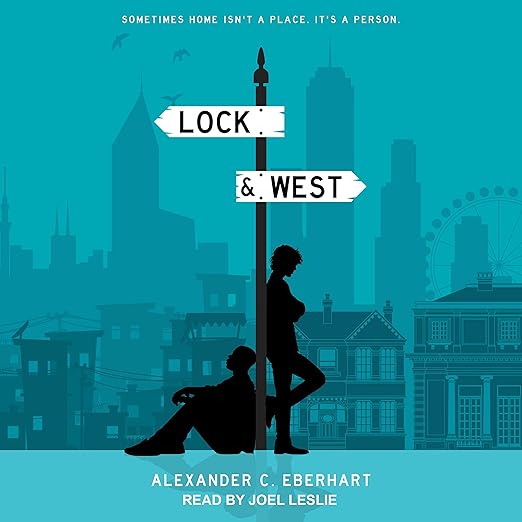
Lock is Lachlan, newly arrived at an Atlanta high school after being homeschooled most of his life. He counts when he is nervous. He cannot make easy eye contact. He has rehearsed instructions for how normal teenagers behave and follows them with the concentration of someone who knows the rules of a game they did not grow up playing. West is Westley, who has everything: looks, talent, money, and a pain buried so deep that the synopsis describes a million therapists as inadequate to unearth it. The novel’s opening conceit, that these two people should not fit, is the engine of everything that follows.
What the Alternating POV Makes Possible
The decision to tell the story in alternating first person from both Lock and West is not just a structural choice. It is an ethical one. In a novel this invested in the inner lives of two characters carrying serious psychological weight, giving both of them full interiority is the only approach that respects what they are going through. Eberhart handles the alternation with considerable skill. Lock’s voice is careful and precise, organized around the management of anxiety. West’s voice is fluid and social, organized around the performance of a self he has constructed to avoid being found. One reviewer noted that this contrast makes the dual-narrator approach earn its complexity rather than simply justify it.
Joel Leslie’s narration is essential to this working as an audiobook. Sustaining two distinct first-person voices across nearly ten hours without either becoming a parody of itself or blurring into the other is genuinely difficult, and Leslie does it with consistency and intelligence. His Lock is measured and slightly tentative. His West is warmer but always with a layer underneath that signals the concealment. A reviewer who called this book excellent and felt nothing could have been done better was, I think, responding partly to how well the narration honors that distinction.
The Dark Material and How Eberhart Handles It
Multiple reviewers note that Lock and West confronts heavy subject matter head on: sexual violence, addiction, suicide ideation, eating disorders, abuse. One reviewer described these as important things that often get pushed under the rug, and the book’s approach supports that framing. Eberhart does not use these experiences as plot twists or as shorthand for character damage. They are part of how these specific people became who they are, and the book traces the consequences with the kind of specificity that separates psychological accuracy from genre convention.
The content warnings are real and relevant. A reviewer who experienced the book as an emotional roller coaster, including almost sobbing at certain points, was not exaggerating. This is a heavy listen, and it asks something of the listener that lighter YA does not. The mature themes designation in the product listing is accurate, and parents deciding whether this is appropriate for younger teenagers should know that the darkness is substantial and handled directly rather than implied. That directness is, I would argue, a feature rather than a flaw.
The OCD Representation and Its Specificity
Lock’s characterization as someone with OCD is handled with more specificity than the disorder usually receives in YA fiction. His counting, his behavioral scripts, his exhaustion from constant social calculation, are not framed as quirks or as endearing eccentricities. They are the texture of how he experiences the world, and the novel takes that experience seriously without turning it into the central drama at the expense of everything else. One reviewer described the relationship between the two characters as a love story between a quiet sixteen-year-old with OCD and a bubbly one with hidden problems, noting that mental health is explored and experienced without editorializing. That non-editorial approach is one of the book’s signal achievements, and Joel Leslie’s narration communicates it with the appropriate seriousness.
For Readers Prepared to Meet the Material Where It Lives
Lock and West is aimed at older teenagers and adult readers of YA LGBTQ fiction who want their romance grounded in genuine psychological complexity. The free audiobook version is an accessible way to test the opening chapters, which establish the tone and voice immediately. Listeners who prefer lighter romance with less trauma content should know going in that this is a novel that takes both its darkness and its warmth seriously, and does not resolve one at the expense of the other. For readers who have been looking for a YA novel about two boys with real damage finding their way toward each other with the honesty that requires, this is an impressive and affecting piece of work that stays with you past the ending.
Frequently Asked Questions
Is Lock and West part of a series, or does it stand alone?
It is a standalone novel. The story has a complete arc with resolution, though it does not tie off every thread in a way that forecloses imagination about what comes after.
How does Joel Leslie differentiate between Lock’s and West’s first-person voices across nearly ten hours?
Leslie gives Lock a careful, precise quality organized around social management, while West’s voice is warmer and more fluid but with a consistent undercurrent of concealment. The distinction holds throughout without either voice feeling exaggerated.
The content warnings mention mature themes. How explicit or graphic is the difficult content?
The difficult material, including references to sexual violence, addiction, self-harm, and suicide, is handled directly rather than euphemistically but without graphic physical detail. The focus is psychological rather than sensational. Reviewers consistently describe it as heavy but not gratuitous.
Is this primarily a romance, or does the mental health content take over the story?
Both elements are genuinely integrated. The romance is central and reaches a satisfying resolution. The mental health content is not a backdrop but is woven into how both characters experience their relationship. Neither takes over at the other’s expense.