Quick Take
- Narration: Lauren Ambrose is exceptional, carrying three distinct teenage voices and the AIDS crisis backdrop with a sensitivity that multiple listeners cited as a reason they sat in parked cars to finish chapters.
- Themes: Queer identity in the shadow of the AIDS crisis, friendship as chosen family, the courage of visibility
- Mood: Heartbreaking and radiant, the way 1989 New York City deserves to be remembered
- Verdict: One of the best YA audiobooks I have encountered in recent years, rooted in specific history and entirely alive to its emotional complexity.
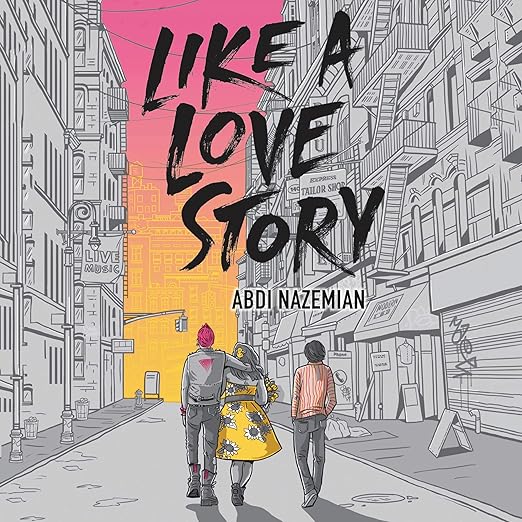
I started Like a Love Story on a Sunday afternoon when I had two hours before a dinner commitment and no particular plan for what to listen to. I did not make it to dinner on time. I sat in my kitchen pretending to prep vegetables while Lauren Ambrose’s voice carried me through 1989 New York, through ACT UP demonstrations, through the terror of a generation watching their community disappear, and through three teenagers navigating who they were in the middle of all of it. The vegetables went uncut for a while.
Abdi Nazemian’s novel is a Stonewall Honor Book and a Time Magazine Best YA Book of All Time, distinctions that sometimes function as credentials to be checked and then set aside. In this case they point toward something real. The book is doing something that most YA fiction about the AIDS crisis either avoids or simplifies: it takes seriously what it felt like to be young and gay in 1989, when everything you knew about gay life was mediated through images of men dying, and it does this through three very different young people who share a single devastating historical moment.
Three Voices, One Year, One City
Reza is an Iranian immigrant who has just moved to New York with his mother and stepfather. He is gay and terrified, not just of discovery but of what being gay means in the only images available to him. Judy is his girlfriend, a fashion-obsessed aspiring designer who worships her uncle Stephen, a gay man with AIDS who is an active ACT UP member. Art is Judy’s best friend, the only out student in their school, whose photography documents the crisis as a form of witness and activism.
The narrative rotates among these three perspectives, and Nazemian handles the rotation without losing the specific texture of each voice. Reza’s sections carry the particular claustrophobia of a teenager performing a self he cannot sustain. Art’s carry the loneliness of visibility without community. Judy’s carry the grief of watching someone she loves navigate a world that treats his life as disposable. Each is fully imagined. None is a symbol rather than a person.
The AIDS Crisis as Historical Specificity, Not Backdrop
What elevates Like a Love Story above other YA treatments of LGBTQ history is the specificity with which Nazemian engages the AIDS crisis. Uncle Stephen is not a symbol of loss. He is a specific man with a specific history of activism, specific pharmaceutical frustrations, specific friendships. ACT UP is not a backdrop. It is a living organization with tactics, arguments, and internal tensions. One reviewer who lived through this period described the book as bringing them back to how it actually felt, the combination of grief, rage, and the radical decision to keep being visible anyway.
The decision to set the epilogue at the Pulse nightclub is one I was not prepared for, and I will not describe it in detail here. What I will say is that it is not gratuitous. It is an act of historical linkage that places 1989 and 2016 in direct conversation and refuses to let the book end in a clean emotional resolution that its subject matter doesn’t warrant. It is the kind of artistic decision that divides readers who want YA to leave them with hope and those who want it to leave them with truth. Nazemian attempts both at once.
Lauren Ambrose and Why This Audiobook Is Better Than the Print
Lauren Ambrose’s narration is the rare performance that genuinely adds to the material rather than simply conveying it. She brings granular vocal differentiation to all three protagonists without resorting to affectation or stereotype. Her reading of Art’s photography-as-activism sequences has a particular quality that one reviewer described as making them sit in the car long past their destination to finish chapters. I understand exactly what that reviewer means. Ambrose finds the rhythm in Nazemian’s prose and honors it without pushing. The audiobook version of this story, at ten hours and fifty minutes, is the version I would recommend to any listener.
Who Needs to Listen to This Audiobook
This free audiobook is essential for anyone who was not alive in 1989 and wants to understand what the AIDS crisis felt like from inside a queer teenager’s experience. It is also essential for those who were alive then and want to find that history rendered with accuracy and love. It is appropriate for teenage listeners, despite the weight of its subject matter, and genuinely important for young readers who are currently navigating their own questions of identity and community. The one caveat: come prepared. This is not light listening. But it is the kind of listening that stays with you.
Frequently Asked Questions
Is Like a Love Story appropriate for younger teen listeners given its subject matter?
Yes, with parental awareness of the content. The book deals with the AIDS crisis, queer identity, and grief, but handles all of these with care and without explicit content. It is standard YA in its treatment of these themes.
Does the audiobook require prior knowledge of ACT UP or 1980s AIDS history to be fully appreciated?
No. Nazemian builds the historical context into the narrative through Judy’s uncle Stephen and Art’s photography work. The audiobook is accessible to listeners with no prior knowledge of this history.
Why does Lauren Ambrose’s narration get such strong praise from reviewers?
Ambrose differentiates the three protagonists distinctly without resorting to caricature, and her pacing honors Nazemian’s prose rhythm. Multiple reviewers specifically noted that her performance made them extend listening sessions past their planned stopping points.
Is this a free audiobook, and how does it compare to other LGBTQ YA titles in terms of historical depth?
Yes, it is available as a free audiobook. In terms of historical specificity around the AIDS crisis, it is among the most rigorously researched YA titles in this space, grounded in the specific activism and emotional reality of 1989 New York.