Quick Take
- Narration: Jonathan Todd Ross delivers a warm, unhurried performance that suits the parable-like tone perfectly, grounding emotional beats without overselling them.
- Themes: Purpose and calling, sacrifice vs. practicality, faith and fatherhood
- Mood: Quietly uplifting and contemplative, like a long drive after a hard week
- Verdict: If you respond to sports-as-metaphor storytelling and want something that leaves you thinking about the choices you haven’t made yet, this one delivers.
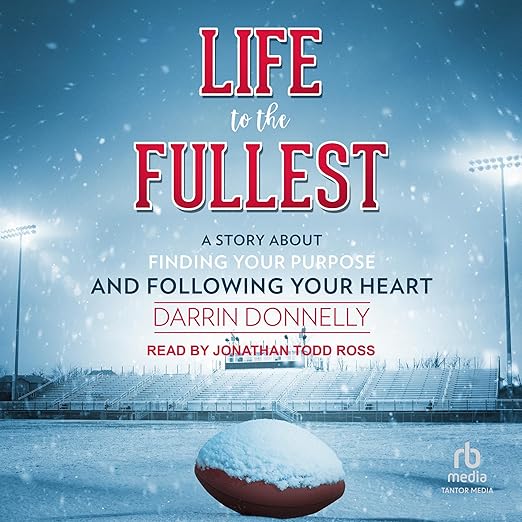
I picked up Life to the Fullest on a Thursday evening when I needed something that wasn’t going to punish me. I was tired of nonfiction that demanded spreadsheets and tired of thrillers that demanded attention I didn’t have. What I wanted was a story that took something I cared about and turned it into a question worth sitting with. Darrin Donnelly’s fourth installment in the Sports for the Soul series did exactly that.
The setup is deceptively simple. High school football coach John Callahan, son of a coaching legend, is days away from the state championship when he learns his school is closing for good. Everything he built, everything he chose over more lucrative paths, is going away. In that raw moment of doubt, his long-dead father appears and gives him a kind of waking vision: a tour of what life might have looked like if he had taken the practical road instead of the purposeful one. It is a structure borrowed from Dickens and Frank Capra, and Donnelly doesn’t pretend otherwise. He uses it cleanly and with conviction.
Our Take on Life to the Fullest
What Donnelly does well, and what the reviews consistently affirm, is make fundamental values feel earned rather than preachy. Reviewer Anthony Cappoferri noted that the book is “replete with real life and real world situations of defeat, setback, and heart-break” and that is accurate. Donnelly does not let John off easily. The alternate-life sequences are not idyllic warnings; they are genuinely tempting, and the book is honest enough to show why the practical path has real appeal. That tension is what keeps the story from becoming a simple morality tale. You feel the weight of the road not taken even as you understand why John’s father believes he chose correctly.
The five-step framework for finding purpose, woven through the narrative rather than bolted onto the end, is the book’s structural gamble. It mostly pays off. Each principle arrives naturally through story events rather than through chapter headings and bullet points, which makes the didactic intent easier to absorb. Occasional moments tip toward the instructional, but they are brief.
Why Listen to Life to the Fullest
Jonathan Todd Ross is a significant reason this audiobook works. His voice carries a relaxed authority that feels appropriate for a story about a man who has made peace with who he is, even as that peace is being tested. He never pushes for emotional effect, which is the right call for material this earnest. Reviewer Cathy Sandler called it a “sweet easy read” and the narration reflects exactly that quality. The pacing is unhurried in a way that invites reflection rather than impatience.
At just under five hours, the runtime is well-calibrated. Donnelly writes in a plain style that Patrick’s review captured well: “core values while entertaining us with easy flowing stories.” That is precisely the mode. There is no literary ambition here beyond clarity and warmth, and the audiobook format amplifies both. It is the kind of listen that works well during a commute or an evening walk when you want company that doesn’t overwhelm.
What to Watch For in Life to the Fullest
Listeners who prefer moral complexity or narrative ambiguity will find the book’s certainties a bit comfortable. The father-son relationship is idealized in ways that feel intentional but occasionally airless. The supporting characters around John, especially the players on his final team, are functional rather than fully drawn. If you come to the series for the football itself, Donnelly is more interested in what the game represents than in the game’s details.
One honest note: the five-step framework is clearly designed to stay with you after the story ends, and some listeners may feel the book tilts toward self-help territory in its final act. That is not a flaw exactly, but it is worth knowing going in. Donnelly is a values writer first and a storyteller second, and the balance shifts accordingly as the book reaches its conclusion.
Who Should Listen to Life to the Fullest
This audiobook is well suited for coaches, parents of athletes, and anyone at a crossroads questioning whether the life they built was the right one. It works particularly well for listeners who already have some relationship with Donnelly’s earlier Sports for the Soul books, though each volume stands alone. It is a natural fit for faith-adjacent readers who want inspiration without sectarianism, and for anyone who finds the parable format more persuasive than prescriptive nonfiction. If you have no patience for stories that wear their lessons openly, this is not your book. But if you can meet earnestness on its own terms, Donnelly earns the genre.
Frequently Asked Questions
Do I need to have read the earlier Sports for the Soul books before listening to Life to the Fullest?
No. Each book in the series features different characters and a self-contained story. Book 4 works as a standalone, though listeners who have read earlier installments will recognize Donnelly’s style and format immediately.
Is this audiobook more fiction or more self-help?
It is primarily a parable-style novel, but a five-step framework for finding purpose is embedded in the narrative. Think of it as a story with instructional intent rather than a self-help guide dressed in narrative clothing.
How does Jonathan Todd Ross handle the father-son dynamic in his narration?
Ross keeps the emotional register warm but restrained. He differentiates the father’s voice with a slightly deeper, more measured tone that works well for the mentor role without becoming theatrical.
Is the football content central to the story, or is it just background?
Football is the setting and the metaphor, but Donnelly focuses almost entirely on what the game means rather than the mechanics of playing it. The state championship game matters emotionally, not tactically.