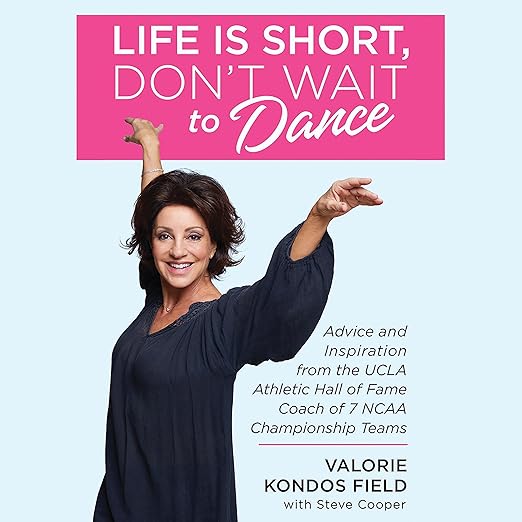
Quick Take
- Narration: Self-narrated by Valorie Kondos Field, and the warmth and humor she brings to her own stories is irreplaceable. You feel the classroom, the gym floor, the hard conversations.
- Themes: Unconventional leadership, athlete wellbeing, authenticity as competitive advantage
- Mood: Warm, candid, and quietly motivating without being preachy
- Verdict: One of the more genuinely useful coaching memoirs you will find in audio form, made better by the fact that the author tells it herself.
I started listening to Life Is Short, Don’t Wait to Dance on a Saturday morning run, expecting a standard sports memoir. About forty minutes in, Valorie Kondos Field, known to her athletes as Miss Val, was describing how she arrived at UCLA as a professional ballerina with zero gymnastics experience and zero coaching credentials, and how she initially responded to that gap by trying to imitate the coaches around her. What made her stop was noticing that it was not working, and more importantly, that it was making her miserable. That pivot, from mimicry to authentic method, is the spine of this entire book.
Miss Val narrates it herself, and that matters. She has an expressive voice and a comedian’s sense of timing. The stories about John Wooden, her longtime mentor, land with real tenderness, and the passages about her breast cancer diagnosis are delivered with the same matter-of-fact courage she seems to apply to everything else in her life. Publishers often err on the side of professional narrators for safety, but this is one of those cases where the self-narration is the right call.
Our Take on Life Is Short, Don’t Wait to Dance
The book’s central argument is that treating your athletes, or your employees, or your students, as full human beings rather than performance machines is not just ethically correct but strategically superior. Miss Val built a UCLA gymnastics program that won seven NCAA championships not by drilling conformity but by choreographing individuality. The results speak clearly enough, but what makes the audiobook worth seven hours of your time is the specificity of the stories she uses to get there.
The sections on Katelyn Ohashi are particularly well-handled. If you know Ohashi only from the floor routine video that reached over a hundred million viewers, hearing Miss Val describe the years of careful, patient rebuilding that made that joy possible reframes the whole thing. Similarly, the chapter on Jamie Dantzscher, who found confidence at UCLA after experiencing prior abuse, is handled with care and avoids sensationalism. These are stories about what sustained support actually looks like, not just inspirational highlights.
Why Listen to Life Is Short, Don’t Wait to Dance
The book was published in 2018, and some of the anecdotes date from the height of the Larry Nassar scandal in gymnastics. Miss Val addresses the situation directly, which gives the book an honesty and moral urgency that purely motivational sports memoirs tend to avoid. She is not just describing what great coaching looks like but making a case for why the alternative, the win-at-any-cost model that enabled Nassar’s abuse, destroys what it claims to build.
One early reviewer, a teacher of junior high students, described taking Miss Val’s tips directly into the classroom. That points to who this book is really for: it is not limited to athletes or coaches. The underlying principles, about curiosity, authenticity, caring for the whole person, and refusing to let a weakness go unaddressed, translate across leadership contexts without much adaptation required.
What to Watch For in Life Is Short, Don’t Wait to Dance
The book’s structure is anecdotal rather than systematic, which works well for the audio format but may frustrate listeners who want a clear step-by-step framework. The philosophy is consistent, but it surfaces through accumulated stories rather than through numbered principles or structured chapters. If you come to it expecting a leadership manual with takeaways at the end of each section, you will need to do some of that synthesis yourself.
The tone is relentlessly positive, which is both a strength and occasionally a limitation. Miss Val frames almost every setback as the setup for a useful lesson, and while that is authentic to her worldview, it can feel slightly curated in moments where a harder or more unresolved perspective might have been more instructive.
Who Should Listen to Life Is Short, Don’t Wait to Dance
This is excellent listening for coaches, teachers, managers, and anyone who has ever tried to lead a team and found that technique alone was not enough. It is also worth recommending to gymnastics fans, particularly those who followed the Nassar trial and want a firsthand perspective from someone inside the sport who built something genuinely different. Readers who dislike the memoir format or prefer data-driven leadership books may find it too personal, but for most listeners it earns its length.
Frequently Asked Questions
Do you need to follow gymnastics to get value from this audiobook?
Not at all. The gymnastics context provides the stories, but the leadership and coaching principles Miss Val draws from them are transferable. Several reviewers describe applying her methods in classrooms, businesses, and parenting situations.
How does Miss Val address the Larry Nassar scandal and the broader gymnastics abuse crisis?
She addresses it directly and with moral clarity. The book was published during the height of the Nassar revelations and Miss Val uses the moment to argue explicitly for a different model of coaching, one centered on athlete wellbeing rather than performance at any cost.
Is the self-narration distracting or difficult to follow?
The opposite. Miss Val has a warm, expressive delivery and a genuine sense of humor that makes the seven hours feel shorter than they are. Reviewers consistently cite the narration as one of the strengths of the audio version specifically.
How much of the book covers Katelyn Ohashi, whose floor routine went viral?
Ohashi is one of several athletes Miss Val profiles in depth, not the sole focus. The section on her covers the years of rebuilding, both athletic and personal, that preceded the viral moment, which gives significant context to what that routine actually represented.