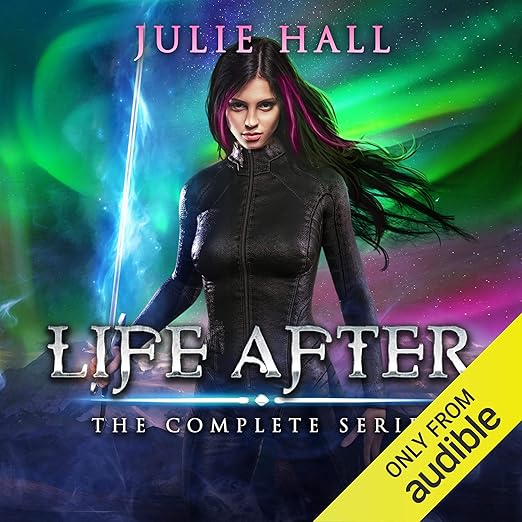
Julie Hall built an entire afterlife bureaucracy for this series, complete with demon hunters, a training academy, and a chain of command that answers, eventually, to a very literal Satan, and this audiobook bundle asks a listener to commit to all thirty-one hours of it at once. Life After: The Complete Series packages all four books in Hall's YA fantasy saga into a single listen, following Audrey Lyons from her disoriented first minutes as an amnesiac afterlife recruit through a sword-wielding endgame that puts her on Lucifer's list of problems. It's a big ask for a first-time listener, four full books with zero breathing room between them, but the box set format also solves the exact problem that plagues most series audiobooks: never wondering which volume to buy next.
Where This One Lands
Audrey Lyons narrates her own afterlife with the kind of self-deprecating humor that makes a premise this strange go down easily. She wakes up dead, memory-wiped, and immediately drafted into demon-hunting duty she never wanted, and Hall leans hard into the comedy of that mismatch before the plot turns serious. The training-academy scenes with Logan carry real romantic tension, sparks that the synopsis itself describes as generated by swords and personalities clashing in equal measure, and the eventual reveal of the most powerful sword in existence gives the series its central stakes without ever losing Audrey's voice as the actual engine of the story. One reviewer calls the series 'not theologically sound' and notes that Hall herself would agree, framing it instead as a conversation starter about what an afterlife bureaucracy might actually look like, which is a fair way to approach a book that borrows liberally from angel-and-demon mythology without pretending to be doctrine.
Vanessa Moyen narrates, and her established range with young, self-aware female protagonists carries over well here. She's previously handled first-person heroines who rationalize their own choices in real time without losing the listener's sympathy, a skill Audrey's afterlife wisecracking depends on just as much as any romance novel's internal monologue does. Moyen keeps Audrey sounding young without sounding naive, which matters across thirty-one hours of a character who starts the series knowing nothing about her new existence and ends it wielding the most dangerous weapon in it.
The emotional register runs deeper than the snark initially suggests, too. One reviewer who devoured the whole box set in what she calls an unusually fast read describes being left frustrated, grinning, and even crying by the end, a meaningful range for a series that opens on jokes about Audrey's reluctance to exercise. Hall clearly earns the shift from comedy to genuine stakes rather than forcing it, letting Audrey's growing competence as a demon hunter carry real emotional weight once the Satan plotline escalates past its initial setup.
What Makes Life After: The Complete Series Worth Hearing
The pitch here is straightforward: readers who go looking for afterlife-set urban fantasy with a reluctant chosen one at its center, and who already love The Mortal Instruments, Buffy the Vampire Slayer, or Supernatural, will recognize the shape of this story within a chapter or two. Hall built a USA Today best-selling series out of that familiar shape, and a 4.6 average across more than 600 ratings suggests the execution lands even for listeners who have sampled a dozen versions of the reluctant-chosen-one setup before. What keeps it from feeling like a retread is Audrey's specific voice, sarcastic, a little lazy about her own physical training, more interested in surviving than in being heroic, which gives Hall room to undercut the genre's usual self-seriousness.
Buying the complete series as one box set instead of four separate purchases also changes the listening experience in a real way. A saga this plot-heavy rewards momentum, and thirty-one hours consumed as one continuous binge means a listener never loses track of which secret Logan is currently keeping or how far Audrey's sword training has actually progressed. For a series that leans on escalating stakes book to book, that continuity is worth more than the discount pricing the product description leads with.
It's also worth noting this was Hall's freshman series, per one reviewer's description, meaning a debut author built this entire afterlife mythology and carried it to USA Today best-seller status and a 4.6 rating across four full books, without an established readership to fall back on. That's a genuinely strong first outing, and it likely explains why the world feels so fully imagined from book one: Hall wasn't holding anything back for a sequel that might never get greenlit.
Points to Consider
Thirty-one hours is a real commitment, and Hall's afterlife mythology is dense enough in the early chapters that a distracted listener could lose track of the hierarchy Audrey is being trained to navigate. The series also plays fast and loose with religious iconography, angels, demons, a very literal Satan as antagonist, in service of entertainment rather than theology, and listeners who want their afterlife fiction to track closely with any specific faith tradition should know upfront that this isn't that kind of book. A companion PDF ships alongside the audio, worth grabbing if the series' internal rulebook of ranks and assignments gets hard to track by ear alone.
Because this is four books compressed into one listen, the pacing inevitably has soft patches, particularly in whichever volume is doing the most worldbuilding groundwork for what comes after. Listeners who prefer a tightly contained single story should adjust expectations: this is serialized fantasy built for accumulation, with romantic tension between Audrey and Logan stretched deliberately across the full run rather than resolved early, and Satan's actual role in the plot escalates gradually enough that early chapters undersell how central he becomes.
Practically speaking, thirty-one hours is not a weekend binge for most listeners; treating the box set as a multi-week listen, roughly the pace of a prestige television season, is a more realistic approach than powering through all four books back to back. Chapter breaks between the four component novels work well as natural stopping points, which helps the density of the early training-academy chapters land without feeling rushed.
Should You Listen to Life After: The Complete Series?
Teen and adult fans of YA urban fantasy who want a big, binge-ready commitment are the clearest audience, especially anyone who already has Cassandra Clare or the Buffy universe on their shelf and wants a new mythology to sink thirty-plus hours into. Listeners drawn to reluctant-hero training-academy stories, with a slow-burn romance running underneath the demon-hunting plot, will find exactly what the synopsis promises, and Moyen's narration makes Audrey's voice easy to spend that much time with.
Skip this one if a single, self-contained story is what you're after, or if loose, non-doctrinal treatment of angels, demons, and the afterlife isn't something you want to spend thirty-one hours inside. Readers who prefer a slower, more literary pace over plot-forward genre fiction should also look elsewhere, since Hall's series is built for momentum and cliffhangers rather than introspection.
Common Questions
Does this audiobook include all four books in the Life After series?
Yes, this is the complete box set, bundling all four novels into a single continuous listen of just over thirty-one hours, narrated by Vanessa Moyen throughout.
Is Life After appropriate for younger teen listeners given its afterlife and demon-hunting content?
The series treats angels, demons, and a literal Satan character loosely and for entertainment rather than doctrine, and its violence stays in the swashbuckling, sword-fighting register typical of YA urban fantasy rather than graphic horror.
Do I need to experience the individual Life After books in this audiobook bundle in order?
Yes, the four books tell one continuous story and should be experienced in sequence, and this box set format makes that easy since no separate purchase is needed between installments.