Quick Take
- Narration: Robert Petkoff is the definitive voice for Lucas Davenport and brings the same reliability to Lethal Prey that he has across the Prey series, handling both the police procedural beats and the character interplay with ease.
- Themes: Cold cases and the distortion of memory, crowdsourced justice, the killer hiding in the open
- Mood: Taut and methodical, with unexpected structural provocations at the end
- Verdict: A strong entry in an established series with a genuinely interesting cold case mechanism, complicated by an ending that has divided the readership sharply.
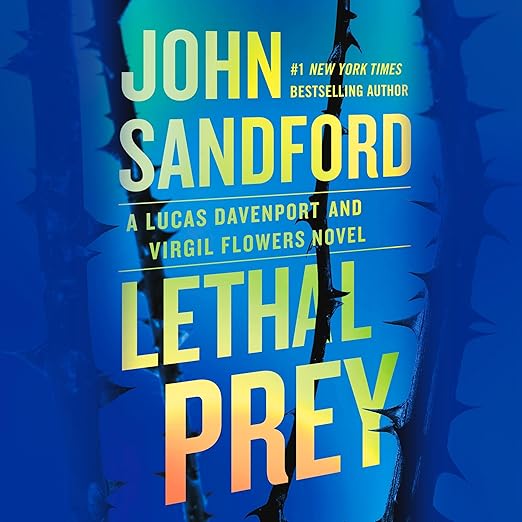
I have been listening to John Sandford’s Prey series long enough that I can predict the rhythms of a new entry almost from the first chapter. Lucas Davenport will be competent and occasionally reckless. His scenes with Virgil Flowers will generate the best dialogue in the book. The procedural infrastructure will be meticulous. And then Sandford will do something at the end that I did not see coming. Lethal Prey, the thirty-fifth installment, follows this template in most respects and then violates it in the final pages in ways that the readership has been arguing about since publication. I finished it on a Saturday evening and then spent a half hour staring at the ceiling, which is not nothing for book thirty-five of anything.
The cold case mechanism here is genuinely interesting. Doris Grandfelt was stabbed to death twenty years ago; her twin sister Lara, now facing a breast cancer diagnosis, takes matters into her own hands and publishes the entire investigative file online with a $5 million reward attached. True crime bloggers converge. Lucas and Virgil are called in to review whatever the crowd surfaces. And somewhere in the middle of all this, the killer, who has been living quietly in plain sight, watches every new clue appear online and adjusts accordingly.
Our Take on Lethal Prey
The crowdsourcing element is the book’s most distinctive structural choice, and Sandford handles it with more sophistication than the premise might suggest. The tension between the investigators’ deliberate, evidence-based method and the bloggers’ public, click-driven approach generates procedural irony that is specific to the current moment rather than generic thriller texture. One reviewer described the army of social media personalities as both useful and a liability, which is exactly the ambiguity Sandford maintains throughout. The killer benefits from every new detail the investigation broadcasts online, and this creates a momentum problem that Sandford leans into rather than away from.
The partnership between Lucas and Virgil is, as always, the book’s most reliable pleasure. Their dynamic has not calcified across thirty-five entries, which is itself a kind of achievement. Sandford writes their banter with enough freshness that it does not feel like obligation, and the specific tension of a cold case, where there is no active crime scene to anchor the investigation, gives their scenes a slightly different quality than the usual pressure-cooker procedural rhythm.
Why Listen to Lethal Prey
Robert Petkoff has been the voice of this series long enough that his Davenport has become definitional. His narration carries the institutional confidence that Lucas projects while also managing the dry humor of the Lucas-Virgil partnership without overplaying it. Petkoff is particularly good at Sandford’s descriptive passages, which one reviewer singled out as among the best in the genre for their ability to put you right in the scene. Those passages do not slow the audio down; they deepen it.
At eleven hours and twelve minutes, this is a comfortable Prey-series commitment. Sandford writes efficiently and Petkoff paces accordingly. The investigation builds steadily and the tension of watching the killer track every new development through the bloggers’ posts is maintained throughout, which is the book’s most original contribution to the series’s established formula.
What to Watch For in Lethal Prey
The ending. Readers are divided and the disagreement is genuine. Several reviewers who consider themselves strong Sandford admirers described the final page as jarring in a way that feels like a rule violation, a departure from the implicit contract Sandford has built over thirty-four prior entries. Others, perhaps a smaller group, found it a bold structural choice that suggests a sequel is coming. What is undeniable is that the resolution is open-ended in a way that this series has not previously been, and whether that reads as frustrating or intriguing will depend almost entirely on your tolerance for ambiguity in a genre that has historically rewarded closure.
The crowdsourcing investigation device, while fresh in this installment, is noted by at least one reviewer as having been used before in the series. If Sandford returns to it in future books, it may feel less distinctive. For now, it carries its weight.
Who Should Listen to Lethal Prey
Series readers who have followed Lucas Davenport across thirty-four prior books will find this a competent and often very good installment with an ending that demands either acceptance or a sequel to resolve. New listeners can follow the cold case investigation without prior context, though the partnership dynamic between Lucas and Virgil will carry more emotional weight with series familiarity. Anyone who requires a conventional resolved ending from their crime fiction should wait until a potential sequel clarifies where Sandford is going with this particular narrative thread. Everyone else should proceed with appropriate awareness that Sandford appears to have written his first honest-to-goodness cliffhanger.
Frequently Asked Questions
Is Lethal Prey accessible to listeners who have not read the previous Prey novels?
The cold case investigation is self-contained and followable without series knowledge. However, the Lucas-Virgil dynamic and the full pleasure of their partnership will carry more weight for listeners familiar with earlier entries.
Does the ending of Lethal Prey set up a direct sequel, or is it simply ambiguous?
The ending leaves a major plot thread unresolved in a way that strongly implies a follow-up, though Sandford has not confirmed one explicitly. Multiple reviewers assumed a sequel must be coming, but there is no official indication as of this review.
How does the crowdsourced true crime blogger element affect the investigation’s pacing?
It creates a specific kind of dramatic irony: the killer tracks every new clue the investigation makes public, which generates tension from the gap between what the investigators know they are broadcasting and what they cannot control. Sandford manages this dynamic consistently throughout.
Is Robert Petkoff the right narrator for a cold case story with a different rhythm than the usual active-crime Prey entries?
Yes. Petkoff’s measured delivery suits the slower-burn retrospective quality of a cold case investigation, and his rendering of Sandford’s descriptive passages holds the atmosphere of the St. Paul setting effectively.