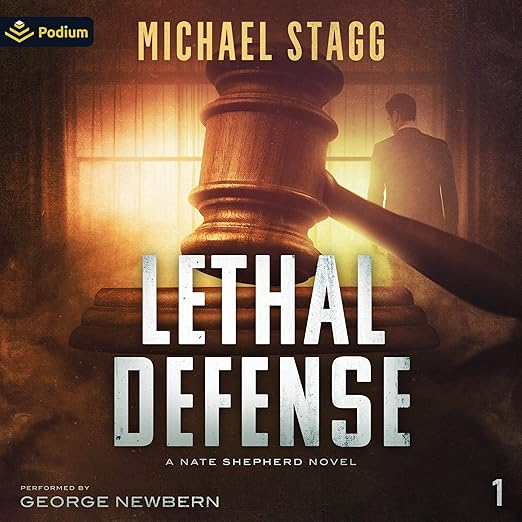
Quick Take
- Narration: George Newbern brings a composed, professional quality to Nate Shepherd that fits the character’s controlled public persona while leaving room for the personal fractures underneath.
- Themes: Courtroom drama, moral ambiguity, trauma and professional identity
- Mood: Taut and character-driven
- Verdict: A legal thriller that earns its courtroom intensity through character work rather than plot contrivance, with a protagonist whose hidden backstory gives the proceedings unexpected weight.
Legal thrillers live or die by whether the courtroom sequences feel like they are happening to real people or to generic archetypes running through genre choreography. I finished Lethal Defense on a Tuesday evening when I should have been doing other things, which answers the question of which category it falls into.
Michael Stagg’s premise is familiar enough on the surface: small-town attorney takes on a high-profile murder case with personal complications. What lifts the first book in the Nate Shepherd series above that template is the specific way those complications work. Nate did not take on this case because he is particularly bold or because he specializes in defending the indefensible. He took it because an out-of-town lawyer needed local counsel, and circumstances spiraled. That accidental entry point is more believable than the usual legal thriller setup, and it keeps Nate feeling like someone who is working at the edge of his competence rather than a superhero in a suit.
Our Take on Lethal Defense
The moral question at the center of the case is well-chosen. Nate’s client killed a man in defense of a friend. The victim was, by any reasonable account, evil. The killing was brutal. Nate’s job is to prove the brutality was justified, and the book does not let him do that comfortably. Every aspect of the case connects to a terrible event in Nate’s own past that he has spent years managing, and as the trial progresses, those private memories become professionally dangerous.
Reviewers have noted that the plot does not offer many surprises and that the ending is predictable once the setup is clear. That is a fair assessment. This is not the kind of legal thriller that builds toward a shocking revelation about who actually did it. The dramatic tension is generated by the question of whether Nate can hold himself together long enough to do right by his client, and whether his past will be weaponized against her before he can close the case. That is a character question rather than a mystery question, and for readers comfortable with that distinction, it works.
Why Listen to Lethal Defense
George Newbern’s narration is well-suited to Stagg’s writing. He delivers the courtroom exchanges with a sense of procedural weight, and the dialogue-heavy scenes benefit from his clean differentiation between characters. One reviewer specifically praised the way Nate’s family dynamic is rendered, and Newbern earns that praise. The scenes between Nate and his family, particularly those that establish what he is protecting by keeping his past buried, carry more emotional freight than a pure procedural would allow.
Stagg manages the legal elements with apparent confidence. The courtroom sequences feel procedurally accurate without becoming technical exercises. He has a particular skill with cross-examination scenes, letting the tension build through question structure rather than dramatic confrontation, and those scenes are where the book is at its best.
What to Watch For in Lethal Defense
One reviewer noted that some characters are slightly stereotypical and that the three main characters are the most distinctively drawn. That balance is real. The aggressive prosecutor and the dogged reporter who pursues Nate outside the courtroom are functional rather than fully developed. They serve the plot’s needs efficiently without becoming people. If that is a problem you have with the genre generally, it will be a problem here.
The pacing is deliberate rather than relentless. Stagg takes time with scenes where other legal thriller writers might cut. Some readers will find that refreshing; others, expecting the genre’s characteristic propulsion, may feel occasional drag. The nine-and-a-half hour listen is well-paced overall, but the middle section, where Nate is building his defense strategy before the trial begins in earnest, moves slower than the courtroom sequences.
Who Should Listen to Lethal Defense
Listeners who enjoy legal thrillers with more character depth than genre average, and who do not require a mystery-style reveal to find courtroom tension satisfying. Fans of the genre who have worked through the major series and want a strong series debut from a newer voice. Less suited to listeners looking for high-velocity plotting or significant narrative surprise.
Frequently Asked Questions
Is Lethal Defense a standalone listen or do I need to commit to the full Nate Shepherd series to get satisfaction?
It works as a standalone. The case opens and closes within this book, and Nate’s personal backstory is fully developed here. The ending opens the door to further installments but does not leave the central narrative unresolved.
The synopsis describes a brutal killing of an evil victim. How graphic is the violence in the audiobook?
The murder is described with some detail as a key element of the case, but this is not a horror-adjacent listen. The violence is relevant to the legal and moral argument rather than sensationalized.
George Newbern is a prolific narrator. Is his style a good fit for this kind of character-driven legal thriller?
Yes. His controlled, professional delivery suits Nate Shepherd’s public persona well, and he handles the dialogue-heavy courtroom exchanges with clean differentiation. The character work in family scenes also benefits from his restraint.
One review notes the plot lacks surprises. Is Lethal Defense still worth listening to if you are primarily a plot-focused thriller reader?
If you need genuine narrative surprise to stay engaged, this may feel predictable. The book’s satisfactions are primarily character-based. Readers who enjoy watching competent people navigate pressure situations with their private lives at risk will find more to hold onto.