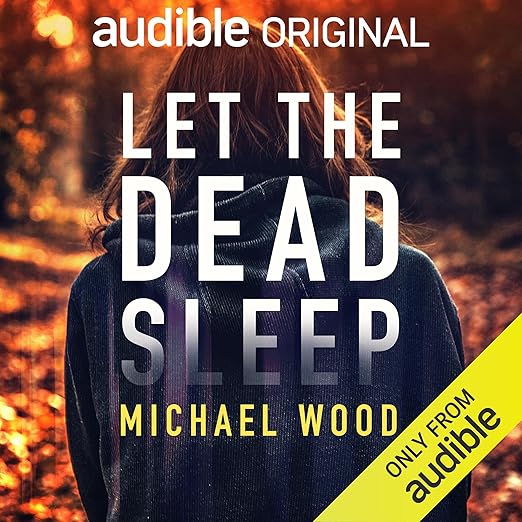
I finished Let the Dead Sleep on a Sunday afternoon with the curtains half-drawn, the kind of listening session that starts as background company and ends with you sitting very still. This Audible Original by Michael Wood arrives with a narrator who is already associated with the territory: Gemma Whelan played a central role in ITV's The Tower, a crime drama built around similar themes of institutional silence and the long shadow of violence. Her casting here does not feel incidental, and it pays off in ways that become clear by the end of the first chapter.
The setup is efficient and emotionally loaded from the first scene. Twenty-five years ago, a serial killer dubbed the Richmond Ripper killed four women in London before vanishing entirely. Crime reporter Holly Sullivan has spent her adult life adjacent to that case because her sister Annabel was the fourth victim. Now her mother is dying, and Holly is running out of time to find answers that would matter to both of them. When she begins digging seriously into the cold case, someone starts watching her. When she is targeted directly, it becomes clear that the killer is not only still alive but active enough to protect whatever he buried twenty-five years ago.
Holly's Grief Becomes Her Investigative Method
What Wood does well here is build the emotional infrastructure before he deploys the thriller mechanics. Holly is not simply a reporter chasing a story. She is a woman who has constructed her entire professional identity around a trauma she was never able to process through any other channel. The investigation is not a detached intellectual puzzle. It is grief that has been redirected into methodology, and the difference between those two things is the difference between a competent crime novel and one that actually stays with you after it ends.
That distinction matters enormously in audio, where you are living inside a character's head for the full runtime, and Whelan's performance honors it. She delivers Holly's determination without making her seem reckless, and her grief without making her passive. The character is driven in the specific way that people are driven when the thing they cannot stop working on is the thing they most need to resolve for reasons that have nothing to do with professional ambition. Whelan understands this distinction and plays it through the full eight and a half hours.
The Richmond Ripper case itself is constructed carefully. Wood withholds just enough to keep the mystery live without resorting to the cheap misdirection that undermines lesser entries in the genre. The detail that the killer claimed four victims across a specific London geography before simply stopping, neither caught nor definitively identified, creates genuine unease. Serial killers who vanish rather than being apprehended carry a different kind of dread than those who are eventually contained. The open file becomes a kind of presence in Holly's life rather than a concluded event.
An Audible Original Built for Long Listening Sessions
The synopsis is transparent about one of the book's structural moves: Holly cannot trust anyone in her inner circle, because someone close to her is hiding the darkest secret of all. This is a well-worn thriller device, and whether it succeeds depends entirely on execution. In this case, it works because Wood takes his time establishing Holly's relationships before he destabilizes them. We spend enough time with the people in Holly's life to understand why she trusts them and what it would mean to lose that trust. The eventual revelation has weight because the affection preceding it felt genuine rather than planted for effect.
As an Audible Original, the production quality is high and the runtime is precisely calibrated. There is no padding, no subplot that goes nowhere, no secondary character introduced without eventual purpose. The format rewards the tight construction Wood brings to it. This is the kind of audiobook that benefits from being listened to in long sessions rather than commute-length chunks, because the atmosphere compounds with time and the emotional stakes become more present the longer you stay inside Holly's perspective.
Whelan's Narration Favors Dread Over Plot Speed
Let the Dead Sleep is not a police procedural and makes no attempt to be one. Holly is a journalist, which means her access to information is lateral and often clandestine. She reconstructs rather than investigates with institutional authority. She is working without the official machinery that most crime fiction protagonists can lean on, which makes her vulnerability to the killer's counter-moves feel genuinely credible rather than contrived. Listeners who prefer their crime fiction built around detectives with institutional resources may find this approach frustrating. Listeners who prefer the outsider-investigator model built around personal stakes rather than professional mandate will find it entirely satisfying.
The emotional texture here is closer to a literary thriller than a conventional crime novel in the procedural tradition. Whelan's narration consistently honors that register, pitching the performance toward interiority and dread rather than plot velocity. The result is an eight-and-a-half hour experience that feels shorter than it is, which is the highest compliment you can pay to audio fiction.
Chamber-Scale Intimacy Suits Tower Fans Best
Ideal for listeners who enjoyed The Tower or similar British crime productions where the personal and procedural are tightly braided, and for fans of Michael Wood's existing catalog. Also well-suited to listeners who want a focused, intimate thriller with a genuine emotional core beneath the plot mechanics. Skip it if you want a large ensemble cast or a multi-strand investigation with competing perspectives. This is a chamber-scale thriller built around a single protagonist's decades-long reckoning with loss.
Is Let the Dead Sleep part of a series, or does it stand completely alone?
It stands alone as an Audible Original. No prior book in a series is required, and the story reaches a complete resolution within its eight-and-a-half hour runtime. Michael Wood has an existing thriller catalog, but familiarity with his other work is not necessary to engage fully with this one.
Why was Gemma Whelan specifically cast as the narrator?
Whelan is identified in the Audible marketing as the star of The Tower, a British crime drama with similar thematic territory around violence, secrets, and investigation. Her familiarity with this genre register and with morally complex female leads makes her casting purposeful. Her restraint in the performance is a particular asset, keeping Holly's grief from tipping into melodrama.
Does the cold case mystery actually resolve, or does the book end ambiguously?
The central mystery of the Richmond Ripper's identity and the secret within Holly's inner circle both resolve within the audiobook. This is not an open-ended literary thriller. Wood delivers a specific answer and earns the conclusion rather than withholding resolution for a potential sequel.
Is Let the Dead Sleep available as a free audiobook?
Yes. As an Audible Original, Let the Dead Sleep is available as a free audiobook for Audible subscribers. It is exclusive to the platform and included with active memberships, making it a no-commitment listen for anyone curious about Michael Wood's work.