Quick Take
- Narration: Arnie Mazer captures the conversational, smoke-room atmosphere of Auerbach’s storytelling sessions with an unhurried warmth that suits oral history.
- Themes: dynasty-building and institutional culture, race and integration in professional basketball, the oral tradition of sport
- Mood: Warm, raucous, and nostalgic
- Verdict: For basketball history readers, this is an essential primary-source document dressed as a casual afternoon with one of the game’s great minds.
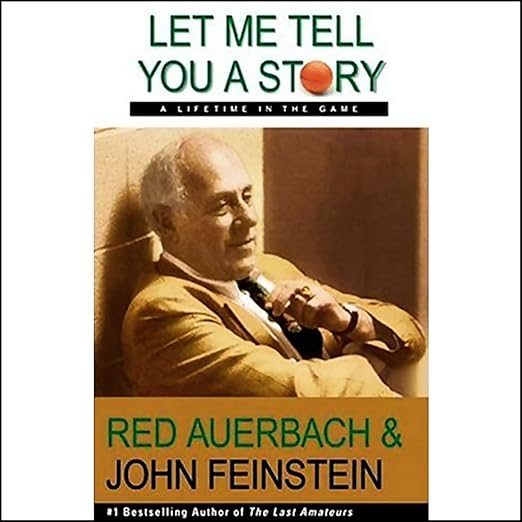
I was halfway through a cross-country flight when I started Let Me Tell You a Story, and by the time we landed I had barely noticed the three hours pass. That is not something I say about many sports books, especially short ones. John Feinstein has earned his reputation as one of the finest sports writers working, and this 2004 collaboration with Red Auerbach, nine-time NBA championship coach of the Boston Celtics, is something genuinely unusual: an oral history captured in real time, in the room, with the man himself still alive and fully inhabiting his memories.
The premise is simple. Feinstein spent several years meeting regularly with Auerbach and his circle of friends in Washington, D.C., listening to stories. The result is not a traditional biography and is not trying to be. It is more like a seat at the table in one of those sessions, with Arnie Mazer’s narration providing the genial, unhurried voice that matches the material.
Our Take on Let Me Tell You a Story
What makes this audiobook work is the texture of Auerbach’s memory. At eighty-seven, he was not offering sanitized public relations anecdotes. He held opinions, corrected the record on other people’s versions of events, and had the kind of frank assessments of players and coaches that you simply do not get from official institutional histories. The stories about Bill Russell, Bob Cousy, Larry Bird, and Wilt Chamberlain carry biographical weight precisely because Auerbach was there, not as an observer but as the architect of the situation he is describing.
One reviewer noted the racial history dimension of the book, pointing out that Auerbach grew up in Brooklyn in a genuinely multiracial neighborhood rather than the segregated Washington D.C. of his high school years, and that this background shaped his willingness to draft some of the first Black players in the NBA and to name Bill Russell as the first Black head coach in the league’s history. Feinstein draws this thread out with appropriate care, letting Auerbach speak rather than editorializing around him.
Why Listen to Let Me Tell You a Story
The audio format is ideal for this material. Listening to Arnie Mazer tell these stories aloud captures the oral nature of Auerbach’s performance better than reading the text on a page. These are stories that were spoken before they were written, and the audiobook returns them to that register. Feinstein’s skill as a writer is visible in the curation, he knew which stories to preserve and how to sequence them for a listener, but the primary voice is always Auerbach’s, and Mazer honors that by staying out of the way.
At three hours, this is one of the shorter titles in Feinstein’s bibliography. It is genuinely entertaining throughout without the inevitable stretches that longer oral histories often have. For basketball fans who already know the broad outlines of the Celtics dynasty, the pleasure is in the specific detail: the name a reader might not recognize, the incident that complicates the official narrative, the moment where Auerbach admits what he got wrong.
What to Watch For in Let Me Tell You a Story
Listeners coming to this looking for a comprehensive historical account of the Celtics dynasty will find it incomplete by design. This is not that book. It is a curated portrait, and the curation reflects what Auerbach chose to share with Feinstein over those sessions, which means certain periods and relationships receive more attention than others. The three-hour runtime is also a structural constraint, Feinstein is working with what he captured rather than with a full biographical mandate.
Some non-basketball readers have found the sports-specific references dense enough to require external context. If you come to this without knowing who Sam Jones or Bob Cousy was, a brief detour to their Wikipedia pages before listening will pay dividends.
Who Should Listen to Let Me Tell You a Story
Essential listening for fans of the Boston Celtics and of NBA history from the 1950s through the 1980s. Also valuable for anyone interested in leadership, team culture, and the integration of professional sport. The oral history format and the Feinstein storytelling pedigree make it accessible to general readers with limited basketball knowledge, though the experience is richer with context. Football-only sports fans will find the basketball specificity a barrier.
Frequently Asked Questions
Do I need to be a Celtics fan or a basketball expert to enjoy this audiobook?
Not strictly, though familiarity with names like Bill Russell, Bob Cousy, and Larry Bird adds significant texture. The book functions as an engaging oral history for general readers, but basketball fans will extract considerably more from the specific stories and assessments.
How does Let Me Tell You a Story fit into John Feinstein’s body of work?
It occupies a unique place, more intimate and less narratively structured than his traditional sports journalism books like A Season on the Brink. Several reviewers note that Feinstein is at his best with basketball subjects, and this collaboration showcases his ability to step back and let his subject carry the material.
Does the book address the racial integration history of the Celtics directly?
Yes, though not as a central thesis. Auerbach’s decisions to draft early Black players and to appoint Bill Russell as player-coach emerge through his own recollections, with Feinstein drawing out the cultural and personal context. It is integrated into the storytelling rather than treated as a separate analytical chapter.
Is the three-hour runtime enough to do justice to Auerbach’s career?
No, and the book is not trying to be comprehensive. It is a curated collection of conversations, not a full biography. Think of it as a highlight reel of the most revelatory sessions Feinstein had with Auerbach, complete in itself but openly partial.