Quick Take
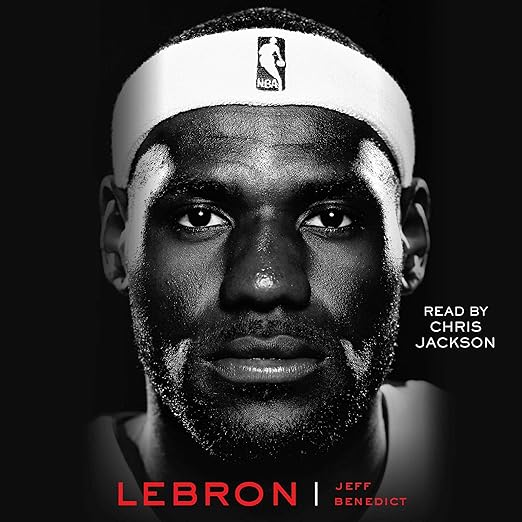
- Narration: Chris Jackson delivers the biography with a gravity and warmth that suits the subject’s scale, bringing the Akron childhood and the NBA arena with equal conviction.
- Themes: Poverty to power, the politics of Black celebrity, loyalty as both strength and vulnerability
- Mood: Absorbing and novelistic, with the sweep of a Dickens chronicle applied to contemporary sports history
- Verdict: The most complete account of LeBron James yet written, valuable not just as sports biography but as a study in how talent, circumstance, and deliberate ambition interact.
I am not a basketball person. I watch the playoffs occasionally, I track the broad contours of the league’s personalities, but I have never had a strong stake in the game itself. Jeff Benedict’s LeBron changed something about that. I started it because Benedict’s Tiger Woods biography had impressed me as a model of sports biography done with genuine literary seriousness, and I finished it seventeen-plus hours later with a significantly more complicated understanding of what LeBron James actually represents, as an athlete, as a businessman, as a political figure, and as a person shaped by a childhood that very nearly did not produce him at all.
Benedict is described as the most celebrated sports biographer of our time, and the evidence is in how he structures this book. He had access to more than 250 interviews and thousands of pages of primary source documents, and he uses that research not to produce an exhaustive archive but to build a narrative with the momentum of a novel. The comparison to Dickens that appears in the book’s own promotional copy is not idle. LeBron’s origin story, a scared and lonely boy in Akron whose mother was sixteen when he was born and who sometimes disappeared entirely, leaving her child to fend for himself, has the quality of a nineteenth-century serialized tragedy. The basketball comes later, and it never entirely displaces the weight of what came before.
The Boy from Akron Before the Basketball
The early chapters of LeBron are the book’s most important and least expected. LeBron James is so thoroughly the symbol of elite athletic achievement that it is easy to forget the contingency of how he got there. He missed close to one hundred days of school in the fourth grade because the conditions of his home life were simply incompatible with attendance. His mother, struggling with her own instabilities, eventually placed him with Frank Walker, a youth football coach whose family provided the stability that made everything else possible. Without that placement, and without Frank Walker putting a basketball in LeBron’s hands, the rest of the story does not happen.
Benedict reconstructs this period with the care it deserves. He draws on interviews with people who knew LeBron in Akron, who saw him before he was a phenomenon, and who have a more complicated understanding of who he is than his media presence typically allows. One reviewer described this as showing a side of LeBron she was unaware of, and that is accurate. The book does not traffic in hagiography. It follows the actual shape of a human life, which includes failure, luck, dependence on other people’s generosity, and choices that could have gone differently.
The Political Figure No One Expected
The evolution of LeBron James from a player who deliberately avoided political controversy to someone who publicly clashed with a sitting president is one of the book’s most carefully traced arcs. Benedict documents the specific moments and decisions that marked this shift, from LeBron’s criticism for not joining his teammates in protesting China’s role in the Darfur genocide to his partnership with President Obama and his vocal campaigns against gun violence, racism, and voter suppression.
What Benedict makes clear is that this evolution was not a conversion but a development. The instinct to protect himself and those he loved from political exposure was formed in a childhood where exposure was dangerous. The willingness to become a public advocate for specific causes came when he understood that his platform was itself a form of power, and that not using it was a choice with consequences as real as using it. The book’s treatment of this arc is neither celebratory nor critical. It is analytical, which is what it should be.
Chris Jackson’s Performance Across Seventeen Hours
Chris Jackson narrates with a sustained and serious engagement that the material demands. At seventeen hours and thirty-six minutes, this is a substantial listening experience, and Jackson maintains the energy and commitment across that runtime without the compression that can happen in long biography audiobooks. He handles the movement between the Akron childhood, the NBA years, and the post-playing business and philanthropy with consistent clarity, which means the listener never has to do extra work to anchor themselves in the timeline.
His reading of the political sections, where the stakes are highest and the language is most charged, is appropriately measured. He does not editorialize through emphasis where the text has already made its point. For a biography of a figure this politically contested, that restraint is the right call. One reviewer noted that the sourcing in the book is as detailed as an academic publication, and Jackson reads with a corresponding seriousness.
Who Should Listen and Who Should Skip
LeBron is a genuine biography in the sense that it was written to be understood and evaluated on literary terms, not just as fan content. Basketball enthusiasts will find it essential, but the book’s reach extends beyond the sport. Readers interested in the intersection of celebrity, race, philanthropy, and political power in contemporary America will find Benedict’s analysis as relevant as any more explicitly political book on those subjects.
Listeners who want a book primarily about basketball strategy, coaching, and game analysis will find this is not that book. Benedict is interested in LeBron the person and the phenomenon. The game appears throughout, and key moments in LeBron’s career are rendered with real narrative force, but the sport is always in service of the biographical subject rather than the other way around.
Frequently Asked Questions
How does Benedict’s LeBron compare to his Tiger Woods biography in terms of depth and approach?
Reviewers who have read both describe them as consistent in method and ambition. Both books are built on exhaustive primary research and structured to read as narrative rather than chronicle. LeBron may be more politically engaged than Tiger Woods because its subject operates in a more explicitly political public sphere. Both are considered among the better examples of contemporary sports biography.
Does the book address the later stages of LeBron’s career, including his time with the Los Angeles Lakers?
Yes. Benedict’s research and interviews cover LeBron’s full career arc through his time in Miami, his return to Cleveland and the championship, and his years in Los Angeles. The book also addresses his business empire, his philanthropic work through the I PROMISE School in Akron, and his status as the first active NBA player to become a billionaire.
How does Benedict handle the criticism LeBron has faced over the years, including the China-Darfur controversy?
Benedict addresses the controversy directly and without either defending or condemning LeBron’s position at the time. He contextualizes it within the broader arc of LeBron’s political evolution, noting the specific choices LeBron made and when his stance shifted. The treatment is analytical rather than partisan.
Is this audiobook accessible to listeners who are not already fans of basketball?
Yes. Multiple reviewers who are not basketball-focused describe finding the book compelling on its own terms. The origin story sections in particular read as social history as much as sports history, and LeBron’s business and political activities occupy enough of the book that non-sports readers have substantial material to engage with. One reviewer specifically recommended it to non-basketball enthusiasts.