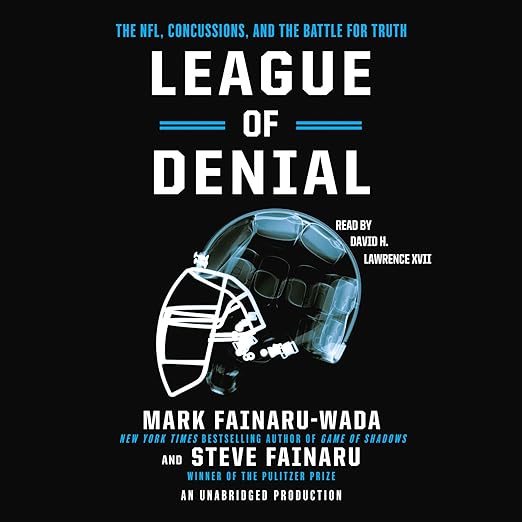
Quick Take
- Narration: David H. Lawrence XVII handles the investigative reporting structure cleanly, his delivery suits the procedural rhythm of the Fainaru-Wada and Fainaru reporting without editorializing.
- Themes: Institutional cover-up and corporate power, CTE and neurological damage, the moral economy of professional sports
- Mood: Methodical and deeply unsettling, it unfolds like a long-form investigation, not a polemic
- Verdict: Fourteen hours of rigorously documented reporting that permanently changes how you hear the sound of a football tackle.
I listened to League of Denial during a week when football was in heavy rotation on the television in the next room. The contrast was uncomfortable in exactly the way the book intends. By the end, every highlight reel hit landed differently. That is the particular achievement of Mark Fainaru-Wada and Steve Fainaru’s reporting: it does not tell you what to feel about the NFL. It shows you what the NFL knew, when it knew it, and what it chose to do with that knowledge. The moral conclusions are yours to draw.
The book is structured around two interlocking narratives. The first is the medical science of chronic traumatic encephalopathy, the brain disease that was appearing in the autopsied brains of retired NFL players at a rate that made coincidence impossible as an explanation. The second is the NFL’s institutional response to that science, which the Fainaru-Wadas document using exclusive interviews, previously undisclosed documents, and private emails. The parallel structure works because neither narrative can be understood properly without the other.
Mike Webster and the Science That Started Everything
The central figure in the early chapters is Mike Webster, Hall of Fame Pittsburgh Steelers center, whose mental deterioration in retirement was so severe that at the time of his death he was fantasizing about shooting NFL executives. The pathologist who first identified CTE in Webster’s brain was Bennet Omalu, a Nigerian-born physician working in Allegheny County who published his findings in a peer-reviewed journal and was then subjected to a sustained campaign of pressure from the NFL’s own research committee to retract the paper. That campaign is documented in detail, and it is where the book’s Big Tobacco parallel becomes undeniable.
The authors draw that comparison explicitly, tracing structural resemblances between the tobacco industry’s multi-decade denial of the smoking-cancer link and the NFL’s funding of its own scientific committee to produce findings that contradicted independent research. The NFL’s December 2005 paper concluding that players do not sustain frequent repetitive blows to the brain on a regular basis is quoted directly. The absurdity of that conclusion, visible even to a casual fan, is precisely the point.
Junior Seau and the Stakes of the Cover-Up
If Webster is the book’s scientific origin point, Junior Seau, the San Diego Chargers linebacker who died by suicide in 2012 with CTE in his brain, represents its human cost at its most prominent. The battle over Seau’s brain tissue between independent researchers and the NFL becomes a microcosm of everything the book is arguing about institutional power and the suppression of inconvenient evidence. The Fainaru-Wadas treat Seau and his family with genuine care, and the chapters dealing with his decline and death are the most emotionally demanding in the book.
One reviewer noted that the book stopped abruptly at a certain point, an observation that reflects the reality that this is reporting on an ongoing story rather than a settled history. The legal battles and the science were still developing when the book was published in 2013. That incompleteness is not a flaw so much as an honest representation of where the investigation stood.
What Lawrence XVII Does With 14 Hours of Investigative Text
Investigative journalism is not natural audiobook territory. The density of documentation, the multiple named sources, the technical medical terminology, and the procedural pacing all create challenges that narrators of fiction do not face. David H. Lawrence XVII navigates this by maintaining a steady, even-handed delivery that lets the material generate its own tension rather than imposing theatrical urgency from the outside. The effect is that of a careful, methodical presenter who trusts the story to carry its own weight, which is the right instinct for reporting this thoroughly documented.
Some listeners may find that register too restrained for fourteen hours. But the alternative, a narrator who performed outrage on behalf of the authors, would have undermined the book’s credibility. Lawrence’s approach honors the journalism by getting out of its way.
Who This Investigation Is For
League of Denial rewards listeners who can sustain attention across a long-form, document-driven narrative. It is well-suited to anyone who follows professional football and has wondered, in good faith, what the scientific evidence on CTE actually shows and what the NFL has actually known. It is also essential listening for anyone interested in how large institutions manage inconvenient science, from the legal strategies to the in-house research apparatus to the media relationships that shape public perception.
If you come to this audiobook looking for a balanced account that treats the NFL’s position as credible, you will not find it. The Fainaru-Wadas are not both-sidesing an investigation where the evidence is overwhelmingly one-sided. What you will find is rigorous, compassionate, and deeply uncomfortable reporting on a public health crisis that was visible and documented before most people were allowed to know about it.
Frequently Asked Questions
Does League of Denial cover the NFL’s eventual settlement with players over concussion injuries?
The book was published in October 2013, before the full settlement was finalized and implemented. It covers the legal landscape as it existed at that point, including the early stages of the player lawsuits, but listeners looking for the resolution of the legal proceedings will need to supplement this with more recent coverage.
How does the audiobook compare to the Will Smith film Concussion, which covers similar ground?
Several reviewers specifically noted that the book is considerably more comprehensive than the film. While the film focuses narrowly on Bennet Omalu’s story, League of Denial covers an ensemble of scientists, players, NFL officials, and journalists over a much longer timeline, making it a far more complete account of the institutional dynamics at play.
Is medical or scientific background necessary to follow the CTE research sections?
No. The Fainaru-Wadas explain the neuroscience in accessible terms throughout, and David H. Lawrence XVII reads the technical passages clearly. Readers with medical backgrounds will find the science familiar, but the book is written for a general audience and does not require prior knowledge of neurology.
How does the book treat the NFL players themselves, as opposed to league officials?
With considerable empathy. The authors are careful to distinguish between the players who built the NFL into a ten-billion-dollar industry without knowing the risks they were accepting, and the league officials and committee members who had access to information the players were denied. The players, including Webster and Seau, are rendered as human beings, not as data points.