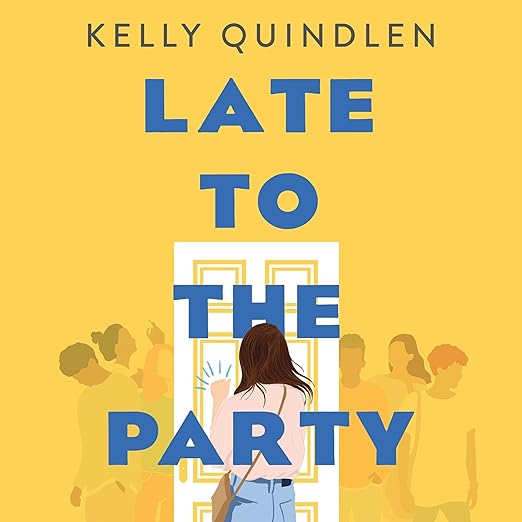
Quick Take
- Narration: Piper Goodeve captures Codi’s anxious interiority with warmth and specificity; she modulates between the nervous self-consciousness and the tentative joy without overplaying either.
- Themes: Queer coming-of-age, the cost of friendship secrets, summer as transformation
- Mood: Tender and funny, occasionally awkward in exactly the right way
- Verdict: Kelly Quindlen has written one of the more honest queer YA audiobooks in recent years, and Piper Goodeve’s performance brings Codi fully to life.
I picked this one up on a Thursday afternoon with no particular intention other than wanting something that felt like summer. I had a long drive ahead of me and I’d been in a stretch of dense, serious reading and was ready for something that didn’t require footnotes. I was not prepared for how completely Late to the Party would pull me in, or for how a coming-of-age novel about a seventeen-year-old deciding to go to parties would land with the kind of emotional specificity that the best YA always manages to achieve and most adult literary fiction gives up on too early.
The setup is exactly what the synopsis promises, and Kelly Quindlen wastes no time making Codi Teller real. She’s gay, she’s shy, she and her two best friends Maritza and JaKory spend most of their time in her basement watching Netflix, and the summer before senior year kicks off a sequence of events that will force her outside every comfort zone she has carefully constructed. What distinguishes this from the generic version of that story is how precisely Quindlen understands what it actually feels like to be on the outside of the social world you’re watching through a window.
The Difference Between Shy and Invisible
One of the things I most appreciated about this audiobook is how it refuses to conflate introversion, social anxiety, and marginalization into one undifferentiated condition. Codi isn’t just shy. She’s a girl who has constructed a very specific identity around not trying, because trying would mean risking rejection, and that arrangement has its own logic. Piper Goodeve’s narration understands this distinction. There’s a quality to her reading of Codi’s internal monologue that captures someone who is acutely observant precisely because she’s trained herself to watch rather than participate.
The friendship with Ricky, formed after Codi witnesses something he desperately needs kept secret, is the heart of the novel. Reviewers praised the secondary characters as “compelling” and contributing significantly to Codi’s journey, and that’s accurate. Ricky doesn’t function as a fairy godparent figure, which is the easy version of this role. He’s a person with his own complications, his own reasons for taking Codi under his wing, and his own limitations. The dynamic feels like an actual summer friendship rather than a narrative device.
The Secret That Splinters Everything
The more complicated element of the novel is the one that generates its real tension: Codi’s decision not to tell Maritza and JaKory about her new social world. This is where Quindlen takes a risk that not all readers appreciated. Several reviewers found Codi’s behavior toward her best friends genuinely frustrating, even inexcusable at moments, and I think that response is both understandable and the point. Codi is a flawed protagonist doing something recognizably human: finding a new self and being unable to integrate it with the old one, not out of malice but out of a kind of overwhelmed avoidance that will be familiar to anyone who has navigated a significant transition while still maintaining relationships formed before it.
Goodeve plays these sections without softening them, which is the right choice. Codi’s self-awareness about her behavior doesn’t excuse it, and the narration keeps that moral complexity visible without turning the character into someone you stop rooting for.
The Open Ending Question
The most consistent critique in reviews is the feeling that the ending leaves too much unresolved, with one reader describing the sensation of a missing chapter. I understand this reaction. The novel ends in a way that is more suggestive than conclusive, particularly regarding Codi’s friendships and the Lydia romance. My own feeling is that Quindlen made a deliberate choice: summer transformations don’t come with clean resolutions, and the novel is more honest for resisting the tidy wrap that the genre often demands. But listeners who need emotional closure may find this unsatisfying.
At eight and a half hours, the audiobook is perfectly paced for a weekend listen. Goodeve maintains energy through the ensemble scenes, which involve a lot of dialogue and shifting emotional registers, and she handles the quiet scenes with equal care. A reviewer who read the novel in three hours noted being unable to put it down, and the audio version replicates that quality. This is one of those titles where the narration actively enhances the material rather than simply conveying it.
Who Will Love This and Who Might Not
Readers who loved Rainbow Rowell’s Eleanor and Park or Becky Albertalli’s Simon vs. the Homo Sapiens Agenda will find familiar warmth here, though Quindlen’s tone is less arch than Albertalli and more grounded than some of Rowell’s more stylized work. If you’re listening for queer representation that treats being gay as one true thing about a character among many rather than the entire plot, this delivers that. If you need a tidy ending and a protagonist who behaves well throughout, you may want to manage expectations on both counts. But for summer listening, for anyone who remembers being seventeen and figuring out who you are when your existing group can’t see the new version of you yet, this is well worth the eight hours.
Frequently Asked Questions
Is Piper Goodeve’s narration suited to a first-person story about a teenage girl figuring out her identity?
Very much so. Goodeve finds the specific register between self-deprecating humor and genuine vulnerability that Codi’s voice requires. She avoids the twee affectation that sometimes undermines YA narrations and instead delivers something that sounds like an actual person processing experience in real time.
Does the novel address Codi’s sexuality as a major plot element or more as background context?
Both. Being gay is a given in Codi’s identity from the opening pages, but the novel spends relatively little time on the coming-out mechanics that dominate some queer YA. The more central struggle is social confidence and the particular terror of wanting something (Lydia, a new social world) badly enough to risk the existing self you’ve built around not wanting things.
Several reviews mention frustration with Codi’s behavior toward her friends. Is this a character problem or a feature?
Definitely a feature, though it may not feel like one while you’re listening. Codi’s avoidance of Maritza and JaKory while she navigates her new world is presented as wrong, and she knows it. The novel is honest about the cost of that behavior. If you need protagonists to behave well throughout, it will feel like a flaw. If you’re interested in the realistic texture of how people actually handle transitions, it’s one of the book’s strengths.
Is this appropriate for younger teens as well as older YA readers?
The content is appropriate for most teen readers. There are no explicit scenes. The mature elements are emotional: a complicated friendship betrayal, the anxiety of a first crush, and some frank discussions about sexual orientation. A high school counselor who reviewed the book called it “a true representation” of what she witnessed in thirty years of working with teenagers, which is about as strong an endorsement of authenticity as you can get.