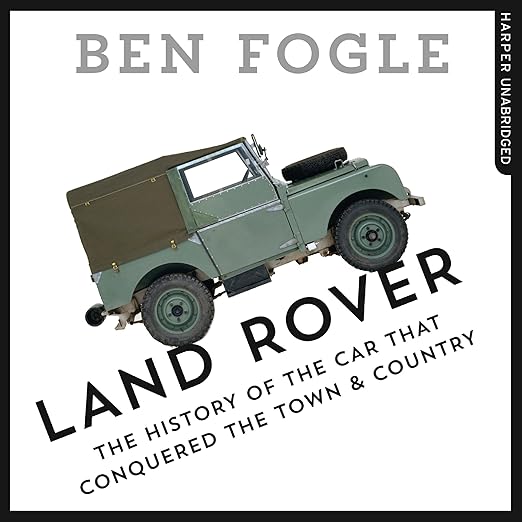
Quick Take
- Narration: Confident with technical vocabulary, takes advantage of the more lyrical passages without overreaching
- Themes: British manufacturing history, the transformation of a utility object into a cultural symbol, corporate succession
- Mood: Enthusiastic and celebratory, occasionally nostalgic
- Verdict: Satisfying for Land Rover enthusiasts and British industrial history readers; too affectionate in its treatment to serve as critical cultural analysis.
There is a specific kind of automotive writing that treats cars as biographical subjects, following them through manufacturing decisions, engineering constraints, cultural moments, and the long process by which a utilitarian object becomes a symbol of something larger than its specifications. When it works, you understand not just the vehicle but the culture that made it and was made by it. I started this one expecting something in that mode and found it largely delivered, with a few qualifications worth noting.
The Land Rover is a genuinely interesting subject for this approach. Born from post-war aluminum surplus and the practical needs of a British farming family, transformed into a military vehicle, then a luxury object, then a symbol of British identity that outlasted almost everything else British manufacturing produced in the same period: the history is rich with contradiction and productive accident.
The Manufacturing History as Biography
The strongest sections of this book are the ones covering the original development of the Series I Land Rover and the engineering decisions that shaped the vehicle’s fundamental character. The story of how Maurice Wilks’s Jeep on his Welsh farm became the design brief for what would eventually become one of the longest-running vehicle platforms in history involves the specific combination of material constraints, practical necessity, and slightly reckless confidence that produces iconic industrial design. The narrator handles these sections with appropriate enthusiasm, conveying the sense that the engineering decisions mattered and that the people making them understood they were making something unusual.
The account of the transition through Series II, Series III, and eventually Defender and Discovery territory is where the book has to work harder. The shift from agricultural tool to luxury product involves changes in corporate ownership, manufacturing philosophy, and customer base that are less dramatically satisfying than the origin story but are arguably more interesting as cultural history. Tata’s acquisition and the decisions that followed represent a genuinely complicated chapter in British manufacturing history, and the book gives it adequate if not exhaustive treatment.
What the Narration Brings to Technical Material
Books about vehicles face a specific challenge in audio: the technical vocabulary of engineering and mechanical design does not always translate cleanly to spoken prose without visual aids. The narrator navigates this by maintaining a pace that allows the listener to absorb the technical information without getting lost in specification details. The performance is confident with the material, which matters in this context. There are passages describing engine variants and chassis modifications that would be bewildering if delivered with uncertainty. The narrator’s fluency with automotive terminology provides the necessary anchor throughout.
The more lyrical passages, there are some, particularly in the sections about Land Rovers in Africa and the Middle East, where the book reaches for something closer to travel writing, land well in audio. These are the moments when the narrator’s voice has room to do something beyond information delivery, and the performance takes advantage of that space without overreaching into the melodramatic.
The Audience This Book Serves Well
Land Rover enthusiasts and owners are the obvious audience, and they will find this history detailed enough to be satisfying without being so technical that it excludes anyone without a workshop background. British industrial history readers and automotive cultural history readers will find the broader context well-handled. General listeners looking for a story about how something was made and what it came to mean will find the hook accessible even without prior knowledge of the vehicles.
Skip it if you are expecting a critical examination of Land Rover’s later corporate decisions, including the environmental impact of its products or the peculiarities of the luxury SUV market it helped create. The book is broadly celebratory in its treatment of the subject. That is not a disqualifying quality, but it is worth knowing going in. This is writing that loves its subject, and listeners who share that affection, or who are curious about acquiring it, will get more from it than those looking for something more analytically detached from the material.
The Object’s Biography Beyond the Factory
The most genuinely interesting aspect of the Land Rover’s cultural history is how the same vehicle acquired completely different meanings in different contexts simultaneously. In Britain, it became associated with a particular kind of rural landowning identity, practical but not humble, working but expensive. In postcolonial Africa and the Middle East, it became the vehicle of aid organizations, missionaries, and government administrators, carrying an entirely different set of associations about institutional authority and foreign presence. In the consumer markets of the 1990s and 2000s, it became a luxury status object whose connection to any of those earlier meanings was purely aesthetic.
A book that tracked all three of those trajectories simultaneously and examined how they relate to each other would be a genuinely demanding cultural history. This book is not quite that book, it follows the manufacturer’s perspective more than the user’s, but it gestures toward that complexity often enough to be interesting. The audiobook delivers what it promises: a thoroughly researched and affectionately told account of how one of the twentieth century’s most recognizable vehicles came to exist and what it became. For listeners who have spent time around Land Rovers, who know the smell of the interior, the particular rattle of the chassis, the way the steering works on a rutted track, this audiobook will feel like time well spent in the company of someone who understands the attachment and has researched its origins with genuine care.
Frequently Asked Questions
Does the book cover the full history through the current Defender models or does it focus on the classic period?
The history spans the full arc from the original Series I through the various ownership transitions including Tata’s acquisition and the decisions that shaped the modern lineup. The classic period receives the most detailed treatment, but the book does not end in the 1980s.
Is prior automotive knowledge required to follow the engineering discussions?
Not substantially. The narrator’s fluency with automotive terminology helps, and the technical passages are written to be accessible to enthusiasts without requiring workshop-level expertise. The book assumes interest in the subject but not professional knowledge.
How does the book treat Land Rover’s military history and its use in conflict zones?
The military use across multiple conflicts and territories is covered as part of the vehicle’s broader cultural reach and reputation for durability. The Africa and Middle East sections are among the more evocative passages in the book, reaching for something closer to travel writing in their portrait of the vehicle in extreme environments.
Does the author address the contradiction between Land Rover’s utilitarian origins and its current positioning as a luxury product?
The transformation from agricultural tool to luxury object is one of the book’s central threads, and the authors treat it as a genuinely interesting historical process rather than a simple betrayal of origins. The cultural and economic forces that drove that transformation receive honest treatment, though the book remains broadly celebratory in its overall stance toward the subject.