Quick Take
- Narration: Marissa Lenti gives Yuna an endearing deadpan quality that fits the character’s antisocial-gamer-turned-overpowered-isekai-hero arc perfectly.
- Themes: Overpowered protagonist in a gentle isekai, slice-of-life fantasy, comedy of absurdity
- Mood: Light and breezy, like scrolling a cozy game on a slow afternoon, low stakes, high charm
- Verdict: An ideal palate cleanser between heavy reads, with enough warmth and humor to reward fans of gentle isekai who don’t mind a paper-thin plot.
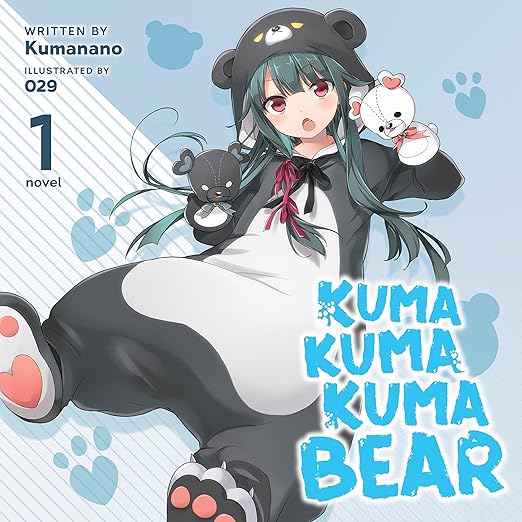
I picked up Kuma Kuma Kuma Bear immediately after finishing a long and emotionally demanding political nonfiction title, on the basis that it was exactly as different as possible from what I’d just been listening to. I was right, and I don’t mean that as a criticism. Sometimes the right book is the one that requires nothing from you except to follow a teenage shut-in in a bear onesie around a fantasy world, and this volume delivers that with genuine warmth.
The setup is quintessential cozy isekai: Yuna, a 15-year-old dedicated gamer and antisocial shut-in who funds her gaming habit through stock trading, downloads an update to her favorite VRMMO and wakes up transported into the game world for real. She starts at level one but is equipped with an absurdly powerful bear onesie that grants her impressive abilities, abilities she cannot turn off, because she cannot take the bear suit off. The book follows her adjusting to this new reality, discovering what she can do (far too much, most of it bear-themed), and encountering the town and characters that will anchor the rest of the series.
The Bear Onesie as Comic Engine
The central joke of the book, and the series, is that Yuna is catastrophically overpowered for her world and catastrophically under-prepared to care what anyone thinks about her bear costume. She’s not a reluctant hero; she’s an indifferent one, someone who has spent years cultivating the specific skill set of not being bothered by social expectations. The comedy comes from the gap between how she’s perceived by the world (a strange child in a bear suit) and what she’s actually capable of (handling monsters that veteran adventurers fear). Kumanano keeps this gap productive throughout the volume without overmilking it.
The slice-of-life pacing that reviewers describe as the book’s signature quality is genuine, Kuma Kuma Kuma Bear is not interested in sustained narrative tension. The chapters are short, the incidents are episodic, and the stakes are intentionally low. One reviewer described finishing it as a recovery read after a stressful high-stakes series, which captures the function accurately. This is comfort reading with bear-shaped edges.
Marissa Lenti and the Sound of Cheerful Indifference
Marissa Lenti’s narration is well-matched to the material. Yuna is fundamentally an antisocial person who finds most social interaction more baffling than threatening, and Lenti gives her a quiet deadpan quality that makes the character’s obliviousness funny rather than grating. The supporting cast, the adventurers, townspeople, and various individuals confused by or charmed by the bear-suited stranger, are differentiated enough to track without individual performances being particularly memorable on their own terms.
At four hours and seventeen minutes, this is among the shorter audiobooks in any regular rotation, which suits the episodic format. Each short chapter functions almost as a standalone scene, and the audio version flows naturally through them. There’s no complex worldbuilding terminology to track, no elaborate magic system to keep straight, and no interpersonal web of intrigue to untangle. You can listen at full speed and still catch everything.
What Light Novel Volume 1 Establishes
First volumes of light novel series have a specific job: establish the character, sketch the world, and make readers want to know what happens next without demanding too much investment upfront. Kuma Kuma Kuma Bear Vol. 1 does all of this efficiently. Yuna is a genuinely likable protagonist, her kindness emerges as a natural extension of her indifference to social hierarchy rather than as a calculated virtue, which makes it feel more authentic than the generous-chosen-one archetype usually manages.
The world is thin, but deliberately so. Kumanano isn’t trying to build a secondary world with Tolkienian depth; the setting is a framework for Yuna’s encounters, and the framework is enough. The bear magic is gently ridiculous and consistently amusing. The series has sustained a substantial readership across many subsequent volumes, which suggests Kumanano has successfully established the formula this first book introduces.
It’s also worth noting how Kumanano handles Yuna’s backstory, the detail that she funded her gaming habit through stock trading and essentially paid her parents to leave her alone, in a way that manages to be both absurd and oddly coherent. Yuna is a character whose competence in one narrow domain (games, and by extension the game world she now inhabits) coexists with near-total indifference to social norms, and that combination produces most of the book’s humor as well as its more touching moments. When she chooses to help characters in her new world, the choice feels genuine rather than obligatory, she’s not helping because heroes are supposed to help but because it interests her or because she has the capacity and sees no reason not to. That motivational clarity gives her a distinct flavor among isekai protagonists, many of whom help others primarily to signal their own goodness. Lenti captures this quality well in her narration, keeping Yuna’s generosity dry-eyed and practical.
Who This Audiobook Is For
Fans of gentle isekai will feel at home here. This is unambiguously for listeners who want warmth and comedy over plot complexity or emotional weight. The YA designation is appropriate: the content is accessible to younger listeners without being condescending to adults who enjoy the genre.
Listeners who need momentum and narrative stakes to stay engaged will find this too episodic to sustain attention. And anyone looking for sophisticated worldbuilding, political intrigue, or character depth should look to more ambitious isekai titles. But for what it is, a charming, low-stakes, bear-themed slice of life, it’s done very well.
Frequently Asked Questions
Is Vol. 1 a complete story, or does it end on a cliffhanger that requires the next volume?
Vol. 1 is episodic rather than arc-driven, so there’s no dramatic cliffhanger. Yuna’s situation in the world is established but open-ended by design, the series is built for ongoing slice-of-life reading rather than volume-by-volume plot resolution.
How does Marissa Lenti handle the bear-themed magic and game terminology without it feeling awkward on audio?
Very naturally. The bear references are played for gentle comedy rather than technical explanation, and Lenti’s deadpan delivery makes the absurdity land without over-selling it. The game-world terminology is minimal and self-explanatory.
Is this appropriate for the younger end of the YA audience, or is it targeted at older teens and adults?
The content is appropriate for a wide YA range, there’s nothing graphic or disturbing. The humor and sensibility skew toward readers who appreciate the isekai genre specifically, which tends to attract older teens and young adults, but younger readers who enjoy the genre will be fine.
How does this compare to other gentle isekai light novels in audio format?
It’s among the most deliberately low-stakes entries in the genre, lighter and more comedy-focused than many alternatives. If you want cozy isekai with minimal conflict and maximum bear-related absurdity, this is the right pick. If you want some plot tension alongside the slice-of-life elements, other titles may serve you better.