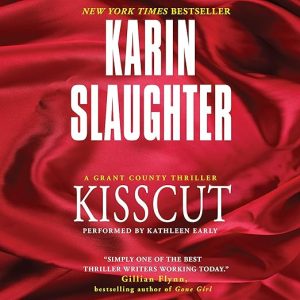
How much brutality can a crime novel earn? Kisscut puts that question to a reader more directly than most, and anyone considering the audiobook should have an answer ready before the first hour is out. Karin Slaughter's second Grant County novel begins with a teenage quarrel at a skating rink that turns into a shoot-out, and then the autopsy arrives and converts a local tragedy into something far worse: evidence of long-term abuse, and of ritualistic self-mutilation, in a town where the children immediately close ranks.
The Review
The structural device at the heart of this series is easy to miss and does an enormous amount of work. Sara Linton is Heartsdale's pediatrician and its medical examiner, which means the same woman treats the town's living children and autopsies its dead ones, often the same children at different points in their lives. The arrangement is not a convenience. It puts a professional obligation to protect and a professional obligation to document inside one person, and the friction between them is where the novel generates most of its moral pressure.
The title repays a moment's attention, and one reviewer has already done the work. Pisces51 explains that the term 'refers to a label that can be peeled away from its background', a die-cutting process where the surface layer separates cleanly while the backing stays intact, and traces it to a scene involving Lena and a family photograph. As a description of what this novel is about, that is almost too apt: a community whose visible surface lifts away from what sits underneath it, with the seam invisible until somebody starts picking at an edge. The same reviewer notes that Slaughter favors one-word titles throughout her catalog, which turns each of them into a compressed thesis rather than a label and raises the stakes on whether the chosen word earns its keep.
Two reviewers disagree about the book's tension in a way that is more useful than either verdict alone. T.H.H., at five stars, calls it 'darker than Blindsighted and far more gripping', praising a plot with too many moving parts to solve early and adding that 'Even the subplots are engaging.' Pisces51, at four, headlines a review saying the novel lacks Slaughter's usual nail-biting suspense while remaining very good. Both can be true. A book that spends its length on institutional silence rather than on a chase will read as denser to one person and slacker to another.
Why Listen to Kisscut
Series continuity is the best reason to come at this one in order rather than in isolation. Lena Adams is still inside the wreckage of her sister's death and of the attack she barely survived in book one, and the description makes that carryover explicit. T.H.H. also flags a trip back to Jeffrey Tolliver's childhood home and the account of how he and Sara first met, the kind of interior material a series can only afford once its cast is established. Listening consecutively lets that accumulation land the way it was built to.
Kathleen Early is credited on this recording, and the hardest job in Kisscut belongs to the teenagers. A group of adolescents deliberately protecting each other has to remain individually distinct while behaving as a bloc, and a listener has nothing but voice to separate them by, with no dialogue tags visible and no name at the top of a chapter. Add a three-way adult investigation and a town of relatives turning their backs, and the roster is the technical challenge here rather than the violence.
Twelve hours and thirty-nine minutes buys a full procedural rather than a thriller sprint, and the pacing reflects that. Frustration is the engine: Sara and Jeffrey are blocked at every turn, families refuse to speak, and the investigation advances by inches. That structure suits long-form listening, where the accumulation of small refusals registers more heavily than it does on a page you can skim. A reader impatient for momentum should know the obstruction is the point rather than a pacing failure.
The Caveats
The content warning here is not a formality. The subject is the sustained abuse of children, described through forensic examination and investigative detail, alongside self-harm and the abduction of a young girl. Slaughter has never been an author who implies where she could state, and this novel gives that instinct its hardest possible subject. Audio removes the skim, which matters more than usual for material like this, and I would not recommend it as company for a commute or a difficult stretch of your own life.
The rating on this listing needs interpreting rather than trusting. Fourteen ratings for a novel by one of the best-selling crime writers working is a thin sample attached to this particular edition, not a measure of the book's standing, and single scores move it noticeably at that volume. One of the visible three-star reviews concerns the condition of a secondhand 2002 printing that had been sitting in a warehouse, and says nothing at all about the writing. Weigh the review text and disregard the average.
One more thing to head off confusion. The publisher copy on this listing opens by promoting a Will Trent thriller before it describes the novel you are actually buying, which is ordinary cross-promotion rather than a mislabeled product. Kisscut belongs to Grant County, book two of that series, with Sara, Jeffrey and Lena at the center. Will Trent is a separate, later sequence entirely, and anyone arriving in expectation of that sequence will spend twelve hours waiting for a character who never appears.
Who Karin Slaughter Is Writing For
Readers already inside the Grant County series are the clear audience, particularly anyone who finished Blindsighted and wants to know where Lena's story goes. Beyond them, this suits crime readers who prefer small-town claustrophobia to a metropolitan manhunt, and who want forensic detail supplied by someone who understands what a medical examiner actually does. One reviewer describes having read everything this author has written and going back to the beginning to read it all again, which is the pattern Slaughter tends to produce in the people who take to her.
Stay away if graphic material involving children is a hard limit, and treat that as advice rather than a caution, because nothing here is softened. Newcomers should begin with the first book instead, since Lena's arc depends entirely on events that happen before this one opens. And readers who want the propulsive, twist-driven version of this genre should note that the four-star review on this page names exactly that as the thing this novel trades away.