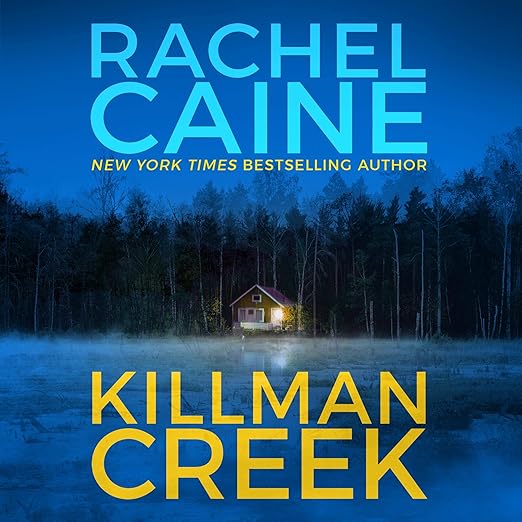
Quick Take
- Narration: Emily Sutton-Smith carries Gwen Proctor’s first-person sections with authority and barely contained fury, which is exactly what the character requires. The pacing through action sequences is strong.
- Themes: Surviving intimate partner terror, the psychology of hunting the hunter, trust under siege
- Mood: Relentlessly tense and propulsive, with a paranoid edge that doesn’t let up
- Verdict: If you finished Stillhouse Lake already invested in Gwen Proctor, this second installment escalates everything that worked in the first book.
I was halfway through my evening commute when Gwen Proctor received the text message that opens Killman Creek’s central conflict: You’re not safe anywhere now. I almost missed my stop. Rachel Caine is not subtle about raising stakes, and by the time her escaped-serial-killer ex-husband has invalidated Gwen’s carefully constructed new identity and scattered her sense of security again, the book has you in exactly the position it wants: unable to set it down, unwilling to sleep until you know how it ends.
This is Book 2 in the Stillhouse Lake series, and while Caine provides enough context for new listeners to orient, the emotional investment that makes Killman Creek work is earned in the first book. Gwen Proctor has spent years rebuilding a life after her ex-husband Melvin Royal was exposed as a serial killer and she was publicly suspected of complicity. That first novel established who she is under pressure. This one asks what happens when the pressure becomes absolute.
Our Take on Killman Creek
The premise is tight and high-concept in the best thriller tradition: a woman trained by proximity to a killer goes hunting for him when he escapes prison. Gwen leaves her children with a fortified neighbor and sets out with Sam Cade, whose sister was one of Melvin’s victims, and what follows is a chase narrative that keeps inverting the predator-prey dynamic. One reviewer described it as keeping them “on my toes” in a way that most thrillers don’t manage because you can usually sense where they’re heading. Caine’s structural moves here are genuinely surprising.
What distinguishes Killman Creek from competent thriller and into something more durable is the psychological texture of Gwen’s interiority. She is not a protagonist who processes trauma neatly or responds to threat with the clean competence of genre convention. Her decisions are shaped by years of hypervigilance, the particular kind of shame that comes from having been publicly suspected of complicity in your partner’s crimes, and an anger she has learned to channel rather than suppress. Emily Sutton-Smith’s narration captures all of this without softening it. The fury is present even in Gwen’s quiet moments, and that consistency across nearly twelve hours is impressive work.
Why Listen to Killman Creek
The action sequences are where Caine and Sutton-Smith together are at their best. The pacing accelerates in ways that feel earned rather than mechanical, and the book’s “sophisticated and savage mind game”, as the synopsis describes Gwen’s adversary, means the physical danger is always layered with psychological manipulation. Trust erodes systematically across the narrative, and Caine handles that erosion with more nuance than the genre usually allows. When alliances that seemed secure start showing cracks, the paranoia compounds in ways that feel organic rather than manufactured.
One reviewer who called the first book in their top five of all time described being surprised that the sequel could live up to it, and came away believing it did. For a sequel operating in thriller territory, where the first book’s surprise is unavailable to you the second time, that’s a significant achievement. The character development that Book 1 initiated clearly deepens here rather than stalling, which is the central risk every sequel faces.
What to Watch For in Killman Creek
The book requires you to have read or listened to Stillhouse Lake first. Not because the plot is incomprehensible without it, Caine provides adequate context, but because the emotional weight of Gwen’s situation, the specific quality of what she stands to lose, and the relationships around her are built on investment the first book creates. Jumping in here will give you a competent thriller; jumping in after Book 1 will give you something with genuine emotional stakes.
The ending leaves threads deliberately open for Book 3, which some listeners will find energizing and others will experience as incomplete. If you prefer thrillers that close all their doors, this series-based approach may frustrate. The resolution within Killman Creek is satisfying on its own terms, but Caine is clearly building toward something larger that this volume advances rather than concludes.
Who Should Listen to Killman Creek
Listen if: You have already read or listened to Stillhouse Lake and are invested in Gwen Proctor’s arc; you like psychological thrillers where the protagonist’s interiority is as important as the plot mechanics; or you want a serial killer narrative told from the perspective of someone who survived proximity to one rather than a detective pursuing an abstraction.
Consider skipping if: You haven’t started the Stillhouse Lake series and are unwilling to commit to Book 1 first. Also worth noting for those who prefer self-contained thrillers: this is a middle-of-series book that intentionally keeps some of its threads alive for what follows.
Frequently Asked Questions
Can Killman Creek be listened to without having read the first Stillhouse Lake book?
Technically yes, Caine provides enough background information that new listeners can follow the plot. But the emotional investment that makes this thriller hit hard is built in the first book. The relationships, the specific trauma Gwen carries, and the stakes of what she’s protecting are all substantially richer if you’ve spent time with her in Stillhouse Lake first. Starting here is possible; starting there is better.
How does Emily Sutton-Smith handle the dual narrative, Gwen’s first-person sections and the third-person sequences involving other characters?
Sutton-Smith is particularly strong in Gwen’s sections, where the controlled fury and hypervigilance of the character’s psychology comes through clearly. She handles the transitions between perspectives without losing momentum, and the pacing through action sequences is notably effective. Several reviewers note that the character voices feel stronger and more distinct in this installment than in Book 1.
The synopsis describes a ‘sophisticated and savage mind game’, is Killman Creek primarily psychological, or does it have significant action and physical confrontation?
Both, in roughly equal measure. The mind game element refers to how Gwen’s adversary works to isolate and destabilize her psychologically while the physical chase narrative runs parallel. Neither dominates exclusively. The book is propulsive enough for action-thriller readers while maintaining the psychological complexity that distinguishes it from pure action.
Is Killman Creek significantly darker than Stillhouse Lake, or does it maintain a similar tone?
The stakes are higher and the threat is more immediate, Melvin is loose rather than imprisoned, so the tension runs hotter throughout. But the tone is consistent with Book 1: psychological thriller with a protagonist who is capable and damaged in equal measure. It does not pivot into graphic violence or horror; the darkness is situational and psychological rather than gratuitous.