Quick Take
- Narration: Sharp and kinetic, calibrated for a YA thriller that moves fast and cannot afford narrative drag.
- Themes: Inherited danger, found family among enemies, the cost of being trained rather than raised
- Mood: Tense and propulsive with moments of genuine darkness, sustained at high velocity
- Verdict: A genuinely compelling YA espionage thriller that earns its comparisons to elite-school action fiction and sets up a series with real promise.
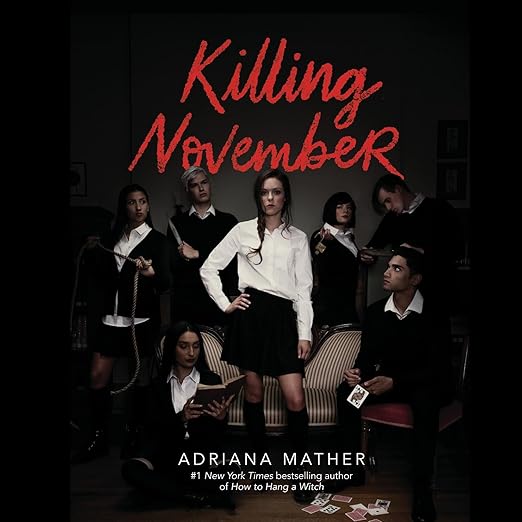
I started Killing November on a Wednesday afternoon when I was specifically looking for something that would require active attention rather than the passive absorption I had been defaulting to for several days. By eight that evening I had finished the first half of the book and was seriously considering canceling the plans I had made for the rest of the evening because the world Adriana Mather had built felt more immediately pressing than anything waiting for me in the actual world. That specific experience of suspension, of genuinely not wanting to return to ordinary life because the narrative has established a more urgent reality, is what good YA thriller writing does at its best, and this novel produces that experience consistently and without obvious strain.
November is a sixteen-year-old who is abruptly sent to a mysterious school in the middle of winter with no phone, no outside contact, and no explanation she finds satisfactory. The school, called Academy Absconditi and set in a cold and isolated location that the story uses for maximum atmospheric effect, turns out to be a training ground for the children of the world’s most dangerous families, populated by students who are being systematically prepared to inherit their parents’ positions in a shadow world of assassination, espionage, political manipulation, and the particular kind of violence that operates beneath the level of official acknowledgment. November does not know why she has been sent here or who made that decision, and the process of uncovering both the school’s purpose and her own connection to it drives the narrative forward with the momentum of a thriller that has thought carefully about what information to withhold and when to release it.
The Academy Setting and What It Demands
The elite school full of exceptional and dangerous students is a proven narrative framework with a long history across multiple genres, and Killing November uses it with genuine invention rather than simply populating a familiar setting with characters designed to produce familiar genre effects. What distinguishes Academy Absconditi from similar settings in the YA genre specifically is the curriculum, which teaches not generalized excellence and refinement but the particular lethal skills specific to each student’s family tradition. The rivalries and alliances that form in this environment are not simply social or romantic in the way that school fiction often makes them; they carry genuine operational stakes because every student is, in principle, both a potential ally and a credible threat.
November’s position as the outsider who does not know the rules creates the reader identification point that the narrative needs, and the author uses it well. Her gradual understanding of the school’s actual purpose and of her own connection to the world it serves unfolds at a pace that withholds enough information to maintain genuine mystery without making the reader feel manipulated by arbitrary concealment. The clues are present in the earlier chapters in retrospect, which is the mark of well-constructed plot architecture rather than a twist that arrives from nowhere to override the story that preceded it.
The Narration and the YA Thriller’s Demands
YA thrillers in audio have a specific requirement that distinguishes them from adult thriller narration: they need narrators who can maintain narrative velocity without sacrificing the clarity that younger listeners require to track a complex plot full of characters with competing allegiances. The genre’s primary audience is not interested in dwelling; they want the story to move forward with purpose, and any moment of vocal performance that creates drag against that momentum will be felt immediately. This production’s narrator understands the requirement and fulfills it consistently. The pacing is tight and purposeful, the character voices are distinct enough to follow clearly in the dialogue-heavy sequences without becoming theatrical or parodic, and the tension sequences are read with the kind of controlled urgency that makes them land as genuinely exciting rather than as descriptions of excitement.
November herself is a first-person narrator on the page, and in audio that interiority becomes the listener’s entire access point to the story’s emotional texture. The narrator’s performance of November’s voice is the audiobook’s central achievement: she sounds smart without being infallible, frightened without being passive, and genuinely funny in the moments where the story permits humor. The relationships with other students, particularly with the characters who become reluctant allies across political and family lines that should make alliance impossible, are rendered with enough warmth to give those relationships genuine stakes.
Series Setup and What It Promises
Killing November is the first volume in a series, and it executes the first-book responsibilities with real competence and without the cheating that first books in ongoing series sometimes permit themselves. It tells a complete story, resolving the central mystery of this volume genuinely rather than deferring it to the sequel. The larger questions, about November’s parents and their place in the shadow world the Academy serves, about the full scope of the Academy’s purpose and its relationship to the political world operating above it, and about the alliances and enmities that will define the subsequent volumes, are established with enough clarity to generate genuine anticipation without creating the sense of a story that has withheld its actual ending for commercial reasons. For listeners who want a YA espionage series with real world-building investment, this is a strong beginning that earns the continuation it sets up. That is not a small achievement for a first book in a series, and it suggests a writer who understands the ethical obligations of serial fiction to its readers.
Frequently Asked Questions
Is Killing November appropriate for the younger end of the YA age range?
The content is appropriate for teens 13 and up, with the caveat that the book includes violence, genuine threat, and psychological complexity that may be intense for younger or more sensitive readers. The dark tone is consistent rather than gratuitous, but parents should be aware it is a thriller rather than lighter YA adventure.
Does Killing November work as a standalone or does it require reading the sequel?
It works as a standalone in the sense that the central mystery of the first volume is resolved. However, larger questions about November’s background are set up for continuation, so readers who want complete resolution should know the series continues in Hunting November.
How does the audiobook narration handle the school’s cast of international and culturally diverse characters?
The character voices are differentiated clearly enough to follow the complex social dynamics of the Academy without becoming a showcase of accent performance. The narrator maintains consistency across a large cast, which is one of the production’s practical strengths.
Are there romantic elements in Killing November and how prominent are they?
Yes, there are romantic elements, and they are handled as a meaningful part of November’s experience at the school rather than as a subplot separate from the thriller narrative. The romantic tension adds stakes to relationships that are also defined by potential danger.