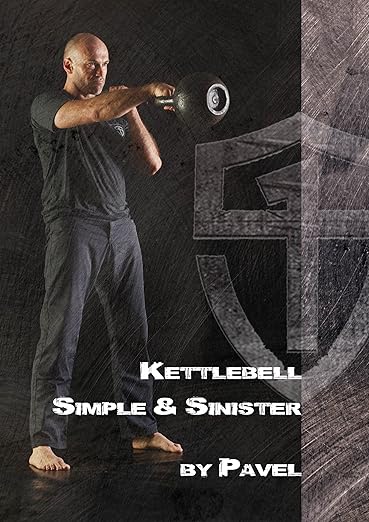
Quick Take
- Narration: Pavel Tsatsouline reads his own work with the dry authority of someone who has been coaching these movements for decades, though technical descriptions of physical form work better with the print edition alongside.
- Themes: Minimalist training, anti-complexity, durability over performance
- Mood: Disciplined and unapologetically spare
- Verdict: The authoritative guide to a genuinely effective two-movement training system, best experienced alongside the print edition for the form cues and photography.
I listened to Kettlebell Simple and Sinister during the week I was evaluating whether to add a kettlebell practice to my own routine, which turned out to be exactly the right context for it. Pavel Tsatsouline has a reputation that precedes him; he is widely credited with bringing the kettlebell to mainstream Western fitness after training Russian special forces athletes, and his programming philosophy, the idea that doing very few things with mastery beats doing many things adequately, has influenced a generation of coaches, athletes, and strength enthusiasts. The book is short, opinionated, and makes no apology for either quality.
The Simple and Sinister program is built around two movements: the two-handed kettlebell swing and the Turkish get-up. Ten sets of ten swings, ten sets of one Turkish get-up per side, performed daily or near-daily with gradual weight progression over months. The goal is not complexity but depth. Tsatsouline wants you to spend a serious amount of time learning to perform these two movements with technical mastery before moving to anything else. The Simple and Sinister labels refer to specific performance standards he has set at particular weights, representing what he considers a genuine baseline of functional strength.
Our Take on Kettlebell Simple and Sinister
Tsatsouline reads the book himself, and his narration has a particular quality: precise, slightly formal, occasionally dry in a way that might register as humor or might simply be the delivery of someone who has said these things many times and trusts the material absolutely. Reviewers describe him variously as a genius and as extremely intelligent, which says something about how the content lands for people who come to it with genuine curiosity rather than skepticism. One reader, after twenty-four years of weight training, noted that the book improved their deadlift technique as a side effect of applying the hip hinge instruction from the swing section.
Why Listen to Kettlebell Simple and Sinister
The case for the audiobook format is straightforward if you are already familiar with the movements from a coach or video instruction, or plan to use visual resources alongside the audio. Tsatsouline breaks down the mechanics of each movement in detail, covering tension generation, hip hinge mechanics, breathing patterns, and the connection between the swing and the get-up in ways that translate reasonably well to audio for reinforcement. The book is short enough to listen to in its entirety multiple times as your training evolves, and several reviewers mention returning to it after their kettlebell practice has progressed past the beginner stage.
What to Watch For in Kettlebell Simple and Sinister
The limitation of any audiobook covering physical movement is that you cannot see what is being described. The print edition includes photographs of each movement at key positions, and that visual reference is genuinely useful when learning a movement pattern for the first time. Tsatsouline’s verbal descriptions are precise, but a complete beginner relying on audio alone may struggle to translate the cues into safe movement without complementary video instruction. This is worth acknowledging before committing to the audio-only format. The book is also opinionated in ways that some readers will find dogmatic, particularly regarding programming variety.
One aspect of the book that translates well to audio is Tsatsouline’s philosophical framework around tension, relaxation, and the relationship between strength and efficiency. He argues that the ideal expression of the swing and the get-up is not brute force but organized tension applied at the right moments, and that concept is accessible through description in ways that the fine motor details of form are not. Experienced movers will find this framework immediately applicable; beginners will get the concept before they can embody it, which is still useful preparation for the physical practice.
Who Should Listen to Kettlebell Simple and Sinister
This audiobook suits anyone considering starting a kettlebell practice or wanting to understand the philosophical underpinning of minimalist strength training from its primary Western advocate. It works for experienced lifters curious about how kettlebell training complements rather than competes with barbell work, and for athletes looking for a durable maintenance program that does not require much equipment or time. Skip it if you need visual instruction to learn movement patterns safely, or supplement with video if you are a complete beginner. The print edition is the more complete learning experience, but the audiobook serves well as reinforcement once the movements are established in your body.
Frequently Asked Questions
Can a complete beginner safely learn the kettlebell swing and Turkish get-up from this audiobook alone?
The descriptions are detailed, but physical movement learning benefits significantly from visual reference. A complete beginner is better served using the audiobook alongside a qualified coach, instructional videos, or the print edition’s photographs rather than relying on audio instruction alone.
What are the Simple and Sinister performance standards Tsatsouline sets in the book?
The standards are specific benchmarks at particular kettlebell weights, representing what Tsatsouline considers a solid baseline of functional strength. The exact targets vary and are presented as long-term goals rather than immediate expectations for new practitioners.
How does this program fit alongside existing athletic training?
Tsatsouline addresses this directly in the book, arguing that Simple and Sinister is designed to complement rather than compete with sport-specific or barbell training. The low volume, high-quality-movement approach means it leaves recovery capacity available for other athletic work.
Is the audiobook version of Kettlebell Simple and Sinister meaningfully different from the print edition?
The print edition includes movement photographs that the audiobook cannot replicate. For learning the movements from scratch, the print edition is more complete. The audiobook is useful for reinforcing the philosophy and revisiting technical cues once you have the basic patterns established.