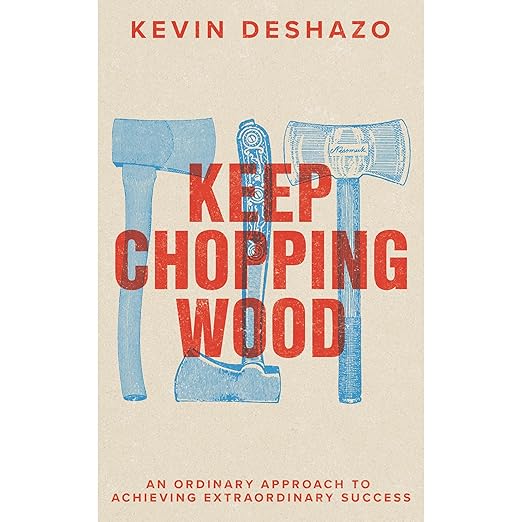
Quick Take
- Narration: Virtual Voice AI narration keeps the delivery clean and consistent, though it lacks the warmth a human narrator would bring to a motivational parable, acceptable given the short runtime.
- Themes: Discipline over talent, process-focused success, blue-collar work ethic
- Mood: Punchy and motivating, like a pep talk you actually needed
- Verdict: A compact, no-nonsense field guide to the discipline gap, best for coaches, team leaders, and anyone who keeps confusing wanting results with doing the work.
I stumbled onto this one on a Tuesday evening when I had about an hour to fill between calls. Forty-eight minutes. I figured I’d half-listen. Instead, I finished it straight through and found myself scribbling notes on a Post-it.
Kevin DeShazo’s Keep Chopping Wood is not trying to be the definitive leadership text. It knows what it is: a short story wrapped around a field guide, designed to get ordinary people moving. The central metaphor, chopping wood, one swing at a time, without watching for results, sounds deceptively simple. It is. But DeShazo earns the simplicity by building a story around it rather than just asserting the principle and moving on.
Our Take on Keep Chopping Wood
DeShazo’s argument is that we live in what he calls a drive-thru culture, where we expect dinner, dry cleaning, and personal transformation all delivered from the driver’s seat. The framing is sharp because it names something real. Most motivational content tells you what you already know. This book does something slightly different, it embeds the lesson inside a fictional scenario that forces you to watch a character wrestle with the gap between knowing and doing. Will K., a reviewer, put it well: the book “incorporates leadership lessons within a real life story so you can picture the principles and not get lost in the words.” That’s the functional difference between this and the thousand other books making the same argument about hard work.
The three pillars DeShazo returns to, belief in the vision, commitment to the process, and discipline to do the work, are not novel. But the sequencing matters. Most people front-load vision and skip straight to expecting results. DeShazo insists the middle piece, the commitment to process, is what separates those who stay in the game from those who quit when results are slow. It is a useful corrective, and he makes it stick.
Why Listen to Keep Chopping Wood
The audiobook format works surprisingly well for this title despite the Virtual Voice narration. At under an hour, there is no padding, no filler sections, no extended analogies that overstay their welcome. You can listen during a morning run or a lunch break and walk away with something actionable. One reviewer, an assistant principal, bought seven additional copies after finishing it, specifically to hand them to young people needing motivation. That tells you something about the practical, distributable quality of the content.
DeShazo writes with a gritty, blue-collar sensibility that avoids the corporate-speak that plagues most leadership content. Phrases like “do you have the discipline to become great?” land differently when they follow an actual story about someone choosing between comfort and commitment. The book earns its conclusions rather than just asserting them.
What to Watch For in Keep Chopping Wood
Virtual Voice narration is the most significant caveat here. For a book built around emotional resonance and motivation, the absence of a human voice is a genuine limitation. The prose is simple enough that the AI delivery handles it without confusion, but there is a ceiling on how moved you can feel by a synthetic performance. If narration performance matters to you, this is worth noting upfront.
The brevity is mostly a strength, but some listeners may find the field guide section at the back feels abbreviated. The story itself does the heavy lifting; the practical exercises are useful but brief. If you are hoping for a detailed coaching framework, this is a primer, not a curriculum. Think of it as the opening argument for a conversation you will need to continue on your own.
Who Should Listen to Keep Chopping Wood
This works best for coaches, team leaders, and anyone in a mentoring role looking for a short, shareable tool. It is also well suited to anyone who has been spinning on motivation without translating it into daily action, the book is essentially a gentle confrontation with that pattern. Skip it if you are looking for new frameworks or research-backed methodology; DeShazo is not offering either. This is philosophy, not strategy.
Frequently Asked Questions
Is the Virtual Voice narration distracting in Keep Chopping Wood?
It is functional but not immersive. The simple prose style means AI narration handles the material without stumbling, but the motivational energy that would come from a skilled human narrator is absent. At 48 minutes, most listeners find it tolerable.
Is Keep Chopping Wood only for athletes and sports coaches?
No. The title and some of the metaphors have a sports-adjacent feel, but the content is squarely aimed at anyone in a leadership or personal development context, educators, managers, entrepreneurs, and people looking to close the gap between intention and action.
How is Keep Chopping Wood structured, is it a story or a guide?
It is both. DeShazo weaves a fictional story illustrating his principles, then follows it with a field guide section that invites reflection and application. The story carries the emotional weight; the guide section is where you put it to work.
At 48 minutes, is Keep Chopping Wood substantial enough to be worth the time?
Yes, if you engage with it actively. The brevity is intentional, DeShazo strips out everything that does not serve the central argument. Reviewers consistently note that it rewards being listened to more than once, or shared with teams as a discussion starter.