Quick Take
- Narration: Shaina Summerville delivers the material with a calm, accessible warmth that suits the teenage audience. The mindfulness exercises and reflective passages benefit from a voice that feels safe rather than clinical.
- Themes: Self-acceptance and the comparison trap, mindfulness for teens, moving from inner critic to inner ally
- Mood: Gentle and affirming, with enough practical substance to go beyond motivational platitude
- Verdict: A genuinely useful guide for teens navigating the impossible standards of contemporary culture. The mother-daughter authorship adds authenticity that purely academic self-help rarely achieves.
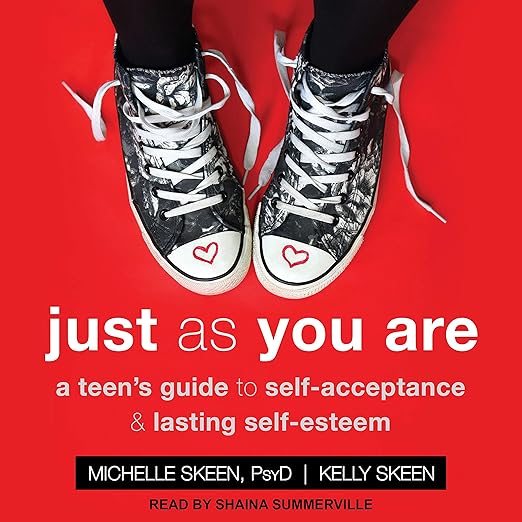
There is a particular kind of book that lands differently depending on when you encounter it. I picked up Just As You Are as an adult who has spent enough years on the other side of the self-comparison spiral to recognize both the problem and the limits of most solutions offered to it. Michelle Skeen and her daughter Kelly Skeen have written a book for teenagers, and reading it as someone long past that stage, I found myself thinking about the specific texture of adolescent self-judgment in ways I had not revisited in some time. This is a book I could have used at sixteen, and the fact that it exists now, carefully calibrated to the actual experience of being a teenager navigating social media and peer comparison, makes it feel like a genuinely necessary addition to the teen self-help space.
The premise is clear and well-constructed: teens face a culture of impossible standards, fueled by social media, peer competition, and media images of perfection, and the resulting comparison game feeds an inner critic that robs them of genuine happiness. Skeen, a psychologist, and her daughter Kelly have built a guide that offers mindfulness tools, thought exercises, and values-based goal-setting in language that is accessible without being patronizing. At under four hours, it is a compact listen, and the brevity is a feature rather than a limitation. The material is explicitly designed to be absorbed in sessions and returned to over time, not consumed in a single sitting and set aside.
What the Mother-Daughter Authorship Actually Adds
The collaboration between a psychologist mother and her teenage daughter is this book’s most distinctive structural feature, and it is considerably more than a marketing angle. Kelly Skeen’s co-authorship grounds the clinical material in the actual, present-tense experience of being a teenager rather than the remembered experience of someone looking back at adolescence from an adult remove. One reviewer who teaches high school and has raised daughters of her own described the book as one she could have used over and over again across her career, attributing its effectiveness partly to the way the Skeens take readers on a guided journey rather than handing down prescriptions from above. Another reviewer, who described recently coming out and reading the book, noted that every point the authors make is expanded with personal stories from other teens, which makes the material feel real rather than theoretical. That grounding in actual adolescent experience, rather than in clinical summaries of adolescent experience, is what distinguishes this book from self-help for teens that is written entirely by adults who have forgotten what it feels like to be on the inside of that age.
The Mindfulness Tools and Why They Work in This Context
The book draws on mindfulness practice as its primary framework for helping teens step out of the comparison loop and develop awareness of their thoughts and feelings in the moment. The way that framework is presented matters enormously for the audience it is targeting. There is a version of mindfulness instruction for teenagers that is condescending, or that imports adult practice language without any adaptation for a younger audience. Skeen avoids that trap consistently. The tools offered here are genuinely practical and calibrated to the attention span and emotional vocabulary of a teenage listener, with exercises that are brief enough to actually attempt rather than intimidating in their scope. A teen mindfulness coach who reviewed the book described using it as a roadmap with clients, finding the exercises transformational in practice rather than merely theoretical. That kind of endorsement from someone testing the material in real sessions carries more weight than a positive impression from a single read-through. The audiobook format adds a particular value here: mindfulness-adjacent material often lands differently when heard rather than read silently, and Summerville’s narration creates the right listening environment for the reflective exercises the book asks of its audience.
Where the Book Has Limits and Who It Reaches Most Powerfully
At just under four hours, Just As You Are is designed for teenagers, and the accessibility of its language means that some adult readers will find it lighter than they are looking for in self-help. The psychological concepts are deliberately not deeply theoretical; the book translates research into accessible, actionable language without fully unpacking the studies behind the tools it offers. For teenagers and for adults who work with them professionally or personally, this calibration is exactly right and represents a genuine skill. For adults seeking a more rigorous engagement with the underlying psychology of self-comparison and inner criticism, the book’s suggested further reading points toward deeper resources. One reviewer noted purchasing the book for a daughter who was struggling, reporting that it seemed to help her find some meaning for herself, which is the most direct measure of a self-help book’s success: it actually works on the person it was written for. Another described sharing it with a daughter’s friends, both of whom gave it two thumbs up, suggesting the material travels well between teenage readers rather than being useful only in a prescribed therapeutic context.
Summerville’s narration is warm and measured, providing the kind of listening environment that allows the book’s mindfulness exercises to feel like genuine invitations rather than assigned tasks. For its intended audience, this is one of the more honest and practically useful self-help titles in the teen space, built with genuine understanding of what the comparison trap costs at that specific age.
Teens Who Will Thrive Here and Those Who May Not
Listen if you are a teenager struggling with self-comparison and inner criticism, or an adult purchasing this for a young person in your life. Also useful for parents, educators, and counselors looking for accessible, evidence-based tools to support teenage self-acceptance. Skip it if you are looking for a deeply researched adult psychology text rather than an accessible teen guide with practical exercises.
Frequently Asked Questions
Is this suitable for both teenagers and adults, or is it written exclusively for teens?
Primarily written for teenagers, with language calibrated for that audience. Adults working with teens, parents, and educators will find it valuable as both a resource to share and a window into the challenges facing this age group. Adult readers looking for personal self-help may find it lighter than they want.
What psychological framework does the book draw on?
The book draws on mindfulness practice and elements of cognitive behavioral therapy, translated into accessible language for a teenage audience. The clinical concepts are not deeply unpacked, but the tools derived from them are genuinely practical and tested.
Does the book address LGBTQ+ teens specifically, or is it general?
The self-acceptance framework is general, but one reviewer described the book as particularly meaningful to them as someone who had recently come out. The book’s emphasis on accepting all aspects of who you are extends naturally to identity dimensions including sexual orientation and gender identity.
How does the audiobook format compare to the print version for this kind of self-help material?
The audio format has a genuine advantage for the mindfulness exercises and reflective passages. Hearing the material creates a different kind of engagement than reading it silently, and Summerville’s narration provides the calm, accessible environment that makes the exercises feel like invitations rather than homework.