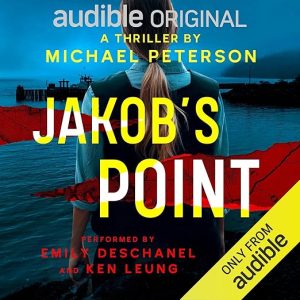
- Performance: Emily Deschanel stars rather than narrates, lending her Bones-era authority to FBI Agent Alice Wheaton in a production designed from the ground up for audio.
- What it covers: Witness protection, hidden identity, forensic listening, trauma and investigation
- Feel: Tight and atmospheric, designed for a single sitting
- Our call: A sharply constructed audio-native thriller that uses its cast and its short runtime as genuine strengths rather than compromises.
Jakob's Point is an audiobook built specifically for the ear, not adapted from the page for it. That distinction matters more than it might sound. This production, crafted by Best Case Studios and starring Emily Deschanel alongside Ken Leung, arrives as an audio-first thriller with a premise that earns its ninety-minute frame: a small American town with more Witness Protection residents than anywhere else in the country, a dead Federal Marshal, and every resident simultaneously a witness and a suspect. For listeners who have grown impatient with the overlong mid-thriller sag that plagues commercial fiction in its audio conversion, Jakob's Point offers a different contract entirely.
What Michael Peterson Delivers
The craft choice that defines this production is what the synopsis calls forensic listening. FBI Special Agent Alice Wheaton's investigative method involves reading what people say in the way a forensic analyst reads trace evidence: not just what words are spoken but the gaps, rhythms, and evasions behind them. It is a clever structural hook because it builds in a reason for Deschanel to perform the audio material with particular intensity. She is not simply narrating; she is modeling attentive listening as a skill.
Deschanel is best known to most audiences from her long run on the television procedural Bones, and this production benefits from that association in specific ways. Her voice carries clinical intelligence without losing warmth, and she handles Alice's gradually surfacing past trauma as a counterweight to the plot's more procedural beats. The pairing of unresolved personal history with an active investigation is familiar thriller architecture, but Deschanel makes it feel less formulaic than it might in less capable hands. Reviewer JBJNYG specifically cited Deschanel's narration as the factor that made the story easy to visualize, which speaks to how well the casting serves the material. This is not a case where a celebrity name adds novelty without substance. Deschanel is doing actual character work here.
Ken Leung's presence in the cast deserves mention. Leung, whose television career includes the series Industry, brings a restrained intensity to supporting roles that suits the atmosphere of Jakob's Point well. His pairing with Deschanel gives the production an ensemble quality that the audio format can sometimes flatten, and the Best Case Studios production values keep the two performances in a consistent register rather than letting one overwhelm the other.
What Michael Peterson Gets Right
The Witness Protection premise is genuinely inventive as a mystery setting. When everyone in town is hiding a prior identity, the usual assumptions of small-town mystery fiction collapse. Nobody is necessarily who they appear to be, which means Alice cannot rely on the social hierarchies and community knowledge that typically anchor this kind of investigation. The Marshal who kept the town's secrets is gone, and his records with him. The investigation has to work from pure behavioral and conversational evidence, which is precisely what Alice's forensic listening skill is designed to process.
Reviewer Mark, noting the production worked well for a short car ride, touches on something real: this is not a padded story squeezed into a tight format. The pacing is genuinely calibrated for under two hours. Reviewer PacificCoastMom praised the twists specifically, which suggests the compressed runtime does not prevent the story from delivering the surprise architecture that thriller readers expect. Short-form audio thrillers that maintain genuine structural tension across their limited runtime are rarer than they should be, and Jakob's Point is a strong example of what the format can achieve when the writing respects its own constraints.
Where Michael Peterson Loses Some Ground
The short runtime is the feature, but it comes with a corresponding constraint: do not expect deep backstory or extensive world-building. Alice's unresolved past trauma is present as a motivating thread, but the story does not resolve it exhaustively within this installment. Reviewer Mark noted the ending as somewhat contrived, which is worth knowing. Jakob's Point is a satisfying short-form thriller, but it functions at the level of a very well-made novella rather than a full-length novel. If you want extensive procedural depth or complex secondary character development, the format will feel limited by design.
What the format does allow is atmosphere. The audio-native design means every scene choice, every pacing decision, was made for listening rather than reading. The sense of Jakob's Point as a place held together by secrets and mutual pretense comes through more effectively in audio than it might on a page, where the reader sets their own pace rather than being led through the town's rhythms by a performed narration. The mature content advisory is real, and the psychological dimensions of the story, including references to Alice's personal trauma, require an adult listener who is prepared for that weight alongside the mystery mechanics.
Who Should Pick Up Jakob's Point
Mystery fans who enjoy procedural investigation through the lens of psychological insight will find Alice's forensic listening approach genuinely satisfying. This production works best for listeners who want something complete in a single session: a long drive, an afternoon clearing out, an evening that needs a defined ending. Fans of Emily Deschanel's work will hear her doing something careful and character-specific rather than simply lending her name to a project. Skip it if you want a lengthy, layered thriller with deep world-building. But as a purpose-built audio experience that respects your time and makes genuine use of its form, Jakob's Point is well worth an hour and forty minutes.
How does this audiobook differ from a typical adapted novel?
Jakob's Point was produced as an audio-first thriller by Best Case Studios, meaning it was written and designed for listening rather than adapted from a print book. The pacing, cast performance, and scene structure reflect that origin.
Does Emily Deschanel's performance live up to the casting in this audiobook?
Reviewers who mentioned Deschanel specifically cited her as adding clarity and character to the story. Her background in television procedural drama fits the investigative tone of the material well, and she brings genuine performance rather than celebrity presence.