Quick Take
- Narration: Scott Brick is one of the most reliable voices in American audiobook production, and his hard-boiled cadence is an ideal match for De Haven’s Depression-era prose, the casting feels inevitable in retrospect.
- Themes: The invention of heroism, Depression-era America and fascism, the myth-making machinery behind icons
- Mood: Pulpy and literary at once, like a Raymond Chandler novel that occasionally features a man who can fly
- Verdict: An intelligent, historically grounded reimagining of Superman’s origins that works for readers who care more about character than cape.
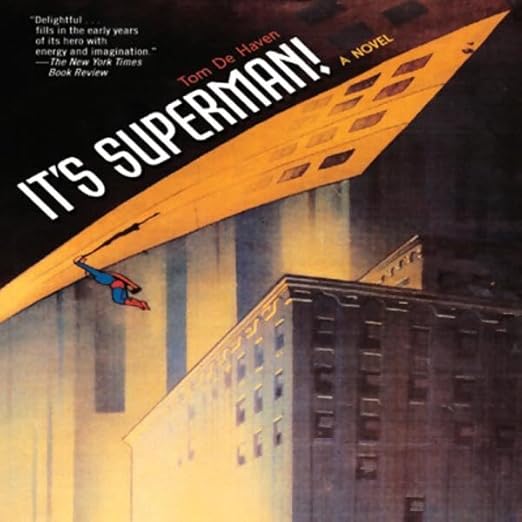
I came to It’s Superman from the direction of literary fiction rather than comics, and I suspect that is the right angle of approach. Tom De Haven is primarily known as a novelist of American vernacular realism, his Derby Dugan trilogy does for Depression-era newspaper culture what this book does for the superhero mythology that emerged from the same period. The two projects turn out to have more in common than you might expect.
Scott Brick’s narration is doing something specific and appropriate here. This is not a book that wants to sound like a Marvel movie. It wants to sound like Raymond Chandler, and Brick, who has narrated more hard-boiled fiction than perhaps any working narrator, leans into that register without tipping into parody. The 1930s atmosphere that multiple reviewers flag as the novel’s greatest pleasure is largely delivered through Brick’s pacing and tone.
Our Take on It’s Superman!
De Haven’s central gambit is to strip the mythology back to its source material, Action Comics, 1938, Jerry Siegel and Joe Shuster, two young men from Cleveland who created something they did not entirely understand, and ask what that original version of Clark Kent would actually look like if rendered with literary seriousness. The answer involves an awkward Kansas kid who is genuinely not sure what to do with abilities that make no sense in his world, a worldly Lois Lane who is not waiting to be rescued, and a Lex Luthor who is explicitly coded as the kind of political opportunist that fascism required.
The novel’s geography is its emotional architecture. Rural 1930s Kansas gives way to Hollywood in its golden age gives way to New York City, and each location has a distinct moral atmosphere. Clark becomes more himself by moving through each one, and the coming-of-age arc, which is the spine of the novel regardless of the super-powered trappings, is traced through place as much as through event.
Why Listen to It’s Superman!
The historical density is a genuine pleasure. De Haven has done serious research and it shows in the specificity of the period details, the Depression-era economics, the newsroom culture, the relationship between Hollywood and the political moment it was navigating. Readers who loved Michael Chabon’s The Amazing Adventures of Kavalier and Clay, which De Haven’s publisher explicitly invokes, will find familiar pleasures here: the comic book industry as a lens for examining American identity at a moment of crisis.
The comparisons to Smallville that appear in the marketing are less illuminating than the Kavalier and Clay comparison, which is doing real descriptive work. This is a book about mythology-making as much as it is about Superman specifically, and De Haven is interested in why America needed to invent this particular figure at this particular historical moment.
What to Watch For in It’s Superman!
Some readers who grew up with specific versions of these characters will find De Haven’s interpretations disorienting. The Clark Kent here is not the Clark Kent of the silver age comics, and the Luthor is not the bald corporate villain of later canonical versions. One reviewer from the long-time-reader contingent notes that this version could function as an entirely original story with the names changed, which is either a criticism or a compliment depending on what you came for.
At sixteen hours, this is a substantial listen. De Haven is writing in long, immersive chapters rather than short episodic ones, and the novel rewards the kind of sustained attention that long-form audio delivers well. The hard-boiled fans in the reviewer pool are the ones who seem most satisfied, which tells you something about the tonal home base.
Who Should Listen to It’s Superman!
Ideal for listeners who like their pop mythology treated with literary seriousness, fans of Kavalier and Clay, of Philip K. Dick’s approach to genre, of the revisionist superhero projects of the 1980s that asked what these figures would actually mean if they existed. Also well-suited for history readers interested in the Depression era and the cultural machinery that produced the superhero concept. Listeners looking for action-forward Superman adventure in the vein of the films may find De Haven’s pace and his interest in period texture more demanding than rewarding.
Frequently Asked Questions
Does Scott Brick’s narration work for a story this focused on 1930s period atmosphere?
Very well. Brick’s natural register sits in the hard-boiled American vernacular tradition, and De Haven’s prose is written in that idiom. The pairing feels matched rather than assigned, and Brick’s pacing helps establish the period without the narration feeling like a costume.
How closely does It’s Superman follow established Superman canon, and will deviations bother dedicated fans?
De Haven departs significantly from canonical versions of the characters, especially Luthor and to some extent Clark himself. Long-time comics fans who need strict canon fidelity may struggle. Those who approach the novel as an independent literary interpretation of the mythology will find the departures productive rather than jarring.
Is this appropriate for younger teen readers, given it is listed under YA?
The YA classification is somewhat loose here. The novel is not inappropriate for mature teens, but its literary ambitions, period-specific density, and interest in political and historical texture make it most rewarding for adult readers and very mature high school students. It is not a teen adventure novel in the conventional YA sense.
How does the Kavalier and Clay comparison hold up?
Reasonably well on thematic grounds, both novels treat the early comics industry and the invention of superhero mythology as serious cultural history, though De Haven’s prose style is more direct and less ornate than Chabon’s. Readers who loved Kavalier and Clay for its historical texture and its argument about American identity will find familiar pleasures here.