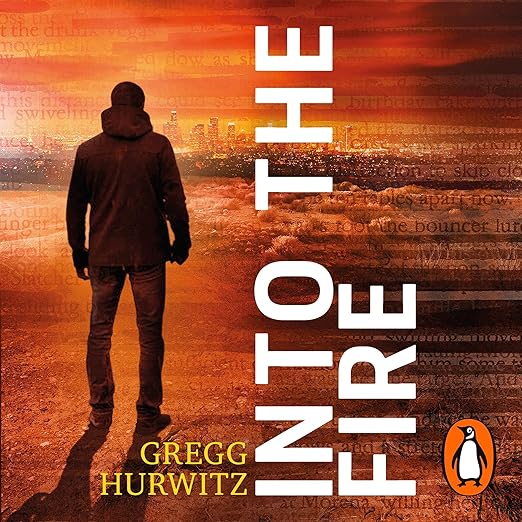
Quick Take
- Narration: Scott Brick is the gold standard for this series, conveying Evan’s controlled authority and suppressed humanity with equal precision.
- Themes: Penance and identity, protection as moral calculus, the cost of capability
- Mood: Propulsive and taut, with genuine emotional undercurrent
- Verdict: One of the stronger entries in an already strong series, though its full power is reserved for readers who have followed Evan from the beginning.
I came to the Orphan X series through a reader recommendation that came with a warning: do not start in the middle. I ignored the advice and picked up Into the Fire, book five, on the strength of Scott Brick’s name in the narration credit. I spent the first hour playing catch-up and the next ten hours completely unable to stop. Gregg Hurwitz writes action thrillers with a structural discipline that most genre writers do not bother with, and Brick is one of the few narrators who can match that discipline with his voice.
Evan Smoak is preparing to retire. That is the premise at the start, and it is the kind of promise the thriller genre routinely breaks. What makes Into the Fire interesting is not the breaking of the promise but the cost of it. Each mission Evan takes as the Nowhere Man is framed explicitly as penance for his time as Orphan X, a government assassin. This moral accounting gives the series an unusual weight for the genre, and book five deepens it by giving Evan a protectee, Max Merriweather, who is almost aggressively ordinary. Max is not trained, not competent, not secretly useful. He is a cousin trying to find out why someone murdered his family member, and he is terrified. That contrast, Evan’s total capability against Max’s total helplessness, generates the novel’s best tension.
Our Take on Into the Fire
Hurwitz plots with a tightness that rewards attention. The forces arrayed against Evan and Max are layered, and the novel builds toward confrontations that feel genuinely earned rather than choreographed. One reviewer called the action sequences outstanding in every way, while another noted that the book focuses on the Nowhere Man aspect of Evan’s identity in a way that prior installments do not. That is accurate: this is a book about what it means to commit to protection when you have spent your professional life committed to elimination, and Hurwitz does not let that theme become decorative.
The moments of warmth and humor that several readers mentioned are real and not incidental. Hurwitz gives Evan a domestic life in his fortified Los Angeles condo, a set of relationships that are carefully guarded and quietly meaningful, and the novel uses those relationships to show what Evan risks by continuing the Nowhere Man work. That contrast between his armored public self and his carefully cultivated private one is where the series earns its character depth.
Why Listen to Into the Fire
Scott Brick has won an Audie Award, and this recording illustrates why. His voice carries physical authority, which is essential for a character like Evan Smoak, but Brick does something more difficult: he modulates that authority into vulnerability during the quieter emotional passages without it feeling like a gear change. The moment when Evan registers that Max is genuinely terrified and adjusts his approach is a small character beat in the text, and Brick makes it audible in his delivery.
At just under twelve hours, Into the Fire is a well-paced listen for its genre. Hurwitz does not pad, and Brick does not linger. The result is an audiobook that moves with the efficiency of its protagonist, which is exactly what it should do.
What to Watch For in Into the Fire
New listeners to the series will miss context. The reviewer who advised reading Orphan X first was correct: the emotional weight of Evan’s history with the program, and the significance of the relationships he has built since leaving it, are established across four prior novels. Into the Fire provides enough context to follow the plot, but the depth of feeling in certain scenes requires prior investment to fully land. This is emphatically a series, not a standalone universe.
The antagonists in this installment are lethal but somewhat less individualized than the principal villains of earlier books, which some readers notice. The threat is organized and credible, but if you have come to the series for sharply drawn opponents with their own philosophical complexity, Into the Fire leans more toward ensemble menace than single-villain depth.
Who Should Listen to Into the Fire
Existing Orphan X readers should come here without hesitation: this is the series at full speed, and Brick’s narration is the best argument for audio over print. New readers should strongly consider starting with the first book, Orphan X, to get the full weight of Evan’s arc. Fans of Lee Child, Vince Flynn, and Brad Thor will find Hurwitz working at that same level of craft, with the additional quality that his protagonist is morally complicated in ways those comparisons sometimes are not.
Frequently Asked Questions
Can Into the Fire be listened to as a first Orphan X book?
Technically yes, plot-wise. But emotionally, the book is significantly richer with four novels of context behind it. The relationships, Evan’s guilt about his past, and the significance of his condo life all carry more weight for readers who have followed the series from the beginning. Hurwitz does provide enough backstory to follow the action.
How does Scott Brick’s narration compare to the written reading experience for this series?
Readers who have done both consistently report that Brick’s performance adds a dimension the text alone does not have, particularly in action sequences where his pacing and vocal control create a physical urgency. His rendering of Evan’s controlled emotional register is widely praised as definitive.
Is this a good entry point for listeners who want explosive action but also character depth?
Yes. Hurwitz balances action choreography with genuine character interiority, and Into the Fire tilts slightly more toward character complexity than pure action compared to earlier installments. The Max storyline functions almost as a reflection of what Evan could have become, which adds thematic weight beyond the thriller mechanics.
Does Into the Fire work as a standalone conclusion, or does it end on a cliffhanger?
The novel resolves its central mission and the immediate threat to Max. The larger arc of Evan’s life, his guilt, his ongoing work as the Nowhere Man, and his relationships, continues across the series. It is a satisfying close to this specific story while leaving the broader narrative open.