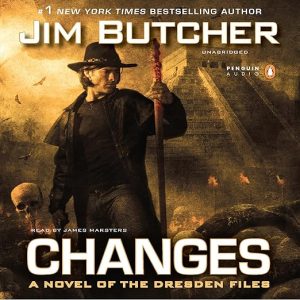
Harry Dresden's child has been taken, and the publisher's own copy tells you so before you press play. That is where this audiobook begins: Chicago's only professional wizard, a former lover who disappeared to South America years ago, a vampire duchess who has discovered the secret Susan Rodriguez kept from everybody including Harry, and a rescue that will cost him considerably more than he has to spend.
What Jim Butcher Delivers
Book twelve is where a long series stops circling. Steve Manke, writing three weeks after the April 2010 release, identifies exactly what changed: the earlier books were built around cases brought to a private investigator, while this one is focused entirely on Harry's personal life. That is a structural pivot rather than an escalation, and it explains why the reaction to this installment ran hotter than usual. The wizard who advertises on a business card has stopped solving other people's problems.
Stakes come from history the series had been carrying for a decade. Susan Rodriguez was attacked by Harry's enemies, left suspended between humanity and the relentless bloodlust of the Red Court, and went south to fight both her savage gift and the people who inflicted it on her. Now she needs him. The vengeful Duchess of the Red Court has found what Susan hid from everyone, and intends to use it. To prevail, the copy warns, Harry may have to embrace the darkness inside himself. That is a genuinely different proposition from a case file. Everything he has spent eleven books protecting, his own restraint included, is now available to be spent, and the publisher makes no attempt to hide which way that goes.
What Jim Butcher Gets Right
Consequence is what this installment sells, and not one of the five accounts disputes it. Karissa Eckert calls it the best book in the series and sets that against considerable affection for everything preceding it, which is the strongest form the compliment can take. A reader in Mexico, writing in 2024, describes the entire Dresden universe changing: conflicts resolved explosively, decisions Harry cannot walk back taken to protect somebody innocent, and conspiracies long suspected finally surfacing in daylight. That account closes on the most useful line available here. Harry is not the same afterward.
James Marsters holds the reading credit, and it is worth saying plainly that nobody on this page has written a word about the reading. Five written accounts, four countries, and every one of them concerned with plot, continuity and consequence rather than with what the recording sounds like. On a fifteen-hour urban fantasy that is a real hole in the evidence, and it leaves a first-time buyer deciding on the strength of the writing alone.
What the material offers is pace. A wizard, a vampire court, a stolen child and a deadline are the components of a book that moves, and the description is honest about the register. Demons, werewolves, dark sorcerers and horrors from beyond the mortal realm have all happened already, and this one is supposed to be worse. The starred Booklist notice reproduced on the listing calls it an entry you cannot miss in one of the best urban-fantasy series being published, which is a 2010 verdict on the writing rather than anybody's opinion of the audio.
Where Jim Butcher Loses Some Ground
Nine ratings is the number that stops you. This is the twelfth volume of an established series, and the page reports nine scores, five of which arrive with written accounts attached. A 4.8 average assembled from nine votes carries no useful signal about a book read this widely. The four scores nobody explained cannot all be top marks, since every visible account awards the maximum, and four anonymous votes tell you nothing about why.
Spoilers need a warning the listing declines to give. The publisher's copy states the central revelation outright in its closing line, and the most detailed reader account goes considerably further, naming who calls, what the surprise turns out to be and who has taken the child. If you are working through the series in order and have not reached book twelve, do not read the description and do not read the reviews. The marketing has already made that choice on your behalf.
Four countries and three languages appear in the written record, which is worth reading as a signal in itself. Accounts arrive from the United States, Mexico, India and Germany, in three languages, spanning 2010 to 2024. A German notice from 2012 admits to devouring the series so fast that no time was left to review anything in between, and calls the books simply addictive. An account from India in 2018 offers nine words of approval. The series travels, clearly. It also means this average is aggregating readers of translated print editions with anybody who bought this recording.
Defects sit in the record itself, two of them small enough to miss. Mystery, thriller and suspense is where this sits, under a Mystery tag, while the starred review printed in its own description calls the series urban fantasy, which is where a buyer would actually go looking. The copy also carries a stray possessive, printing that Susan was Harry's Dresden's lover, the kind of slip nobody proofreads out of a backlist page.
Who Jim Butcher Is Writing For
Existing readers who have reached book eleven are the entire natural audience, and every account here was written by one of them. If you have been waiting for the series to settle the debts it has been accumulating, this is reportedly the volume where that happens, and the reactions from 2010 and from 2024 agree about it fourteen years apart. Anybody who came to urban fantasy for consequences that carry across volumes will find this the payoff. Anyone who has been putting the series off because it looked like episodic detective work has, by this installment's own reputation, just been handed a reason to catch up.
Starting here is the one thing not to do. Eleven books of relationships, obligations and enemies are load-bearing in this plot, which turns on a character who has been offstage for several volumes. Readers who came to the series for its case-by-case structure should know that it is largely suspended. Anybody sensitive to a story built around a child in danger should weigh that in advance, since the marketing makes no secret of it. Arrive here late, and arrive here in order.
- Voice: James Marsters is the credited voice, on a wizard-detective series that has been building toward this volume for eleven books.
- Big ideas: urban fantasy, vampire court politics, a rescue with no way back, a series turning point
- Atmosphere: Urgent, angry and irreversible
- Worth it?: The installment long-time readers point to first, and a genuinely terrible place for anybody to begin.
Before You Listen
How much of the earlier series do I need before this audiobook?
Most of it. The plot turns on Susan Rodriguez, a former lover attacked by Harry's enemies and absent in South America for several volumes, and on obligations to allies built up across eleven previous books. The publisher assumes all of that. Coming in cold means the emotional weight of every major decision lands on nothing.
Does anybody discuss the narration in the reviews?
No. All five written accounts concern plot, series continuity and how the book changes the larger arc, and none of them mentions the reading at all. That leaves the performance genuinely untested on this page, which is unusual for a title with this much series attention behind it.
Is this audiobook darker than earlier Dresden Files books?
By the publisher's own framing, yes. The copy warns that Harry may have no choice but to embrace the darkness within himself, and one reader describes decisions taken here that cannot be reversed. Expect a story about how far a protagonist will go rather than a case that closes tidily at the end.
What is the Red Court?
The vampire faction Harry has been fighting across the series. The description gives them a vengeful Duchess who has uncovered the secret Susan kept, and Susan herself was left caught between humanity and their bloodlust after an earlier attack by Harry's enemies. This volume puts him directly against them rather than against a client's problem.