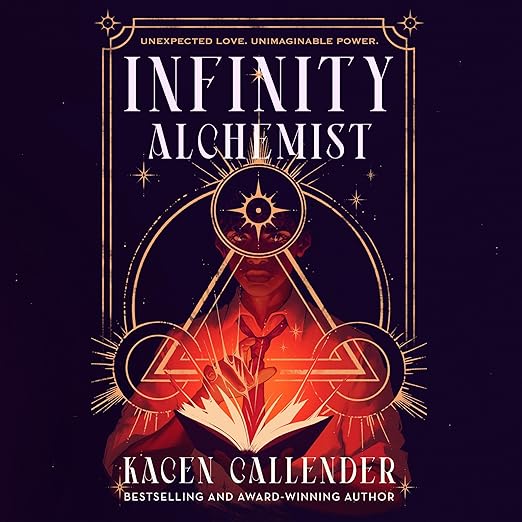
Quick Take
- Narration: Wes Haas brings Ash’s quiet determination forward without overselling the emotional beats, a restrained performance that serves the character’s interiority well across 13 hours.
- Themes: Institutional gatekeeping vs. self-taught knowledge, polyamorous identity, power and the ethics of its pursuit
- Mood: Propulsive and politically charged, with warmth underneath the danger
- Verdict: Kacen Callender’s YA fantasy debut delivers on its representation promises and builds a world interesting enough to carry a sequel.
I started Infinity Alchemist on a long train journey, which turned out to be the right context. There is something about Callender’s prose that suits transit: it moves steadily, it builds rather than sprints, and it rewards the particular attention that comes when you have nowhere else to be. By the time we reached Ash’s first real confrontation with the institutional gatekeeping of Lancaster College, I had missed my stop by two stations.
This is Kacen Callender’s first YA fantasy, and it arrives with the weight of expectation that comes from being the author of Felix Ever After and the novels that earned praise from FIYAH Magazine and the New York Times Book Review. The fantasy frame is new territory for Callender, but the concerns are continuous with their earlier work: who gets access to knowledge and power, what it costs to pursue something you have been told is not for you, and how identity and love complicate every calculation.
Our Take on Infinity Alchemist
The world Callender builds in New Anglia is legible and specific without being exhausting. Alchemy here functions as a science of magic, regulated and gatekept by Lancaster College, whose hierarchy mirrors real-world systems of credential and exclusion with enough precision to carry weight. Ash Woods, rejected by the college, takes a job as groundskeeper and learns in secret. This is not a new premise in fantasy, but Callender gives it fresh texture through Ash’s relationship to his own illegitimate power and through the specific nature of what he is searching for.
Ramsay Thorne is the other engine of this story, and the dynamic between Ash and Ramsay is where the audiobook earns its best sequences. She is condescending, brilliant, and complicated in ways that resist easy categorization. Their collaboration in pursuit of the Book of Source generates genuine tension because both characters have something at stake that goes beyond the surface quest. One reviewer noted the climax felt slightly rushed, and I share that reservation. The final quarter moves faster than the material sometimes warrants, but the destination is satisfying enough that the pacing issue registers as a complaint rather than a fatal flaw.
Why Listen to Infinity Alchemist
Wes Haas narrates with precision. Ash is a character who processes a great deal internally, and Haas renders that interiority without turning it into monotone. The distinction between Ash’s inner voice and his dialogue is clear and consistent across 13 hours and 19 minutes. Ramsay comes through as a distinct presence, which matters given how much of the story depends on the chemistry between the two leads.
The production is from Macmillan Young Listeners and Tor Books, and it shows in the audio quality. The editorial care in the Macmillan Audio line is evident throughout, with clean engineering and thoughtful pacing in the editing.
What to Watch For in Infinity Alchemist
The representation here is substantive rather than decorative. Trans, genderfluid, queer, and polyamorous characters appear throughout the story, and Callender writes their identities as part of the world’s texture rather than as pedagogical moments. One reviewer described being pushed way out of their comfort zone regarding the poly-romantic elements; another said it expanded the possibilities of YA fantasy. Both responses are worth knowing about before you start. This is a story that asks you to accept a broader model of love and identity, and it does not hedge that ask.
The subplot involving Ash’s estranged father introduces complications that the book does not fully resolve. This is likely intentional, clearing ground for the sequel, but listeners who prefer complete arcs may feel the father storyline dangling when the credits roll.
Who Should Listen to Infinity Alchemist
For readers who loved Felix Ever After and are curious whether Callender’s voice translates into fantasy, the answer is yes. For readers new to Callender who enjoy complex systems of magic and institutional power dynamics, this is a strong entry point. Approach with openness to non-traditional relationship structures; the poly elements are central to the story and not easily bracketed. Listeners who want action over introspection may find the pacing slower than expected, but the payoff of the world-building accumulates.
Frequently Asked Questions
Do I need to have read Kacen Callender’s earlier books to enjoy Infinity Alchemist?
No prior Callender reading is required. Infinity Alchemist is the first book in a new series set in an entirely separate world. That said, readers who loved Felix Ever After will find familiar thematic territory around identity, institutional exclusion, and the complexity of love, which may deepen their appreciation of what Callender is doing here.
How central are the polyamorous and trans elements to the plot, and can they be separated from the main story?
They cannot be separated from the story. The trans identity of certain characters and the polyamorous relationships that develop are woven into character motivation and world texture throughout. Callender does not treat them as side material. If this kind of representation is not something you want at the center of your listening experience, this particular book is not a good fit.
Is Infinity Alchemist part of a series, and does it end on a cliffhanger?
It is the first book in the Infinity Alchemist series. The ending resolves the main quest while leaving certain character arcs and the father subplot open for continuation. It is not a severe cliffhanger but it is clearly designed to lead into a second book. As of its 2024 release, this is the first entry in the series.
How does Wes Haas handle the romantic scenes between Ash and Ramsay in the audiobook?
Haas keeps the romantic scenes grounded and understated, which suits Callender’s writing style. The attraction between Ash and Ramsay develops through tension and collaboration rather than through dramatic declarations, and Haas’s performance reflects that gradual build. The chemistry lands without requiring performative emotionalism from the narrator.