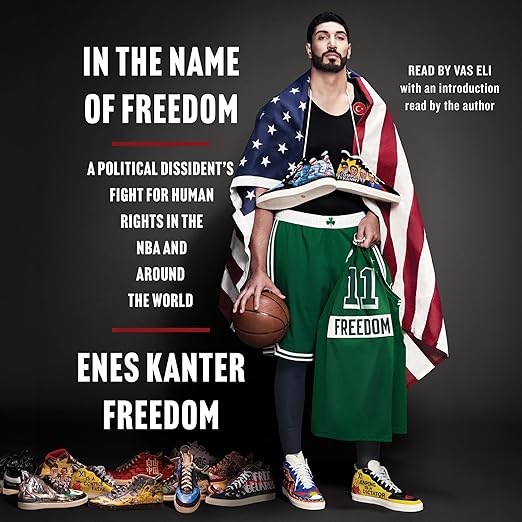
I started listening to In the Name of Freedom on a commute and missed my stop. Not because the prose is pyrotechnic, it is not, but because the stakes Enes Kanter Freedom describes are so concrete and so serious that I found myself wanting to know what happened next in a way that felt more urgent than my usual true crime or thriller listening. The story of a Turkish-born NBA player who spoke out against Erdogan's government and found his father arrested and labeled a terrorist while he himself was made stateless is not a story that needs embellishment. The facts are dramatic enough on their own.
Enes Kanter Freedom was born to play basketball. That sentence from the synopsis is not hyperbole: he was a top-five draft pick and played in the NBA for over a decade. What makes his book unusual within the sports memoir genre is that the basketball exists primarily as context rather than as subject. By the time the book reaches its most significant chapters, Freedom has placed his athletic career in deliberate service to a set of political convictions that cost him that career. This is a book about what you lose when you decide that something matters more than your livelihood.
First, the Big Picture
The early chapters establish Freedom's upbringing in Turkey and his rise through basketball. This is familiar sports memoir territory, competently handled, but the book accelerates when it reaches his public criticism of the Erdogan government. The consequences were not abstract. His father, still in Turkey, was arrested and declared a terrorist. Freedom's Turkish passport was revoked. He became stateless. He could not safely return to a country where he had family and history. A reviewer described these passages as reading like an adventure movie, gripping from the first page, and while that framing makes the story sound entertaining in a light sense, it captures something real: Freedom's account moves with the logic of a political thriller because it is one.
What distinguishes Freedom from the category of athlete-turned-activist is that his activism came with immediate and personal costs rather than with Instagram reach and brand synergy. He did not speak out about China's treatment of the Uyghurs because it was a safe position to take within American media culture. He spoke out despite knowing that NBA ownership had significant financial interests in the Chinese market and that his words were likely to affect his employment. They did. His playing time diminished. He was eventually out of the league. The book does not present this as martyrdom. It presents it as a choice, clearly made and fully understood.
Why In the Name of Freedom Works as an Audiobook
The section of the book dealing with Freedom's public criticism of LeBron James for his association with Chinese manufacturing through his Nike deal is handled with more nuance than you might expect from someone who was directly at odds with the most powerful figure in American basketball. Freedom is not interested in making James a villain. He is interested in the structural question of what happens when the most visible athlete in the world chooses silence on human rights issues because of commercial entanglement. That is a more sophisticated argument than the soundbites from the original controversy suggested, and it gives the book genuine intellectual weight alongside its personal narrative.
Multiple reviewers note that Freedom's voice is bold yet sincere, and that the book invites reflection on justice and responsibility rather than simply asking for admiration. That characterization matches what the book actually does. Freedom is not a graceful prose stylist, but he is direct and honest, and Vas Eli's narration preserves that quality without adding theatrical flourishes that would undermine it.
A Few Reservations
Vas Eli is well matched to this material. A narration that oversold the emotion or adopted a heroic register would undermine the book's credibility. Eli reads with a steadiness that lets the events carry their own weight, and the pacing across seven hours and twenty-two minutes does not drag. Simon and Schuster Audio have produced this with the clean professionalism you would expect for a major political memoir. The rating of 5.0 from 739 reviewers is unusually high for a sports-adjacent political memoir, and the reviews themselves are notably engaged, describing what readers found rather than simply whether they enjoyed it.
Should You Listen to In the Name of Freedom?
In the Name of Freedom is a strong choice for listeners interested in political memoir, human rights advocacy, and the intersection of sports and social responsibility. The free audiobook format removes the barrier that might otherwise give a casual listener pause. If you want a basketball memoir focused on game analysis and locker room anecdotes, this is not that. But if you want to understand how one athlete decided that speaking mattered more than silence even at significant personal cost, this is a serious and well-documented account of exactly that decision. It is worth your seven hours regardless of whether you have ever watched an NBA game.
In Brief
- Voice: Vas Eli delivers Enes Kanter Freedom's story with appropriate urgency and emotional restraint, never overselling the drama that the material already contains.
- Big ideas: Political courage and its personal cost, sports as a platform for moral resistance, the price of speaking when powerful institutions prefer silence
- Atmosphere: Urgent and earnest, occasionally infuriating, ultimately galvanizing
- Worth it?: A sports memoir that refuses to stay inside the lines of the genre, driven by someone who genuinely paid for the courage he is describing.
Common Questions
How much of In the Name of Freedom is about basketball versus political activism?
The basketball context is present throughout but the book's primary focus is Freedom's political journey, his conflict with the Turkish government, his advocacy for the Uyghurs, and his confrontation with the NBA over Chinese business ties.
Does Freedom present a balanced view of his conflict with LeBron James?
More balanced than the public controversy suggested. Freedom frames the confrontation as a structural critique of commercial silence rather than a personal attack, and the book engages seriously with why influential people choose not to speak.
Is prior knowledge of Turkish politics or the Uyghur situation necessary to follow the book?
No. Freedom provides context for both situations clearly enough that listeners unfamiliar with either can follow the argument. He is writing for a general audience, not specialists.
How does Vas Eli's narration handle the more emotionally intense passages, such as his father's arrest?
Eli maintains a steady, controlled tone throughout, including in the most difficult personal sections. That restraint serves the material well, letting the events speak rather than layering performed emotion over them.