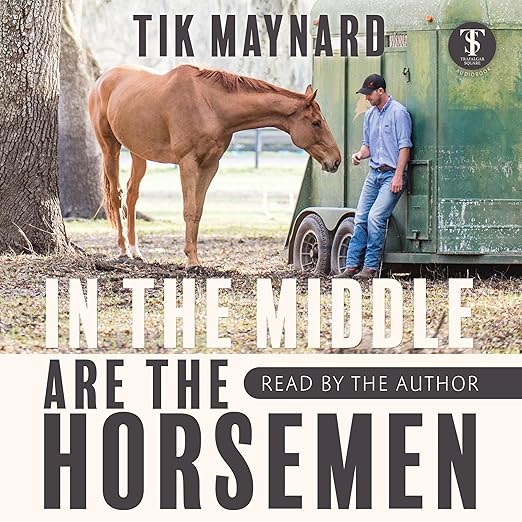
Quick Take
- Narration: Tik Maynard narrates his own memoir, and his unpolished sincerity is exactly what this kind of coming-of-age story needs.
- Themes: Mentorship and hierarchy in elite sport, identity formation through physical discipline, the cost of choosing a vocational life
- Mood: Honest and searching, with an eye for the unglamorous reality behind prestigious stables
- Verdict: A coming-of-age memoir that works precisely because Maynard refuses to make his years as a working student sound more heroic than they were.
There is a genre of equestrian memoir that tends toward the lyrical and the transcendent: the horse as teacher, the stable as sacred space, the rider arriving at hard-won mastery in language borrowed from religious autobiography. Tik Maynard’s In the Middle Are the Horsemen is not that book. It is something more useful and considerably more honest. Maynard chronicles three years as a working student across some of the most prestigious training operations in North American and European equestrian sport, and he does not let the prestige of those institutions smooth over the reality of what working-student life actually involves: physical exhaustion, institutional hierarchy, being told you have the wrong body type to ride, being fired.
I listened to this on a long drive through rural country, which felt appropriate. There is something in Maynard’s voice and in his subject that matches open landscape: unhurried, observational, committed to detail over drama. He was twenty-six when he started this journey, recovering from a career-ending injury as a modern pentathlete and a painful breakup, and the son of prominent Canadian equestrians. That last detail matters. He is not an outsider who fell in love with horses. He grew up around the world he is now entering as a subordinate, and the dissonance between his background and his position gives the narrative a productive tension that drives the best sections of the book.
Olympians as Bosses, Not Icons
The working student system Maynard enters is one that the equestrian world largely keeps to itself. You trade labor for education: long days of stable work, riding, and observation, in exchange for proximity to elite trainers. Maynard names the people he works with: Anne Kursinski, Johann Hinnemann, Ingrid Klimke, David and Karen O’Connor, Ian Millar. These are not obscure figures. They are Olympic medalists and world-renowned names in their disciplines. Maynard’s portrait of them as actual bosses rather than mythologized masters is one of the book’s genuine contributions to equestrian literature.
He is not unkind, but he is specific. Some of these mentors encourage him; some ignore him; some offer feedback that is, by any reasonable standard, demoralizing. He is told he lacks the natural talent. He is praised and then undermined. The inconsistency of mentorship at elite levels, the way that exceptional skill at a discipline does not automatically translate into exceptional skill at teaching it, is something Maynard documents with a clarity that equestrian literature often avoids. One reviewer described the writing as having the elegance of thoughtful observation, and that is accurate: Maynard notices things precisely and does not inflate their significance beyond what the material warrants.
The Prose That Earns Its Literary Comparisons
In the Middle Are the Horsemen has been compared to literary memoir rather than sport memoir, and that comparison is not overreach. Maynard has a writer’s ear for the detail that illuminates character: the specific way a trainer stands when they are displeased, the sound of a stable at five in the morning, the way fatigue changes your relationship to an animal you are supposed to be reading. Several reviewers used the word elegant in describing his writing, and the structure supports that description. The book is not organized by chronology alone; it moves by accumulation of insight, each stable adding a layer to his understanding of both horses and himself, so that the later chapters feel earned rather than simply arrived at.
He also writes about his personal life without sentimentality: the relationship that ended before the journey began, the marriage that happens during it, the losses along the way. These threads are woven into the professional narrative without overpowering it, which requires a kind of authorial restraint that not every memoirist manages. One reviewer noted the book captured something about the wonder of a world with horses in it while remaining grounded in honest experience, and I think that balance is exactly right. Maynard wants you to see the beauty and the difficulty simultaneously, and he does not allow either to cancel the other.
Maynard Narrating Himself, Unvarnished
Author-narrated memoirs succeed or fail on authenticity, and Maynard’s narration succeeds. His voice is not that of a professional audiobook narrator; it has the slightly uneven quality of a person telling their own story rather than performing it. That unevenness is a feature here, not a flaw. When he describes being told he does not have what it takes, the mild flatness in his delivery communicates something that a trained narrator’s modulated disappointment would not quite capture. He means it. He is telling you what it felt like without dramatizing it for your benefit or cushioning it for his own.
The European training sections are particularly vivid. Maynard writes about a world with strict hierarchies and oblique ways of communicating criticism, and he navigates those environments with enough self-awareness to see them clearly without growing cynical about them or the people who maintain them. That quality of calm, precise observation is what sets this memoir apart from the category it might superficially resemble.
At ten hours and twenty-two minutes, the audiobook is a commitment, but the runtime is earned. The structure ensures that each new training situation carries forward what came before, so the cumulative effect by the final chapters is considerably more powerful than any individual section would suggest on its own. Listeners looking for a fast-moving narrative will find Maynard’s pace deliberate and his digressions unhurried. Listeners willing to slow down with him will find themselves genuinely moved by the time the book arrives at its conclusion, which is not triumphant in the conventional sense but true in the way that only honest memoirs manage to be.
Frequently Asked Questions
Do I need equestrian knowledge to appreciate In the Middle Are the Horsemen?
No. Maynard explains the working student system and the disciplines he encounters clearly enough that non-equestrian readers can follow without difficulty. The book functions as much as a coming-of-age memoir about mentorship and vocation as it does a horse book.
Is this audiobook a standalone or related to Maynard’s second book?
It is standalone. One reviewer noted that this first book is stronger than Maynard’s subsequent work, but no prior reading is required. The narrative is complete in itself.
How does Tik Maynard’s self-narration compare to professional narration in similar memoirs?
It is less polished but more authentic. His voice carries the specificity of someone recounting lived experience rather than performing a character, which suits a memoir that prizes honesty over drama.
Does the book cover specific riding techniques or is it primarily a personal narrative?
It is primarily a personal narrative. Maynard describes training environments and lessons he received in enough detail to satisfy equestrian readers, but the focus is always on his human development rather than on technical instruction.