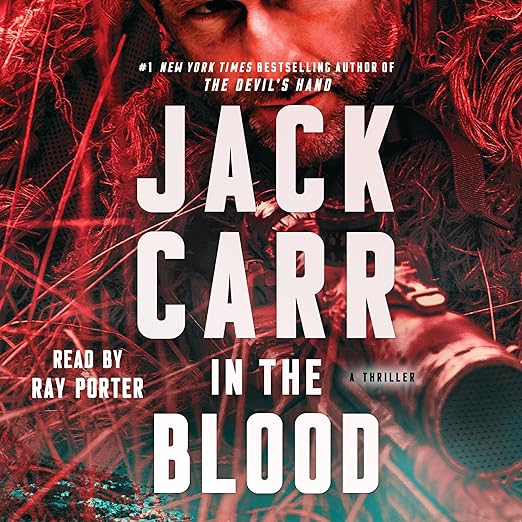
Quick Take
- Narration: Ray Porter is the definitive voice of James Reece, and by book five the fit between narrator and character is so established that it is hard to imagine the series any other way.
- Themes: Loyalty and vengeance, intelligence community moral ambiguity, global geopolitical threat as personal mission
- Mood: Taut and kinetic, technically detailed, geographically sprawling
- Verdict: Exactly what fans of the Terminal List series want from entry five, with the global scope and operational detail that have become the series trademark.
I started In the Blood at the beginning of a long Saturday morning, which is roughly the right environment for a Jack Carr novel. These books have a quality that makes the hours pass without friction, not because they are simple but because they are precisely calibrated to their purpose: sustained forward momentum through technically credible action with just enough character texture to keep James Reece from becoming a pure mechanism of destruction. By book five in the Terminal List series, Carr has refined that calibration considerably.
The book opens with a woman boarding a plane in Burkina Faso after completing a targeted assassination for the state of Israel. Two minutes later, her plane is blown out of the sky. Over 6,000 miles away, Reece watches the names and pictures of the victims on cable news and recognizes a face, a Mossad operative he knew from Iraq years earlier, a woman he thought he would never see again. That is the setup, and Carr commits to it with the kind of detailed global tracking that has become the series’s signature: Reece enlisting contacts across multiple countries, following intelligence threads through several jurisdictions, unaware that the trail he is following may be designed to lead him into a trap.
Our Take on In the Blood
Ray Porter’s narration has by this point in the series settled into a complete understanding of James Reece’s voice. The technical descriptions that one reviewer specifically called detailed and accurate land with the authority that comes from a narrator who has committed fully to the material’s premise. Porter does not soften the operational sections or rush the quieter character passages. He inhabits Reece rather than performing him, and in an action thriller series built largely on the credibility of its protagonist, that distinction matters considerably across a 12-hour listen. A reviewer who had read all five books in order noted the same consistent quality across all of them, with knowledgeable writing and accurate technical descriptions as the recurring strengths. Carr’s background as a Navy SEAL produces a specificity in the operational detail that Porter’s narration delivers without embellishment.
Why Listen to In the Blood
The global scope of this installment is more ambitious than some earlier entries, taking Reece through multiple international settings while tracking both an assassination investigation and a larger potential trap. Listeners who keep a map nearby to track the action, as one reviewer mentioned doing, will get additional satisfaction from following the geopolitical connective tissue. The premise, centering on a Mossad connection and the intelligence services of two nations, gives Carr more room to explore the moral ambiguity of state-sponsored violence than earlier books in the series, and he takes it. One reviewer described burning through every page and another described it as a book that keeps you up at night, both of which are the most honest possible endorsements for a thriller.
What to Watch For in In the Blood
The technical detail that is the series’s greatest strength is also the feature most likely to slow some listeners. One reviewer gave four stars specifically because some action events drag out in too much detail, noting that the associated writing occasionally made sequences difficult to follow. For audio listeners, extremely dense tactical descriptions can require replay in a way that disrupts momentum. If you are a first-time Carr listener, starting from book one of the series gives you the character foundation that makes book five’s emotional stakes function. In the Blood is not designed as a standalone entry and makes no effort to function as one.
Who Should Listen to In the Blood
Anyone who is already in the Terminal List series should listen to this. The storytelling is confident, Porter’s narration is strong, and the global scope makes this one of the more ambitious entries in the series. New listeners should start from The Terminal List rather than jumping in here; Reece’s history is load-bearing for the emotional stakes of book five.
Frequently Asked Questions
Is In the Blood accessible as a first entry into the Terminal List series?
Not ideally. Reece’s history, his losses, his relationships, and the events that have shaped him through four previous books are assumed rather than explained here. The book works as a thriller on its own terms but the emotional depth depends on prior investment in the character.
How does Ray Porter handle the female characters and non-Reece perspectives in this installment?
The opening sequence involving the female Mossad operative is one of the book’s strongest passages in Porter’s reading. He differentiates the perspectives cleanly without relying on vocal caricature. Porter’s narration of the series has consistently demonstrated range beyond the primary Reece voice.
Does Jack Carr’s military background translate into audiobook credibility in the technical sections?
Yes, which is one of the series’s consistent strengths. Multiple reviewers across the series specifically note the accurate technical descriptions as a distinguishing feature. For listeners who have found military thrillers feel fabricated in their operational detail, Carr’s background produces a different quality of specificity that the audio format delivers effectively through Porter’s committed narration.
How does In the Blood compare in pacing to earlier Terminal List books?
It is more globally dispersed than the earlier entries and consequently slightly more complex in its geopolitical threading. Listeners who found the earlier books tightly focused may find this one asks more of them in tracking the international connections. The core forward momentum of the series is intact throughout.