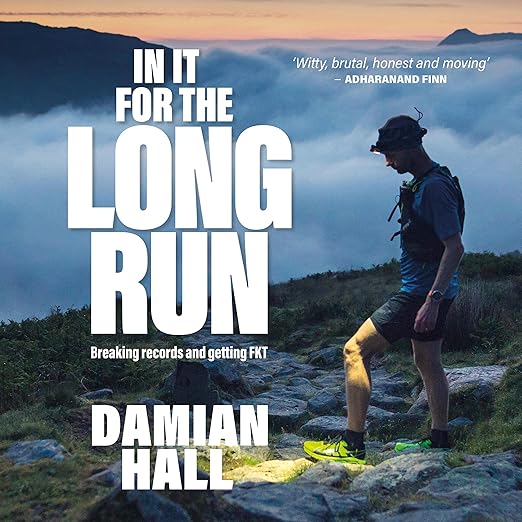
Quick Take
- Narration: Stewart Crank delivers Hall’s dry British humor with easy naturalism, handling the self-deprecation and genuine emotion in the Pennine Way sections without missing a beat.
- Themes: Ultrarunning as midlife calling, environmental activism through sport, the relationship between physical limits and personal identity
- Mood: Funny and warm, quietly inspiring, occasionally infuriating if you dislike green politics
- Verdict: One of the better ultrarunning memoirs in recent years, built around a genuinely remarkable record attempt and written with more literary skill than the genre usually offers.
I started this one on a Sunday afternoon and finished it late the same evening, which tells you something about the pacing. Damian Hall writes with a journalist’s instinct for the telling detail and a runner’s instinct for forward momentum, and the combination produces a memoir that moves quickly even when it is covering ground slowly. Hall’s story begins absurdly, first marathon dressed as a toilet, age 36, a detail he does not let the reader forget early in the book, and arrives somewhere genuinely moving: a 261-mile solo record attempt on the Pennine Way in the summer of 2020, supported by pacers and a crew but essentially running on willpower and very thorough logistical planning through two days and more than fourteen hours of continuous effort.
The framing device is Mike Hartley’s 1989 Fastest Known Time on the Pennine Way: two days, seventeen hours, no sleep. That record stood for thirty-one years. When American John Kelly broke it in the summer of 2020 by 34 minutes, Hall was already preparing his own attempt. He knocked three more hours off Kelly’s time. The account of those 261 miles, woven through with Hall’s broader autobiography, carries the book’s emotional core.
Our Take on In It for the Long Run
What separates Hall from many ultrarunning memoirists is the self-awareness he brings to what is, objectively, an extreme activity that most people will never undertake. He is not evangelical about running. He is not interested in converting you. He is interested in telling you what it felt like from inside, which is a different and more honest ambition. His humor is the dry, self-deprecating British kind that never quite tips into false modesty; he knows he is good at this, and the comedy comes from the gap between what the sport looks like from the outside and what it actually involves.
The environmental thread is real and substantial. Hall’s Pennine Way attempt was explicitly carbon negative: no plastic waste, litter collected along the route, money raised for Greenpeace. His veganism is part of his identity rather than a performance, and he discusses it as one element of his athletic preparation without lecturing. One reviewer found the environmental and political content excessive, and I understand that response even if I do not share it. Hall does not separate his running from his values, and if you buy the book expecting pure athletics memoir, the integration of those concerns may feel like an intrusion. But the alternative would be a less honest book.
Why Listen to In It for the Long Run
Stewart Crank narrates with an ease that suits Hall’s conversational writing style. The humor lands correctly, which is not a given; British dry wit on the page can flatten in audio if the narrator pushes too hard on the jokes. Crank does not push. He reads Hall’s comic timing with something close to Hall’s own rhythm, and the result is a narration that feels like listening to the author rather than a professional reading a text. The Pennine Way sections, which require sustained tension over many hours of physical suffering, are handled with the right gravity without abandoning the humor that Hall uses to survive the experience.
At just under ten hours, this is a single long weekend listen or a manageable working week of commuting. The book is structured to carry that length without flagging; Hall knows how to build a narrative arc, and the FKT attempt serves as a reliable through-line when the earlier chapters meander.
What to Watch For in In It for the Long Run
The book is most gripping in the Pennine Way account and in the earlier sections describing Hall’s escalating obsession with ultras through a series of increasingly improbable race commitments. The middle sections covering training methodology are informative but less immediately exciting for non-runners. Hall is honest about the physical cost of the sport in ways that neither celebrate nor minimize injury and exhaustion.
Non-runners should know that the book is written with genuine accessibility. A reviewer who followed Hall’s adventures online before reading the book noted that the memoir adds the inside-mind dimension that public coverage of races and FKTs cannot provide. You do not need to be a runner to follow the narrative, but you do need some patience for the physical and logistical details that Hall gives serious attention.
Who Should Listen to In It for the Long Run
Ultrarunners and trail runners will find this an essential read from a practitioner who can actually write. Anyone interested in endurance sport memoir will find Hall’s voice refreshingly unsentimental despite the genuine emotion in the later chapters. Readers who enjoyed books like Adharanand Finn’s running sagas or Ross Edgley’s adventure memoirs will have a direct frame of reference, though Hall’s style is drier and more self-aware than either. Those who actively dislike environmental politics threaded into sports memoir will struggle; the two are inseparable in Hall’s worldview.
Frequently Asked Questions
Do I need to be a runner to enjoy In It for the Long Run?
No, though patience for athletic detail helps. Hall writes with enough humor and self-awareness to make the ultrarunning world accessible to general readers. The Pennine Way FKT account works as adventure narrative independent of any prior knowledge of trail running or Fastest Known Time culture.
How explicitly does Hall discuss his environmental activism and veganism in the book?
Both are present throughout and treated as inseparable from his athletic identity. The Pennine Way attempt was explicitly structured as a carbon-negative effort. One reviewer found this content excessive; others considered it central to understanding Hall’s motivation. It is not a minor thread.
How does Stewart Crank’s narration handle the humor in Hall’s writing?
Very well. British dry wit is easy to flatten in narration if the reader over-explains the jokes. Crank reads Hall’s comic timing naturally and the self-deprecating humor lands as written. The tonal shifts between comedy and the more emotionally serious sections of the FKT account are handled without jarring transitions.
Is this a book about the Pennine Way record attempt specifically, or does it cover Hall’s broader running career?
Both. The book moves between Hall’s broader autobiography as a runner, from his first marathon at 36 through escalating ultra commitments, and the specific account of the Pennine Way FKT. The record attempt is the narrative destination, but the preceding career provides necessary context for what makes it significant.