Quick Take
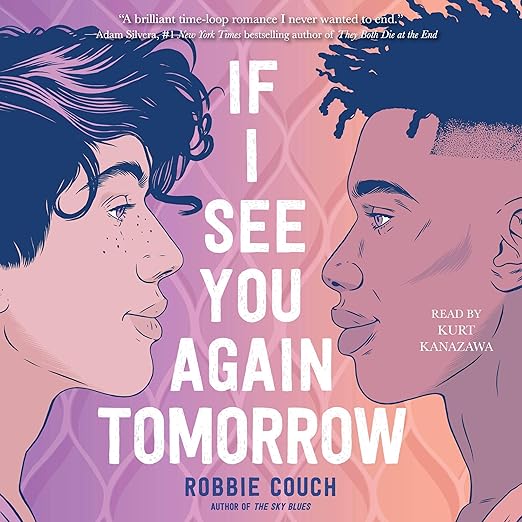
- Narration: Kurt Kanazawa captures Clark’s resigned interiority and gradual thaw beautifully, his voice for the time-loop sections has the right quality of exhausted numbness.
- Themes: Loneliness as a survival mechanism, queer identity without coming-out drama, the courage required to want things again
- Mood: Bittersweet and warm, with a current of genuine ache underneath
- Verdict: Robbie Couch’s time-loop romance is one of the more emotionally precise YA audiobooks in recent years, the speculative premise is almost incidental to what it has to say about loneliness.
I had a particular moment with this audiobook that I wasn’t expecting. I was about 40 minutes in, Clark has just woken up on what the narration tells us is Day 310, and he is going through the motions of a Monday he has lived 309 times before, when I realized I wasn’t listening to a clever premise being executed. I was listening to a book about what happens to a person after they have been lonely for so long that they have made peace with it. The time loop is almost irrelevant. The story is about someone who has stopped believing anything new is possible.
That is not, it turns out, a comfortable subject to spend eight hours with, and Robbie Couch does not let you off the hook. Clark is not performing suffering. He is past that. By Day 310, he has organized his life around the certainty that nothing will change, which means he has quietly abandoned himself. And then Beau appears, the first person to appear on a Monday who wasn’t there on any previous Monday, and the book becomes a study in what it costs to want something again after you’ve trained yourself not to.
Our Take on If I See You Again Tomorrow
The book’s handling of Clark’s queer identity is one of its genuine strengths, and worth discussing because it does something relatively rare in YA romance. Clark is openly gay, happy, and secure in his identity. His sexuality is not a source of conflict, not a coming-out story, not the problem the book needs to solve. It simply is, in the same way that his height or his love of math class simply is. One reviewer described this as an important story to tell, and I agree, the proliferation of queer YA narratives centered entirely on coming out means that books about queer teens whose main struggle is something else entirely are still considerably rarer than they should be. Kurt Kanazawa’s narration handles this matter-of-factness well; there is no special quality in his voice when the romance is with Beau versus what it would be with anyone else.
Why Listen to If I See You Again Tomorrow
Couch writes Clark with a specificity that rewards audio delivery. The internal monologue sections, of which there are many, given the premise, need a narrator who can convey flatness without boring you, exhaustion without self-pity, and the gradual thaw of feeling without overplaying it. Kanazawa does all three. The Windy City setting is deployed with real affection, the series of errands Clark and Beau run across Chicago function as a kind of love letter to the city as well as to the strange logic of a day that keeps resetting. Several reviewers describe being unable to put it down once they got going, which is the right frame for the audio experience: this is a book you will want to finish in a sitting.
What to Watch For in If I See You Again Tomorrow
The time loop premise is never fully explained, which some readers find unsatisfying and others find exactly right. Couch is not interested in the science fiction mechanics, he is interested in what the situation reveals about his characters. If you need narrative closure on the speculative conceit, you will not get it. The book also has a secondary cast, Emmery, Dee, Otto, whose storylines Clark becomes entangled with over the course of the day, and one reviewer noted that the book’s treatment of loneliness through these supporting characters is as affecting as the central romance. Listeners who engage with those threads will get more out of the book than those who treat them as filler between Clark-and-Beau scenes.
Who Should Listen to If I See You Again Tomorrow
Recommended for anyone who enjoys YA romance with emotional depth, and specifically for readers who have grown tired of queer YA that treats coming out as the only story queer teens have. Also for listeners who appreciate speculative fiction used as a vehicle for character study rather than plot mechanics. The New York Times bestseller label is accurate signal here, this reached a wide audience for reasons beyond its genre category. Adults who have written off YA romance may be surprised by what Couch is actually doing.
Frequently Asked Questions
Is If I See You Again Tomorrow appropriate for adult listeners, or is it strictly a teen read?
Several reviewers who identify as adults in their thirties and forties describe finding it as resonant as anything they read in a given year. The emotional subject matter, loneliness, the cost of closing yourself off, what it takes to want things again, is not age-restricted, even if the protagonist is a teenager.
Does the time loop premise ever get a scientific explanation?
No. Couch leaves the mechanism unexplained and focuses entirely on the psychological and emotional dimensions of Clark’s situation. If the speculative element requires resolution for you to find a story satisfying, this one will leave you frustrated.
How does Kurt Kanazawa handle the repetitive early sections of the time loop?
This is one of the genuine challenges of narrating a time loop story in audio, and Kanazawa handles it well. The early Day 310 scenes have the right quality of numb routine without becoming monotonous to listen to. He calibrates the shift in Clark’s emotional temperature across the story convincingly.
Is Clark’s homosexuality a central plot point or a background detail?
Background detail, deliberately. Clark’s identity as a gay teen is established and simply present, the romance with Beau is treated exactly as any romance would be, without the narrative treating it as a problem to be resolved. This is explicitly noted by reviewers as one of the book’s most valuable qualities.